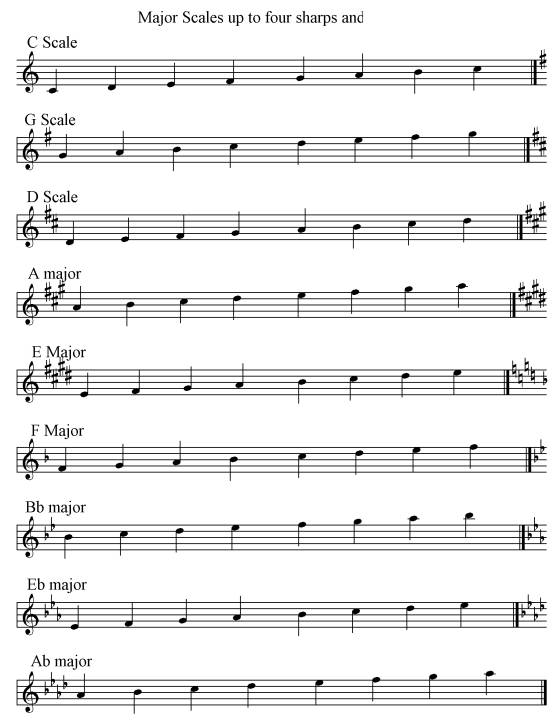
Reading the following:
| The
same tunes chords and complete compositions can be written in any of the keys
below. The process of moving a tune from one key to another is called
TRANSPOSITIO |
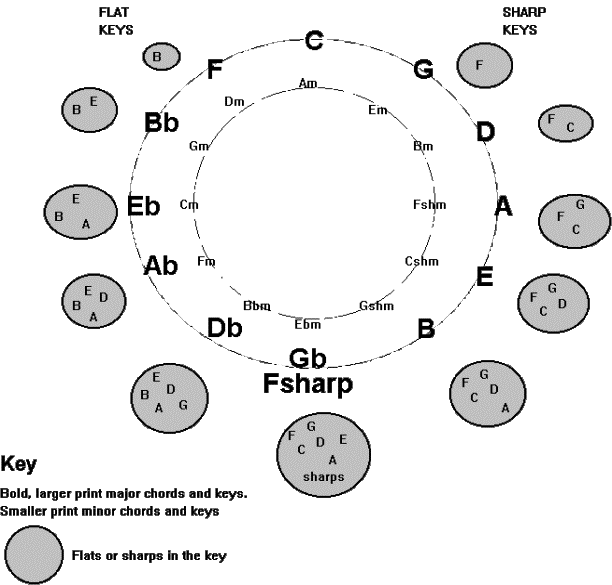
| The key clock below shows
the relationship between keys chords, sharps and flats. For example when a
composition is in C major the two other primary chords used are on each side of
the C (F and G). Where the key centre is G major. The two nearest chords (and
keys) are C and D. |
Key/Chord Clock
What
are the three primary chords (I, IV and V) used in C major? _____________
What are the three
primary chords (I, IV and V) used in F major? _____________
What are the three
primary chords (I, IV and V) used in Bb major? _____________
What are the three
primary chords (I, IV and V) used in D major? _____________
What are the three
primary chords (I, IV and V) used in A major? _____________
What are the three
primary chords (I, IV and V) used in E major? _____________
What are the three
primary chords (I, IV and V) used in Eb major? _____________
What are the three
primary chords (I, IV and V) used in A minor ? ___________
What are the three
primary chords (I, IV and V) used in E minor? ____________