Swan Lake |
Ballet Suite Op. 20 |
|
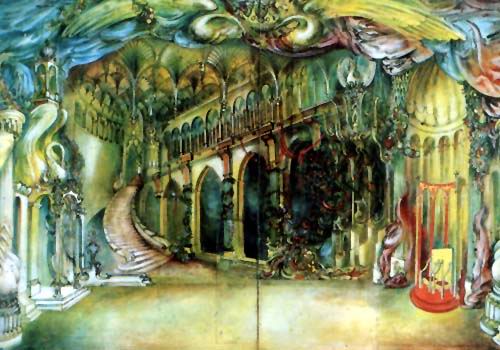
Above: A stage set for the ballroom scene on
Act III of Swan Lake, where the sorcerer cunningly tricks Prince Siegfried
into betraying Odette.
|
Commissioned in 1875, this was Tchaikovsky's first attempt at romantic ballet, which took more than a year to complete. Some of the score was derived from earlier pieces written as home entertainment for the children of his sister, Sasha.
The ballet was premièred at the Bolshoi Theatre in Moscow in 1877 to a poor reception and it was only after Tchaikovsky's death that it gained the praise and reputation it truly deserved.
In September 1882, Tchaikovsky wrote to his publisher, Jurgenson, to ask for his original score. He felt the ballet ‘contained some fairly decent numbers', and he wanted to arrange a selection of its pieces into a concert suite. This work features the ballet's musical highlights.
The Ballet
Set in Medieval Germany, the ballet opens with Prince Siegfried's coming-of-age
party, where his mother insists he must choose a bride at the ball the next
evening. Later that night, Siegfried sees a flight of swans against the settling
sun. Odette appears and tells him she and her friends have been bewitched by
the evil sorcerer, Von Rothbart, and must live as swans by day. She explains
that only one prepared to die for his love can break the curse.
At the ball, a fanfare heralds the arrival of Von Rothbart and his daughter, Odile, disguised as the Knight of the Black Swan and Odette. Siegfried is fooled by Odile's appearance, but as he declares his love for her, the real Odette appears in the form of a swan. Act III closes with Siegfried rushing out to look for his beloved Odette.
In the stormy lake-side setting of Act IV, Odette tells Siegfried the curse can only be broken through her own self-sacrifice. They then both take their own lives - and the curse is subsequently broken.
Shimmering violins
The opening Scene to this selection from Swan Lake illustrates Tchaikovsky's
evocative scene-painting. The shimmering violins and harp glissandos suggest
rippling lake-water. A plaintive oboe introduces the main melody and the sense
of tragedy is heightened by the dramatic entry of the horns, representing the
evil Von Rothbart.
The Waltz that follows is lively and melodic, but is soon interrupted by orchestral bursts. In contrast, the secondary theme enters with a lighter, humorous touch, with a solo trumpet playing in an expressive ‘cabaret' style.
The Dance of the Swans is an elegant and sprightly sequence that dispels any sense of tragedy and foreboding, providing a necessary break from the more emotive passages that have gone before.