
India trip 2004
www.infrasys.biz
FEBRUARY 8, 2004- SHANTI ASHRAM -COIMBATORE
There is a Shanti Ashram in CBE. It was established on Gandhian lines by M. Aram who was an MP. He was a negotiator for the peace initiatives between the GoI and the Naga rebel movement.
The Ashram continues to be run by his daughter Vini Aram, a pediatrician. The Ashram which does rural upliftment work was hosting a full day seminar/workshop for NGOs working in the nearby areas. This was the second annual conference and I happened to be in CBE that day.
Sindhanai Sirpigal represented by Senthil and Sundar were participants and I went along as their guest.
Balaji, the conductor/moderator of this event was an excellent host mixing serious discussion with just enough humor to break the tension and with an incredible ability to keep things on track, on time and allowing full participation from and by all. The entire conference was conducted in Tamizh which all understood.
Over 30 NGOs were represented and I was allowed to make a small presentation regarding infraSys and its approach. I shall simply highlight some items that were covered and some recurring themes.
1. AIDS is a serious problem in India, in Tamil Nadu in particular and acutely in CBE district. Many NGOs are working on building awareness.
2. NSS (NATIONAL SERVICE SCHEME) is a program that many colleges have and volunteers spend time in villages doing rural work. They usually camp in the villages for 10 days or so. This is very active in many
campuses.
3. There is apparently apathy amongst college age adults not to vote in the elections. There is also an awareness-building program and many students are involved in this.
4. Blood drive is also a popular program in colleges and amongst students.
5. Tree planting is an activity that most NGOs want to do.
6. Women's issues and empowerment is also on the agenda of many NGOs.
7. There is an amazing amount of idealism, enthusiasm and wisdom amongst the youth (and most were young) represented at the conference. They were passionate, articulate and came across as very, very dedicated young men and women.
There is also the POET in every Tamilian. Poetry both time tested (KURAL and Bharatiar) and original flowed freely.
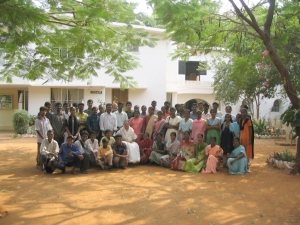
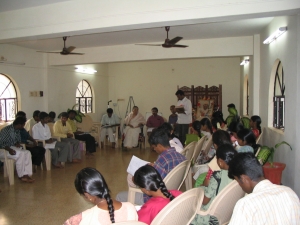
The most significant things I heard at this conference were two items. Both are indicative of the hope that I feel and of the general direction any efforts in rural development must take.
The first: From Vavipalayam: Many of you may know this. A group of 500 residents from these villages actually marched in protest and got removed the licensing of two liquor shops in that jurisdiction. AMAZING.
The second: There was a young man from another frustrated village whose residents had many grievances with respect to how the village had been treated by the elected representatives and the District Collector. So the entire village had resolved NOT to exercise their franchise in the upcoming elections and they have letters (individual) waiting to be mailed, written to every possible official from the local to the President of India to be mailed to reach them almost on the same date. AMAZING.
In these acts there is hope. This is Makkal Shakti (people power) and in this lies the hope and strength of any improvement that must follow. Anna Hazare has demonstrated it. I highly encourage leaders like Ilango Ramasamy (who has been doing this) to raise this empowerment aspect amongst the leadership in the various panchayats. Panchayat Academy to teach this intangible perhaps!
I also feel that the attitude of many of us doing and wanting to do rural development must change. The attitude of the development community is in my view is colonial, paternalistic and even anthropological.
"They" are seen as different and separate and not as equals and part of the same problems we all share. And we do... who do you think is feeding us all. Whose water is bottled and for whom? Who eats the pesticides the farmer sprays?
Two other words that keep cropping up... Adoption and Model. The rural development community will also do well to abandon these two words.
Villagers should not be treated as helpless directionless creatures waiting to be "adopted". The two examples I cite show the strength of its people and I am not sure how many "educated" and "literate" communities could have mustered that kind of initiative in an urban area!!! So forget adopting villages. Work with them, cooperate with them.. Let them tell us what their priorities are.. or at least at a minimum consult with them first.
Only cars and runways have models. There cannot be any model villages. There can be models of a scheme or a project... but something that is so magnificently complex as a community cannot be a model. Calling something a model almost guarantees a future need to explain as to why this model failed.
I have rambled...later this evening we will meet DR.R.K.Sivanappan. NEXT TOP