|
The touch of genius
that marked “Mannish Boy” (apart from the braggadocio of a
“full-grown” Man singing about sex as opposed to the lithe
youths of the rock’n’roll pantheon) was that he took out the
rest of the progression and stayed on the root note repetitively driving
the feel straight down on the riff. This might have been standard practise
in a worksong in the cotton field or chain gang, but was fairly brash
in regard to popular song convention, and when you’re on a good
thing…stick to it.
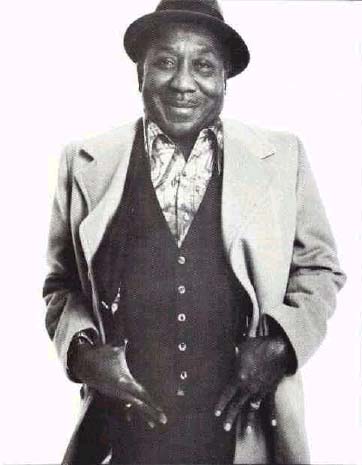
The first version recorded in May 1955 has one of the stellar line-ups
involved, with Willie Dixon on bass and Jimmy Rogers on guitar, so Muddy
only sings, but his “Whoah yeah” at the start is probably
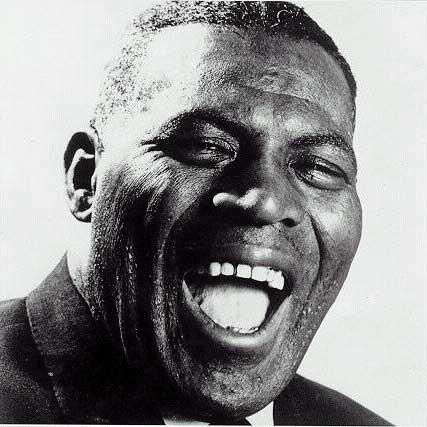
only rivalled as an opening statement by Howling Wolf’s “Moanin’
at Midnight” from 4 years before.
This was Electric Blues in its squalling infancy, rightly regarded as
one of the defining moments in 20th century music. They were writing the
book, and this was a strong opening chapter.
This fact was not known to the general public outside the “Race”charts,
as rock and roll obliterated the market for such material even though
some see this song as aimed at the white market.
The blues as a popular music form was revitalised in the early 60’s
when it was discovered by young British bands exposed to it by sailors
in Liverpool and London. Once there was an appreciation of this revamped
blues by the US record buying public, it took off: the first British band
to have a number
|
|
exposed
to it by sailors in Liverpool and London. Once there was an appreciation
of this revamped blues by the US record buying public, it took off: the
first British band to have a number one in this idiom was The Animals
with “House of the Rising Sun” and a wave of bands soon followed.This
didn’t spill over to the real thing. The black music charts had
now moved their attention away from blues, which they saw as having too
much association with the past, and were well down the track of developing
what became soul. Young white bands in the US such as The Blues Project,
Paul Butterfield, and most importantly, Canned Heat, soon began to appropriate
old blues recordings and rock them up. The classic Canned Heat album “Living
the Blues” was an odd melange of traditional country blues feels,
a thundering live boogie extravaganza, and a Magnum Opus written by Harp
player Al Wilson. This piece, “Parthenogenesis” featured 20
minutes of soundscapes with heavily treated echoing jaw-harps, drones,
electronics, and fuzz-guitar interludes straight from the realm of psychedelia
combined with straight ahead shuffle jams and the great Dr John adding
barrelhouse piano.
Twenty minute pieces had previously been the province of stumblebums like
the Grateful Dead, and although more a collection of ideas than a structured
piece, this was something new for an “authentic” blues band.
This was now a new form in the clothes of the old. It is worth noting
that the founder of Canned Heat, Bob Hite, had over 55,000 78’s
of obscure blues, and was always totally scrupulous in apportioning royalties,
unlike the British bands, most notably Led Zeppelin,who didn’t acknowledge
Willie Dixon’s “You Need Love”
|
|
for their biggest hit “Whole Lotta Love”
until sued 10 years later.
The Psychedelic bands such as Cream also plundered the blues with songs
by Howling Wolf and Albert King. All these white boys milking the canon
of his own label must have impacted on Marshall Chess. He decided to get
out the sitars and fuzz for Muddy Waters to make an album to sell to those
“damn hippies”. They even covered a Rolling Stones song on
it.
To listen to this album today, one could portray it as ridiculous, but
I think it has been judged too harshly. The version of Mannish Boy is
more fluid and has melodic overtones missing from the original. The actual
feel is totally different and a driving fuzz-bass is only barely referring
to the stomp of 1955. Wah-wah is everywhere, as it is on the rest of the
album, but it swings and is even a bit funky.
Blues purists often ignore the fact that the form had to develop to get
to where it was in the 50’s and although that period is now wilfully
fossilised; it has no requirement to remain a musical form that can’t
develope.
The blues would have as much relevance now as the Charleston if it hadn’t
been for its appropriation by the “rock” world, and it is
today as healthy as ever. Practitioners of the original form such as RL
Burnside think nothing of remixing with DJ’s, so I think that what
Muddy did in 68 was The Same Thing, to quote another Willie Dixon song
from the album. Muddy came back to that famous feel one more significant
time (live albums aside) in 1977.(continued over page)
Greg Manson
is a local resident and bass player in local funky act ‘Pussyfoot’
|