 General John J. "Blackjack" Pershing
 | Site Index |
| Home |
| Chain of Command |
| Active Members |
| Upcoming Events |
| Newsletter |
| Pictures |
| About Pershing Rifles |
| FAQ |
| General Pershing |
| The Crest |
| Links |
| Members Only |
| Staff Only |
| Contact Info |
 |
|
|
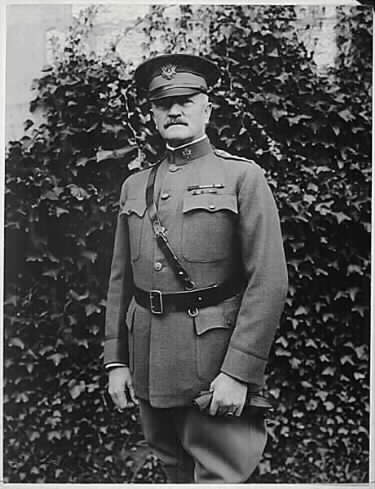
John Joseph “Blackjack” Pershing (1860-1948) was born in Linn County, Missouri. He was a
great American general who led the Expeditionary Force during World War I, and
had a hand in many other campaigns during his life. General Pershing was also
the Professor of Military Science at the University of Nebraska and taught
tactics at The United States Military Academy at West Point. General
Pershing was a strict disciplinarian, cold, distant, and demanding, but known
well for being fair and just, as well as, being a tireless organizer, and a
courageous leader of men.
General Pershing not only taught at West Point, he also graduated from the academy. In the spring of 1882, |
|
Pershing saw an announcement for a competitive examination for an appointment
to West Point. He had no desire to become a soldier but he saw an opportunity
for an excellent education. On the advice of his sister, he took the
examination and won the appointment. Pershing was not a brilliant scholar however. He
graduated 30th in a class of 77, but the officers and his classmates recognized
that he had a rare quality of leadership. After his graduation from West Point,
Pershing was assigned to Troop L, 6th Cavalry, Fort Bayard, New Mexico. For
four years in the desert, he was on active service against the last of the
Apaches and Sioux Indians.
On 15 September 1891, Pershing took up his duties as Professor of Military Science and Tactics at the University of Nebraska. Upon his arrival at Nebraska, Pershing found few men, the interest in the battalion weak, the discipline next to nothing, and the instincts of the faculty and the president of the University against the Cadet Corps. Pershing, still a second lieutenant at the time, demonstrated his belief in stern discipline and soon increased the corps numbers. Because of his disciplinary policies, Pershing developed an elite rifle drill team, which eventually became known as the Society of the Pershing Rifles. Today, Pershing Rifles are found in over 40 universities across the United States. On 1 October 1895, Pershing was ordered to join his regiment at Fort Assiniboine, Montana. He had been appointed a First Lieutenant by taking command of the 10th Cavalry. He was promoted due to the fact that this position had been turned down by a number of other white officers because the 10th Cavalry was a black regiment. Thus, Pershing earned his nickname “Blackjack.” While on duty in Montana, Pershing was active in rounding up a large group of renegade Creeks and deporting them to Canada until he was assigned to teach tactics at West Point. In 1897, Pershing, was assigned to teach at West Point, but he was not well received at the academy because students did not like his strong disciplinary tactics. Pershing later served throughout the Santiago Campaign fighting at San Juan Hill, where he was cited for gallantry, and for which he was subsequently awarded the Silver Star Medal. In the words of his commanding general, S. M. B. Young, he was "the coolest man under fire that I ever saw." Pershing also served gallantly in the Philippines and later in Japan and Manchuria before finally being promoted to captain. Amazingly, Pershing’s outstanding record and proven leadership would eventually get him promoted from the rank of captain directly to Brigadier General. His promotion was partly the result of the efforts of President Theodore Roosevelt to side step the sluggish promotion system after the Spanish-American War. When Congress met on 7 December 1903, President Roosevelt, in his message to Congress, mentioned Pershing by name. This mention was in connection with that portion of his message dealing with the promotion system of the Army. He said that "when men render such a service as Captain Pershing did in the Philippines, it should be possible to reward him with at once jumping him to the rank of Brigadier General." At President Roosevelt’s nomination, Pershing was promoted to brigadier general over 862 senior-ranking officers, September 1906. This is one of the few occasions when an Army officer has been mentioned by name in the President's message to Congress. Pershing would eventually rise to command American Expeditionary Forces in Europe during WW I and obtain the unprecedented rank of General of the Armies – a rank he actively held until his death at Walter Reed Hospital on July 15, 1948. On 15 March 1915, Pershing led an expedition into Mexico to capture Pancho Villa. Pershing organized and commanded the Mexican Punitive Expedition, a combined armed force of 10,000 men that penetrated 350 miles into Mexico and routed Pancho Villa's revolutionaries, severely wounding the bandit himself. There is a prophetic photograph surviving from those days: a picture taken at Nogales of Generals Obregon, Villa and Pershing. Behind Pershing and to his left stands First Lieutenant George S. Patton, Jr. August of that year brought a great tragedy to General Pershing however. A California fire destroyed the quarters where Pershing’s wife and three daughters were living. His only son Warren was the lone survivor of the fire. It was feared for a while that he might lose his mind, but he sought and found solace in hard work and finally regained mastery of himself, and in September of that year was promoted to major general. When the United States entered World War I in April 1917, Pershing was appointed commander-in-chief of the American Expeditionary Force in France and conducted its operations with great success. He convinced the United States government to increase the number of men needed for the army. The Regular Army had perhaps 25,000 men in 1917, and there was no divisional organization except for the hastily scratched-up 1st Division. Pershing was now entering upon the most difficult task of his career. He had the unenviable job of producing a completely organized army. It would take months, possibly a year, to get that Army into the field. In spite of great pressure, Pershing had been able to produce an integrated fighting force of two million men in 18 months, and to fight with it himself as field commander in the last few months of the war. In October of that year he was made a full general. The methods and training programs that Pershing inaugurated early in 1917 were the beginnings of the masterfully refined mobilization training plan of 1941-1945 that produced the finest, most far-flung army the world had ever seen. For his contribution to the Allied victory, in September 1919, he was made General of the Army. The grade of General of the Armies of the United States is associated with two officers in our history, George Washington and John J. Pershing, although only General Pershing actually held it. Following the establishment of the General of the Army grade, Army regulations were changed to prescribe that Generals of the Army would wear five stars. General Pershing continued to wear only four and at no time was he reported of ever wearing more than four stars. Appointed Chief of Staff of the U.S. Army in 1921, Pershing embarked on the unprecedented task of combining into one organization the Regular Army, the National Guard, and the Permanent Reserves. In 1924, at the age of sixty-four, he retired from active duty with the title of "General of the Armies" bestowed on him by Congress. Ill health forced the famous soldier to leave all public service soon after his retirement. Held in the highest esteem by contemporary members of his profession however, his advice on military matters was sought after despite his retirement. America's prominent position in world affairs today is largely the result of Pershing's activities in Europe. If he had less firmly insisted on an independent American Army, and American soldiers were divided among English and French forces, the power of the American government at the peace conference would have been negligible and the American nation would not likely be the world power it is today. On the subject of splitting American forces during the war, Pershing replied, "We came American. We shall remain American and go into battle with Old Glory over our heads. I will not parcel out American boys." On 15 July 1948, John Joseph Pershing passed away at Walter Reed Hospital in Washington, D.C. Before his death, General Pershing refused the offer of a special memorial to him in Arlington Cemetery. His wish instead was to rest with his boys, with exactly the same government-issued headstone, and when he was buried at Arlington, his memorial was as he had wished. Tributes of the greatest men of our time were given him on the days following his death. Men of the Army will always pay tribute to General Pershing. A life such as his is a challenge to his followers in the military profession, and they have accepted that challenge. John Joseph "Blackjack" Pershing, soldier and citizen, will live forever in the memory of the men of our victorious country. His Pulitzer Prize winning memoirs, My Experiences in the World War, were published in 1931. |
