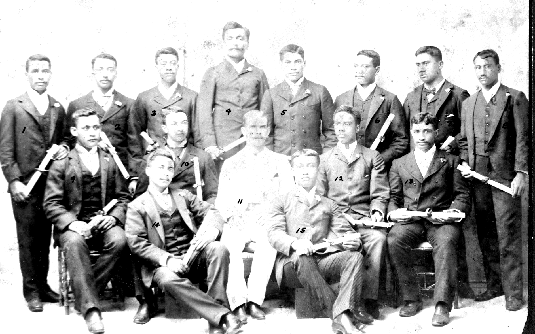
Back row, left to right: David Ai, Issac Harbottle, Solomon Mahekona, Matthew Kane, John Wahinamaikai, Kaili Kanehe, Robert Baker, William Meheula Middle row, left to right: Moses Kauwe, Samuel Spencer, D.S. Ruevsky, James Hakuole, Noah N. Kauhane Sitting foreground, left to right: Henry K. Blake, Abraham Pihi
The story of the foundation of the Bulgarian Kingdom is short and simple. About the middle of the 7th century Kubrat the kin of a Turkish tribe wandering along the banks of the river Volga in the eastern part of Russia, while on his death bed summoned his five sons to give them his last advice, which was that they should love in peace and agreement. But soon after his death these five brothers divided among themselves the kingdom which their father had made great, two of them remained at home while the other three departed with their respective hordes to seek their fortune in distant lands. One of them moved to Panonia, Hungary of today. Another marched toward Italy, while the third named Asparouh, crossing the rivers Dnieper and Dnester reached the northern banks of the river Danube. Hence he followed the delta of the river and in 679 AD with his horde numbering 50000 crossed into modern Bulgaria. At that time Bulgaria was already thickly settled with several tribes, which, however, belonged to one stock, the Slavonic. But these tribes could no unite themselves into a political whole; waging war among themselves was their every day sport, and it required one line Asparouh to unite them into a nation. He thus founded a kingdom which he named Bulgarian Kingdom. All the Slavs adopted the name of the tribe to which Asparouh and his hordes belonged, and it is by that assumed name that they are known to the present day.
The Bulgarians have enacted a somewhat prominent part in the drama of the World?s history. Most of their wars have been with the Eastern Roman Empire. Several times did the Bulgarians reached the walls of Constantinople. In the reign of Simeon the Great, who became the Emperor of Bulgaria, the city would have easily fallen a booty in the hands of the Bulgarian troops had it not been for the craftiness and flattering of the Patriarch of Constantinople.
In the Middle Ages when the Turks crossed the Bosphorous from Asia into Europe to encroach upon the Southern Countries, and were marching at full speed Northward, it was the Bulgarians who greatly diminished their strength and warlike enthusiasm, and had it not been for this protrusion of their advance, today, the historians has said, France and Austria would be under Mohammedan rule.
Bulgaria was concord by the Turks in the very last decade of the 14th century. The subjugation continued for five centuries till the year 1878 when the Bulgarians with the aid of Russia in the Russian-Turkish war of 78-88 threw off the Turkish yoke. This period of five centuries under the Turks was for the Bulgarians an era of bloodshed and misery; it was the period when Mohammedanism was the supreme ruler, and as century after century passed an the yoke became harder and harder.
The Pagan Bulgarians were completely Christianized in the year 864 through the effort of the brothers Cyril and Mehtodius who were sent as missionaries to Moravia, Bohemia and Bulgaria by the Emperor of Constantinople. These two brothers translated part of the Scriptures in the now so called ancient Bulgarian or Slavonic language, and also invented an alphabet for the Bulgarians, which was subsequently adopted by the Russians and the other Slavonic nations.
While under the Turks, the Bulgarians were at liberty to worship in their own churches. Ecclesiastically they were independent for a long period, i.e. they had Archbishop and Bishops from among their own people. But the Greek Patriarch of Constantinople, who having inherited from their ancestors the tendency, nay passion to helenize the whole world, succeeded through some ignominious procedures in establishing their predomination over the church of Bulgaria, which was the so called Greek Church. This was in 1767. The Bishops, priests and even teachers who till that time were all Bulgarians were placed aside and Grecians were substituted in their place . In Divine worship the N.T. Greek took the place of Ancient Bulgarian language. The boys and girls instead of being instructed in their own tongue were obliged to receive their lessons in the Modern Greek. To be striped of national freedom and subjected to a barbarous nation was indeed a heavy task for the Bulgarians, but to be at the same time deprived of the privilege of speaking in their own tongue, it was too heavy a burden to endure. To whom could they go for help in those darn and bitter days? The English correspondents had not as yet penetrated the dark could that hung over the country. Russia humbled in the Crimean War was not ready yet to look into the deplorable condition of her sister nation. But a little longer and the name Bulgarian would have been wiped out of existence. On one hand the Turks were executing their murderous policy, on the other the Greek Bishops were gathering the scares literature of the Bulgarians to kindle the fires of their hearts. The sincere prayer God have pity on us raising from the heart of every Bulgarian received one answer through the missionaries from the United States of America. A few years ago Prince Alexander of Bulgaria, now ex-Prince awarded a few foreigners with Ö among whom were Drs. Washburns and Long, president and vice-president of Robert College, Const. In presenting the decorations the Prince thus address them: ?Gentlemen I do not present you these to flatter you but to express to you and your collaborates my gratitude for what you have done for our people. Had it not been for the missionaries from the United States there would be no Bulgaria today and no Prince of Bulgaria.?
When the missionaries both Congregational and Methodist arrived in Bulgaria the church was still groaning under the ecclesiastical domination of the Patriarch of Const. Ignorance of the greater type, especially in regard to the scriptures, prevailed among the not only the people but also among the priests. The Scripture was chanted in the churches in a language which but few of the priests themselves understood. The people went to church simply to perform, certain ceremonies; kneeling before and kissing the images of the Saints and the Virgin Mary Ö to them a perfect reconciliation to God.
Such was the condition of the Bulgarians when they first came into contact with the American missionaries.
Dr. Hamlin, the well known missionary to Turkey, made the first missionary tour through Bulgaria. This was in 1857. It was his report and dissertation of the country that persuaded the American Board to send missionaries to South Bulgaria, while the Northern part was left open to the Methodist who went there a year earlier. Dr. Hamlin himself was stationed at Const., where he was at work among the Turks and the Armenians, the latter especially. But his work has been such as to produce results which hold a conspicuous position among the providential agencies that have placed Bulgaria in the position in which she is today.
One going through the Bosphorous from the Black Sea toward the Golden Horn, will not fail to see among the many magnificent buildings and palaces of pure marble along the shores, one particular stone building up on a majestic hill not far from the spot where Mahmud the 2nd the captor of Const, in 1453 first stepped on European soil. This five story-building bearing upon its dome the stars and the stripes is Robert College the American Institution on the Bosphorous, of which Dr. Hamlin was the very founder.
Robert College has played an important part in the recent history of Bulgaria. Many a young Bulgarian has received an education there. Many of the prominent positions in the Bulgarian Government are occupied by Robert College graduates and we can safely say today Bulgaria is much indebted to that American Institution an the Bosphorous. The influence and the affect of the work accomplished there for the Bulgarian Nation far exceed the fruitful results of the two ? combined to that same nation.
The struggle of the missionaries in Bulgaria have been mostly with the priests who did not see how they could and why they should abandon their ?fathers? faith?. Until a few years ago the Bulgarians as a whole nation were considered among the most pious people in the world. But alas! It was a piety full of superstitions!
The missionaries in Bulgaria adopted Dr. Hamlin?s frame of work: they opened schools in different parts of the country which have been the chief push to success of the mission work. Since the Emancipation of Bulgaria from the Turks the struggle of the missionaries in Bulgaria gave not been so much with the priests or the Greek church but with Satan himself. When the Russo-Turkish war was declared in 1877 and the Russian officers and soldiers stepped on Bulgarian soil, Satan at the same time sowed the seed of impurity, ? and infidelity.
The mission work in Bulgaria has been proceeded slow and unsuccessful and why? The question, the comprehensive question that has been for a long time in the mind and heart of every Bulgarian is whether Bulgaria shall be ruled by the principle of despotism, or by the principles of freedom; whether Bulgaria shall submit to the blind instrument of ambition of same few, or adopt the sword of independence and die for freedom?s sake if necessary. For an era of five hundred years did Bulgarians bore the yoke of the most barbarous people of the world. The Greek tried to helenize us; the Turks attempted to obliterate the whole race, One hundred thousand Bulgarians, men, women and children were most ignominiously cut to pieces by the brutal and merciless Turk only sixteen years ago. Today the nation lives, but behold the ? and jealousy if our neighbors. Six years ago when North and South Bulgaria one and the same people and country arose to unite themselves under one regime Servia declared war, but happily failed in her attempt. Consider on the otter hand the political anathema with which the Bulgarian Government is afflicted through the capricious notion of certain European powers, Russia especially! And now should not all this be looked at as a great impediment to the missionary work in the country?
But the mission work in Bulgaria has not been a failure; and to these who have pronounced it so we would say that even if it has been a failure, the law of duty to preach the Gospel to all men should ? any such question of failure or success. We should not measure the obligation under which our Master has placed us by the amount of fruit we have obtained, nor should the degree of our obedience be tested by the consequences of our work. All we have to do is to follow the commandment and the will of the Master. Was it not commanded once to a prophet ?thau shalt speak my words to them whether they will hear or not??
Another fact to be taken in consideration is the delay is by no means failure. ?The husband awaits for the precious fruit of the earth, and hath long patience until he receives the early and latter rain.? Bulgaria has not had her latter rain yet.
Shall we limit the success of the missionaries only to the number of apparent converts he has received? Indeed there is the signs which the faithful missionaries are laboring to see; but there are other signs which although hardly visible yet are truly hopeful. Hence we should not simply count the heads of the converts in order to test the amount of labor of a missionary has done but ?reflect for a moment? as someone has expressed it, ?upon the great under-current of peaceful evolution in the thoughts and the hearts of the people?.
It is true there is but a slight number of converts in Bulgaria, but
on the other hand the missionaries with the significant aid of the nation
preachers have been crushing down from day to day the formalities of the
church and the superstitious believes of the ignorant and are opening the
eyes of the peasants as well as citizens to see the infamous deeds of their
bishops and priests.
It was the American missionary that encouraged the Bulgarians to fight their battle against the Greek Bishops and priests, and had it not been for Dr. long. Riggs and Buyington today Bulgaria would still be groaning under the ecclesiastical predominance of the Greek Patriarch.
It was the American missionary that opened the way of the English correspondents to the country to ?pen-picture? the massacres and atrocities committed there in and before the year 1876 by the brutal Turks.
It is to the American Missionary that today Bulgaria owes her political as well as ecclesiastical independence.
Ah! My friends let us have patients! I believe the time will soon come when al the impressions that have been made by the missionaries upon the minds and hearts of the Bulgarian people will bloom and yield an abundant harvest of converts.
?So is the Kingdom of God: as if a man shuld cast seed upon the earth
and should sleep and rise night and day, and the seed should spring up
and grow he knoweth not how. The earth bereth fruit of itself; first the
beada then the ear then the full corn in the ear.?