 |
 |
 |
 |
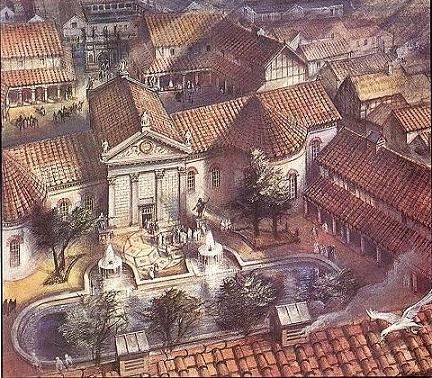

The largest town in Roman Britain. The site does not appear to have been occupied in pre-Roman times, but owed its importance to its position at the lowest point where the roads built by the imperial government could cross the Thames by bridge, and to its suitability as a terminal for maritime trade with the Rhine, Seine, Loire, and Garonne estuaries. 54 BCE - CE 60 It is probable that Julius Caesar crossed the river here in 54 B.C., and Aulus Plautius in A.D. 43. There was, however, a subsidiary crossing at Westminster, at which the Kentish and Hertfordshire Watling Streets both aim; as these roads are clearly early in date it is possible that the Roman army had a depot at Westminster in 43. No certain trace of a fort of the conquest period there or in Londinium itself has yet been found, but it is inconceivable that the crossings were not guarded. CE 60 - 200 Londinium itself is described by Tacitus in connection with the rebellion of CE 60 as an important center for merchants and merchandise (Annals. 14.33); it is likely that a large traders' settlement had sprung up around an army stores-depot--a normal development. Though at that date it had no official urban status, it is probable that already the site's advantages had attracted the offices of the provincial procurator, for Catus Decianus was not in Camulodunum when the rebellion of Boudicca broke out (Tacitus, Annals. 14.32), and certainly his successor, Julius Classicianus, who appears to have died in office, was buried not at Camulodunum but in Londinium. At what date the governor's headquarters also migrated to Londinium is uncertain; but that it was there in the 2d century and probably earlier is suggested by a dedication by the legatus iuridicus giving thanks for Trajan's Dacian victory, and by inscriptions mentioning speculatores and legionaries from all three British legions. Londinium's importance as a center of population ever since Roman times has limited opportunities for excavation, while continual rebuilding and digging of pits and wells has ensured that excavated remains will be fragmentary. Only since WW II, when many areas of the city were destroyed by bombing, has planned exploration been possible, but even so commercial interests have on the whole proved inimical to careful investigation. The earliest buildings were almost all of timber framing packed with clay, which burnt easily when the settlement was sacked in CE 60. A map of these burnt remains indicates that of the two low hills occupied by the later city only the one to the east was originally settled, with some development along the main road to the west. The Wallbrook stream which divides the hills was the effective limit of occupation. The debris of a later fire, however, which destroyed London in Hadrian's reign, ca. CE 130, is much more widely distributed on each side of the stream. By this date, though the city was still unwalled, a large fort of approximately 4.8 hectares had been built on the northwest outskirts, another indication of the exceptional importance of Londinium in the British province. By Hadrianic times, if not some 30 years earlier, a very large forum and basilica had been erected; recent excavations have confirmed that it succeeded a smaller courtyard structure on the same site (also probably a forum), built soon after Boudicca's rebellion. Since the forum-with-basilica is usually found only in administrative centers, it can be deduced that the city gained self-governing status in the 1st century, and as it was not the capital of a tribal civitas it may have been created a municipium. There were also offices of the provincial government, as shown by tile-stamps and a wooden writing-tablet stamped by the procurator's office, and by the recent excavation of a large building in Canon Street, overlooking the Thames, which is best interpreted as the governor's praetorium. The first stages of this building go back to the reign of Domitian. There is, indeed, much other evidence for developments in the later 1st century, including part of a public baths at Huggin Hill; the most illuminating perhaps are the wooden tablets of this date which illustrate the thriving commercial life of the city. Remains indicating the presence of gold- and bronze-smiths have been found, and the cutler Basilis, several of whose knives have been found in Londinium, also almost certainly worked there. Pottery kilns were unearthed by Wren during the rebuilding of St. Paul's Cathedral. The city also certainly served as the main importing and distributing center for the extensive trade in Gaulish terra sigillata, and probably also for Rhineland glass. CE 200 - 400 Excavation has shown that the Wallbrook stream, which divided the city, was not the extensive harbor once imagined: its bed was only 4.5 metres wide, but the margins were subject to extensive flooding. At first the banks were revetted with timber, and continual sinkage led to dumping earth to maintain the levels. Vast quantities of well-preserved metal objects have been preserved in the mud; they suggest a market in the vicinity, though some may be votive offerings. Towards the end of the 2nd century, a small Mithraeum was built on the E bank which attracted wealthy worshipers; excavation has recovered some distinguished sculptures in imported marble which had apparently been buried during the reign of Constantine I, perhaps as a precaution against Christian persecution. The building itself continued in use for another generation. The Severan period was also prosperous: a large bath structure in Lower Thames Street is now known to have formed part of a residence built ca. CE 200. The city wall erected a little later was built of Kentish ragstone, quarried probably in the vicinity of Maidstone and brought by barge to London. Part of a river barge with a cargo of this stone was excavated in 1962 at Blackfriars Bridge: the boat seems to have foundered when its cargo shifted. A town wall was at length provided early in the 3rd century, incorporating two sides of the existing fort and enclosing an area of 132 hectares. No trace has yet been discovered of any earlier earthwork surrounding the city, though the majority of Romano-British towns were thus defended late in the 2nd century before walls were added; it is possible, however, that such a defense, if it existed, enclosed a more constricted area. At 132 hectares within its walls Roman Londinium was 40 hectares larger than either Cirencester, Verulamium, or Wroxeter, its nearest rivals, and in size compares favorably with the majority of towns in the west provinces. The wall was provided with external towers along part of the circuit probably ca. CE 370 (into one of which was built much of Classicianus' tombstone); the purpose of these towers was to make greater use of artillery in the defense of the wall and thus save manpower. Thereafter, with successive restorations, the Roman wall continued to defend and bound the city throughout the mediaeval period. During the 3rd century, after the Severan reorganization, Londinium served as capital of Britannia Superior. At the end of the century a mint, established there by the usurper Carausius, continued to issue coins until 326; in 383 another usurper, Magnus Maximus, reopened the mint for the issue of gold and silver. In 296 the struggle between Carausius' successor and the legitimate regime culminated in the rescue of London by the forces of Constantius I from the danger of looting by the defeated mercenaries of Allectus. The event is immortalized on a large gold medallion of the conqueror which was found at Arras, France, in 1922. It depicts a city gate and the kneeling figure of Lon(dinium) welcoming the mounted Caesar and a galley-load of his men. The recovery of Britain in 296 resulted in reorganization after the pattern of Diocletian. Londinium, which perhaps in 306 received the title Augusta, became the capital of Maxima Caesariensis, one of the four new provinces into which the island was divided, but was also almost certainly the seat of the vicarius Britanniarum, who represented the praetorian prefect in the Diocese of Britain. The Notitia Dignitatum tells us that it was also the seat of the Treasury. CE 400 - 500 Of the fate of the city in the 5th and 6th centuries, little is known. There is some evidence from the distribution of early Anglo-Saxon cemeteries that an effort was made to defend its approaches by settlements of barbarians who may represent foederati. A 5th century Saxon saucer-brooch was found in the ruins of the Lower Thames Street bath block, suggesting that this building did not become ruinous much before 500. Other finds earlier than the 7th century are rare. Though London may never have become completely depopulated, its surviving population shrank considerably. The recovery of its prosperity, which has always depended upon commerce, occurred only with the return of more settled conditions under the established Saxon monarchy. Sources R. Merrifield, The Roman City of London (1965);
 |
 |
 |
 |
 |