The Road Not Taken and The Garden of Forking Paths
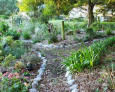
Robert Frost considers life as two roads, while Borges believes in multiple parallel existances ("Naturally, there are several possible outcomes: Fang can kill the intruder, the intruder can kill Fang, they both can escape, they both can die,a nd so forth [...] all possible outcomes occur; each one is the point of departure for other forkings.") However, Frost does allude to multiple existances and more roads than two when he remarks that "way leads on to way."
Frost considers a diverging of two roads during an important life decision only; Borges thinks of one's entire life as a series of choosing paths.
Both authors choose confusing settings as backdrops to a process of realization (significantly, both are told in the first person voice, giving the reader a first-hand account of a major choice in life): Frost chooses a forest while Borges creates a labyrinth discussion which itself becomes a maze. In this way, both authors attempt to find order amidst chaos. The environment plays a key role here as well. In Frost's poem, the speaker persona is "in a yellow wood" (line 1), signalling autumn, or a season of time and maturity. Borges' short story is in the middle of World War I, a time where Dr. Yu Tsun must come to terms with his identity and goals in life.
The significance in date is huge, especially when both are written with the year 1916 in mind. Although Borges writes "The Garden of Forking Paths" in 1941, he was actively involved in World War I during the year of 1916, which he utilizes as the backdrop of his story. Frost literally writes during that year and mentions it as not only the year he lives in, but also as a crossroads in time. Perhaps both are writing of the confusion and need for direction during the years of the First World War.
And sorry I could not travel both
And be one traveler, long I stood
And looked down one as far as I could
To where it bent in the undergrowth;
Then took the other, just as fair,
And having perhaps the better claim,
Because it was grassy and wanted wear;
Though as for that the passing there
Had worn them really about the same,
And both that morning equally lay
In leaves no step had trodden black.
Oh, I kept the first for another day!
Yet knowing how way leads on to way,
I doubted if I should come back.
I shall be telling this with a sigh
Somewhere ages and ages hence:
Two roads diverged in a wood, and I-
I took the one less traveled by,
And that has made all the difference.
-Robert Frost, 1916