
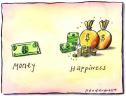


The relationship between money and happiness is one that is very intriguing. Once a student enters into college or technical school, they are in a setting preparing them for a career. Many undergraduates (mistakenly) believe that it is absolutely necessary for them to make a solid income. Yet, research (Diener & Diener, 1995; Diener & Seligman, 2004; Helliwell, 2003; and Schyns, 2003) shows that once a person attains a level of comfort financially, money has very little role in the creation of happiness. If, in Arthur Miller's Death of a Salesman, Willy Loman had been starving on the streets, dirt poor, and living in a cardboard shack on the outskirts of town, then money would be his happiness, as it allows him to purchase his basic needs. However, since Willy Loman was stable enough to support a family (until he lost his job), looking for a higher salary was actually increasing his anxiety and sadness.
The most interesting aspect of psychological research into the connections between money and happiness occur with what psychologists now term "the dark side of the American Dream." Research (Kasser & Ahuvia, 2002; Kasser & Ryan, 1993; 1996; Kim, Kasser, and Lee, 2003) shows that those who stated that their goals were to be wealthy (as many do in attempting to achieve the American Dream) were more likely to be unhappy and depressed, as opposed to those who stated more constructive goals in life, such as connecting with family or making the planet a much better place. It's not surprising, then, to see the strong connections this research has with Willy Loman, who, as a businessman, focused his entire life in the sole goal of making money, when doing just that contributed heavily to his downfall. Willy Loman fell into the dark side of the American Dream, but Arthur Miller warns his audience to pay attention to the more important things in life that will ultimately garner more happiness than counting every single penny.
Materialism, thus, has been the bane of our human existance. It has fueled the human drive to be greedy and acquire more. The United States may be among the most wealthiest, most powerful nations on this planet, yet we Americans are consistently seen by psychologists as the most unhappy. Poorer countries are often much more happier by the laws of relative deprivation, and when we do get a raise at work or hit the jackpot, we are ecstatic for only a brief amount of time, as the adaptation-level phenomenon assures us that financial worries and comparing ourselves to others around us will surely occur once we are over the initial joy of hitting it big.
So how do we achieve happiness in a society completely consumed by the obsession of wearing the latest brand name clothes and buying the hottest electronic equipment? We find a purpose in our lives. Experts suggest that those who aim to touch the lives of others and make a difference in our world rate themselves as much happier people compared to those whose sole aim in life is to make their pockets jingle with money. As people grow older, those who find comfort in their family as opposed to the cash register are much more happier. Why is this? For the simple reason that you are getting the wholesome gratification of quality time spent with others, a life enriched by having a purpose beyond being Uncle Scrooge. If social psychology teaches us anything, it is that, as human beings, the greatest happiness is found in being among those you love and doing what you love.
Money does not buy happiness -- satisfaction and purpose in life does.