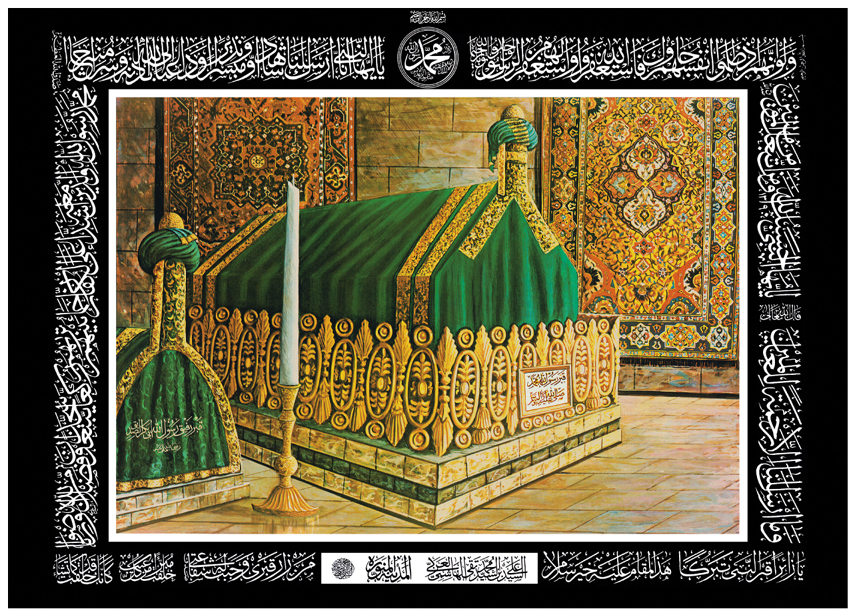
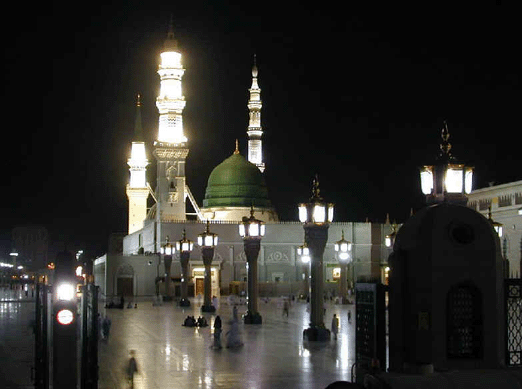
"Muhammad is but a prophet before whom many prophets have come and gone. Should he die or be killed, will you abjure your faith? Know that whoever abjures his faith will cause no harm to God, but God will surely reward those who are grateful to him." [Qur'an, 3:144]
Realizing that the people were withdrawing from him (Umar) and going to Abu Bakr, `Umar fell silent and listened to Abu Bakr's speech. Upon hearing Abu Bakr recite the Qur'anic verse, `Umar fell to the ground. The certainty that the Prophet of God was truly dead shattered him. Beguiled by `Umar's speech, the people listened to Abu Bakr's statement and to the Qur'anic verse as if it was given to them for the first time. They had forgotten that there was any such revelation. Abu Bakr's stark words dissipated all doubt and uncertainty. His Qur'anic quotation reassured the Muslims that their holding fast to God Who never dies would more than compensate for Muhammad's passing.
Throughout the Muslims' disputing of the question of success at the courtyard of Banu Sa'idah and in the mosque, the Prophet's remains were lying on his bed surrounded by his next of kin. After the election of Abu Bakr, the people came to the Prophet's house to prepare for his funeral and burial. There was disagreement as to where the Prophet was to be buried. Some Muhajirun advised that he ought to be buried in Makkah, his native town, in the proximity of his own relatives. Others advised that he ought to be buried in Jerusalem where the Prophets were buried before him. The latter was certainly a baffling view considering that Jerusalem was in the hands of the Byzantines, and the relations between them and the Muslims were most hostile, especially since the Mu'tah and Tabuk campaigns. Indeed, an army which the Prophet himself had mobilized and placed under the leadership of Usamah was supposed to fight them and avenge the Muslim defeat in those campaigns. At any rate, the proposals to bury the remains in Makkah or in Jerusalem were both rejected. The Muslims resolved to bury him in Madinah, the city which gave him shelter and assistance and which was the first one to raise the banner of Islam. Once this decision was made, they proceeded to look for a proper location for burial. Some advocated burial in the mosque where he used to address the people, preach the faith, and lead them in prayer. They thought that the most appropriate place was either the very spot of ground where the pulpit stood or the spot next to it. This opinion, however, did not meet with approval. `A'ishah had related that in his last days, whenever his pain increased, the Prophet used to uncover his face to curse such people as had taken the grave of their prophets as places of worship. Abu Bakr solved the issue when he proclaimed that he had heard the Prophet say that prophets should be buried wherever they die. This opinion carried the day.
Washing the Prophet's body before burial was performed by his next of kin, by `Ali ibn Abu Talib, al `Abbas ibn `Abd al Muttalib and his two sons, al Fadl and Qutham, as well as by Usamah ibn Zayd. Usamah ibn Zayd and Shuqran, the Prophet's client, poured the water while `Ali washed the body, covered as it was by Muhammad's nightgown. It was decided that the Prophet's body should not, under any circumstance whatever, be fully exposed. As they performed their washing, contrary to what is usual in such cases, the body emitted beautiful smells, so that `Ali said continually: "By God, what would I give for you! How sweet you are and how wholesome you are, both alive and dead!" Some western Orientalists sought to explain this fair scent emitted from the body of the Prophet by calling it the result of the perfume which he used so lavishly, remembering that he once declared it one of the good things he truly loved in this world. When the washing was completed, the Prophet's body was wrapped in three shrouds: two made in Suhar and the third in Hibarah in Yaman. When this operation was completed, the body was left where it was and the doors were flung open for the Muslims to enter from the mosque, to take a last look at their Prophet, and to pray for him.
The room was practically full when Abu Bakr and `Umar entered the room and joined the Muslims in a funerary prayer for the Prophet. The prayer was performed without a leader. When it was over, Abu Bakr began to pray aloud, saying: "Peace, mercy, and blessings of God be upon you, O Prophet of God. We witness that the Prophet of God and His apostle conveyed the message entrusted to him by his Lord and that he exerted himself and fought in His cause until God gave victory to His religion. We equally witness that the Prophet of God and His apostle fully performed his promise and that he commanded us to worship none but God alone who has no associates." At the end , of every phrase, the Muslims responded together, "Amen, Amen." When this prayer was complete, the men left and the women and children took turns taking a last look at the Prophet. One and all, every man, woman and child, emerged from that room torn with sorrow and crushed by a sense of bereavement for the loss of the Prophet of God, the Seal of His apostles. They were full of apprehension that some calamity might befall the religion of God in the future.
The Arabs knew two ways of digging graves. The Makkans made their graves flat at the bottom while the Madinese made them curved. Abu `Ubaydah ibn al Jarrah was the gravedigger for the Makkans, and Abu Talhah Zayd ibn Sahl was gravedigger for the Madinese. The Prophet's relatives could not choose between them. The Prophet's uncle, al 'Abbas, sent two men to call the two gravediggers for a consultation. Only one was found and could respond to the call, and that was Abu Talhah, the Madinese. He therefore was commissioned to dig a grave for the Prophet of God as he knew best. When evening came and the Muslims had taken leave of the body of their Prophet, Muhammad's relatives prepared for the burial. They waited until a quarter or a third of the night had passed before proceeding with the burial. In the grave, they spread out a red mantle that once belonged to the Prophet, and the men who had washed the body lowered it to its last repose. They built over it a bridge with bricks and then covered the grave with sand. `A'ishah said: "We did not learn of the burial of the Prophet of God-may God's peace and blessing be upon him until midnight or later"; and so did Fatimah report. The Prophet was buried on Tuesday night, 14th of Rabi` I, two days after his death, in the year 10 A.H.
`A'ishah lived thereafter in her quarters, next door to the Prophet's grave, contented with her proximity to this holy precinct. When Abu Bakr died, he was buried in the immediate vicinity of the Prophet's grave, as was `Umar ibn al Khattab thereafter. It is related that `A'ishah used to visit the grave room without veil until `Umar was buried therein, i.e., during the time it contained only the grave of her father and husband. But after `Umar's burial, she entered the room only when fully veiled.