Temple of Marquis Wu, which is located in
the south of Chengdu, is a famous historical site dedicated to
the memory of both Liu Bei (161-223), Emperor of the Kingdom of
Shu in the Three Kingdoms Period (220-280), and Zhuge Liang
(181-234), Prime Minister of the kingdom.
The temple was
originally built by Li Xiong of the Western Jin Dynasty
(265-316AD), 400 years after Zhuge Liang's death, and rebuilt in
the Qing Dynasty with a total area of 37000 square meters. The
whole complex faces south direction with the first gate, second
gate, hall of Liu Bei, corridor, and hall of Zhuge Liang sitting
on the central axis, in which the hall of Liu Bei is the highest
and greatest one. A board hung above the first gate reads
"Han Zhaolie Temple" ( Zhaolie was a title given to Liu
Bei posthumously). In spite of this, the temple is commonly known
as Wuhou Memorial Temple (Zhuge Liang was conferred on the title
of Wu Xianghou after his death).
The memorial temple,
dignified and simple in style, houses 47 statues of Liu Bei,
Zhuge Liang and other civil officials and senior generals of the
kingdom. The temple is furnished with many inscribed stone
tablets, the most famous being the Tablet of Triple Success of
the Tang dynasty (618-907) with its text by Prime Minister Pei
Du, calligraphy by Liu Gongchuo and carvings by Lu Jian. Today,
the temple of marquis Wu is not only a museum for people to know
the history of three kingdoms, but also a good place for resting
and visiting.
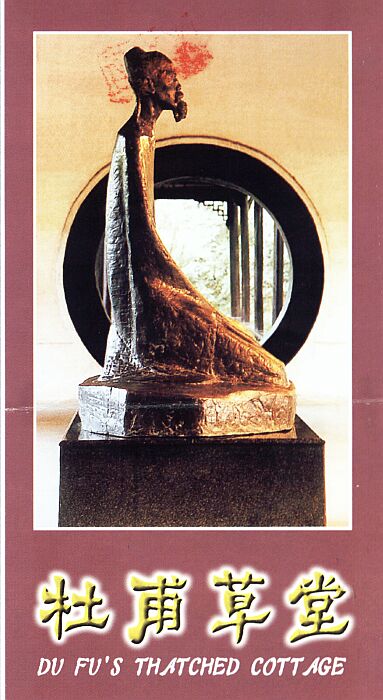
Du Fu (712-770AD) was born in Henan
province. When he was 20 years old, he left his home to travel in
China. He used to be an official in Chang'an (present Xi'an), the
capital of the Tang dynasty, for 10 years, and was later captured
by rebels after an uprising and fled to Chengdu where he built a
humble cottage and stayed for about four years. During these four
years, Du Fu composed more than 240 poems reflecting upon the
misery of the people, in which most of them are very familiar to
Chinese people.
In AD 761, a storm
destroyed the roof of the thatched cottage, which led to the
writing of one of his masterpieces, "the Song of Autumn
Winds Destroying My Cottage". In this poem, he expressed his
anxiety for the plight of other poverty-stricken scholars and the
desire for shelter for all the poor. After Du Fu's death, people
built a new cottage on the ruins of the original site, as a
memorial to Du Fu. The present one was the restoration of the
Ming and Qing dynasties. Cover 20 hectares of leafy bamboo and
luxuriant vegetation.
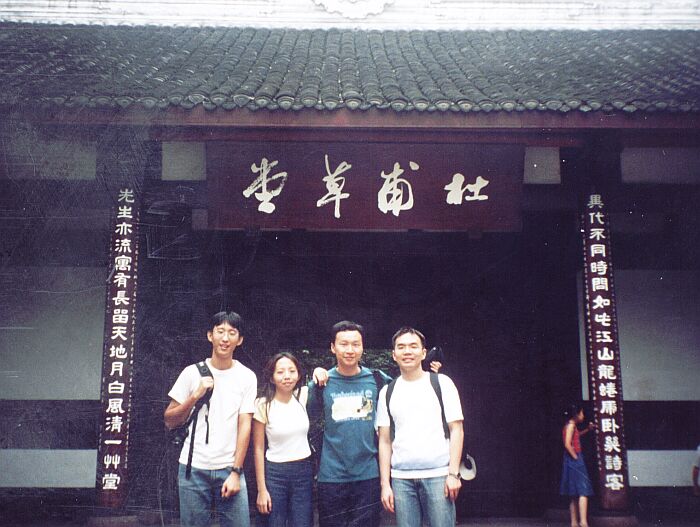
Today, the Thatched
Cottage has become a commemorative museum in the form of a
traditional garden. The area contains several interestin g
structures, including the grand lobby, the Shrine of Gong Bu
(Du's official title) and the Memorial Hall of Du Fu. In the
grand lobby stand two antique wooden screens, one bear a brief
account of Du's life and the other, a traditional Chinese
painting of Du's cottage. Inside the Shrine of Gong Bu are stone
tablets of the Ming and Qing dynasties. Du's poems have been
translated into 15 foreign languages and are on display in the
Memorial Hall of Du Fu. Each year, on January 7th of lunar
calendar, local sch olars and poets get together in the cottage
to honor Du Fu. They celebrate his works by chanting his poems to
the accompaniment of dances and music.
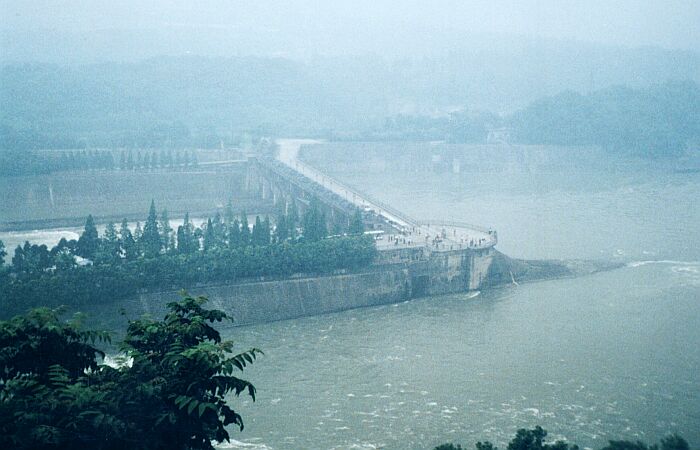
Around BC 250 during
Warring States Period, Libing, a governor of Shu prefecture
(present Sichuan province) in Qin state, directed the
construction of Dujiangyan. The governor gave up the old way of
dam building to catch floodwater. Instead, he employed a new me t
hod by water channeling and diversion to harness Minjiang River
and built the whole works up mainly in two parts: the headwork
and the irrigation system. The project effectively put the flood
under control. Up to now, the whole system still functions perf e
ctly, serving over two thousand years for flood prevention,
irrigation, shipping and wood drifting. It contributes a lot to
the richness of Chengdu plain and its reputation as the Land of
Abundance. On November 29th, 2000, Dujiangyan was listed on world
cultural heritages by UNESCO.
The quest of Xuan
Zang is the basis for a folk tale called The Journey to the West.
The Monkey King is a rebellious sort who is sent to live inside a
mountain until he mends his ways. When Xuan Zang plans his trip
to India, he needs an escort. Buddha is asked if he will allow
the Monkey King to take on the task. The Monkey King has his work
cut out for him. Xuan Zang trusts everyone, including evil
spirits disguised as good s pirits. The Monkey King prefers this
good man to be a little more cynical and certainly less innocent.
The Monkey King meets terrible forces of evil of every shape and
size and defeats them all. The story ends when the group manages
eventually to reach th e west. Today the story is of the Monkey
King's bravery and ability to resist evil. The original story
emphasized the need to rebel and not believe everything you hear.
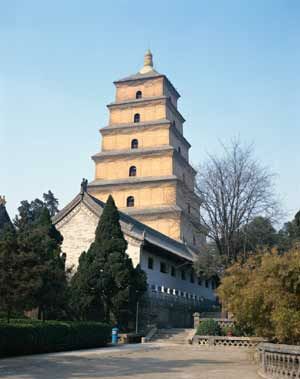
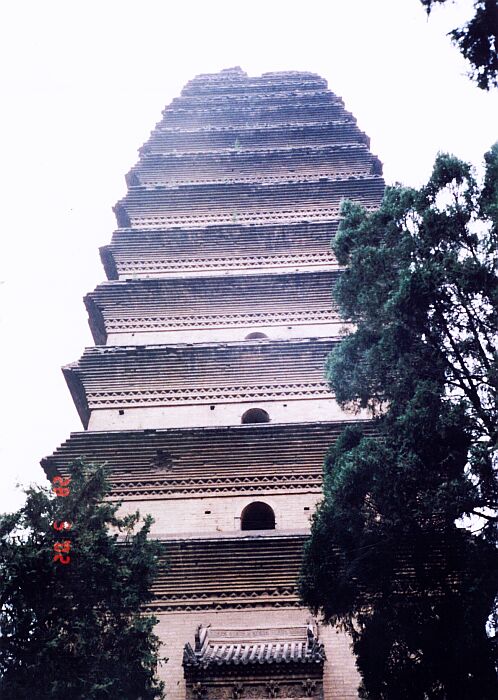
The Little Wild Goose Pagoda. Located on
the grounds of the Felicity Temple, this structure gets its name
because it is smaller than the Big Wild Goose Pagoda, although it
is more stories high. It was completed in 709 A.D., when Bud
dhism was firmly established in China. The influence of Buddhism
was so strong that Daoism, based on the teaching of Lao Zi,
gradually adopted many of the Buddhist rituals in order to
maintain popularity among the people. It is said that the Little
Wild Goose Pagoda had lost several stories during an earthquake
in the 1500s. However, it still looks complete. It has finer
detailing in the brickwork than the Big Wild Goose Pagoda. Above
the arched doorways on the first tier are Tang engravings of ivy
designs and Buddhist figures. The pagoda is part of a temple
complex and monastery. It is also possible to climb to the top of
this structure.
The mausoleum is
located about 7.5 kilometers from Lintong county, Xi'an in
Shaanxi province. Almost one hundred pits containing the
skeletons of horses and terra cotta grooms constituted the
emperor's stables. Even hay was provided. Other pits held clay
models of birds and plants and must have represented his parks.
Some twenty tombs probably hold the remains of his councilors and
retainers. At the center of the necropolis is a mound that marks
the emperor's own grave; it has not yet been excavated.
The historical
records of the first century BC state that the tomb contained
palaces and pavilions filled with rare gems and other treasures,
and was equipped with crossbows to shoot automatically any in
truders; the ceiling was inlaid with pearls to simulate the sun,
stars and the moon, the floors and walls were lined with bronze
to keep out water and mercury was pumped in to give the image of
flowing rivers.
The construction of
the Qin Mausoleum began as soon as Qin Shihuangdi ascended the
throne in 246 BC. The work intensified after the conquest of the
rival states employing 720,00 workers for a period of 39 years.
Li Si - minister of Qin also supervised the project which was
halted in 208 BC., when the capital was besieged by the rebel
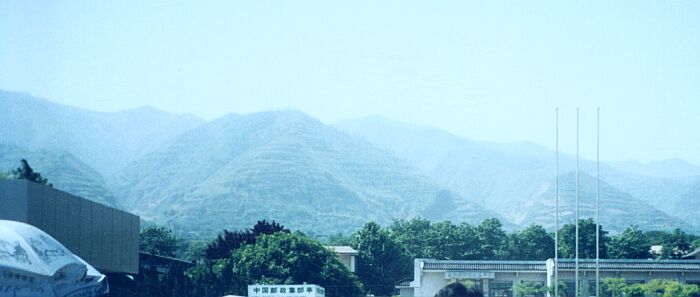
troops. The site chosen was south of the Weihe River beside the
slopes of Black Horse Mountain in what is now Lintong county, 30
kilometers (18 miles) from Xi'an. Screened by the five peaks of
Lishan Mountain, the site co incides with traditional Chinese
geomantic omens as an ideal burial place for emperors who held
the belief that they would spend their afterlife in another
world.
The appearance of the
mausoleum is of a low earth pyramid with a wide base. It is said
to hav e been plundered at least once, but no excavations have
yet been done. Information about the construction of the
mausoleum comes almost entirely from the brush of Sima Qian, the
author of The Historical Records, which was written about a
century after the fall of Qin. Records state that the mausoleum,
which covers 56.25 square kilometers, was a microcosmic replica
of the Qin capital. Originally, double rectangular walls
surrounded the mound with gates on the four cardinal points
resembling the imperial city.
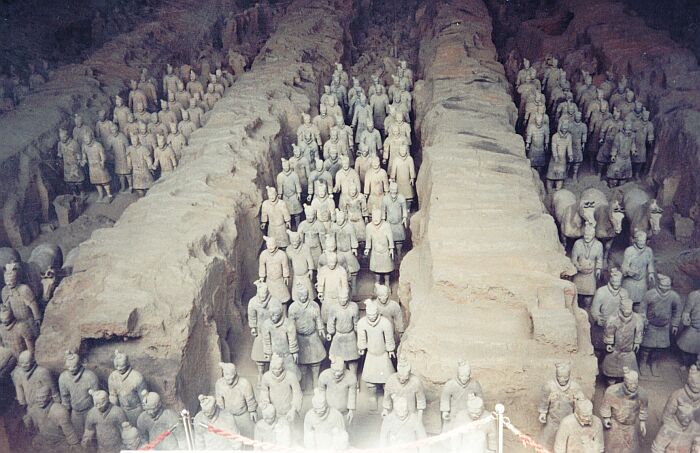
Leading down into the Pit is five slops
doorways on each side. At a distance of 20 meters north of Pit1,
from east to west lie Pit 2 and Pit 3. Fire had wrought damages
on all the three Pits with the ground caved in and most pottery
warriors, horses and weapons broken.
There are four main
categories of figures: chariot warriors, infantrymen, cavalrymen,
and horses. There are generals, middle ranking officers, lower
ranking officers, ordinary soldiers, and armored warriors. The
latter can be further divided according to their headgear into
warriors with a square scarf, a cylindrical bun, or a flat bun.
There are kneeling warriors as well. Besides some bronze swords,
curved swords, spears, crossbows, arrowheads etc. used as weapons
in actual battles, altogether six thousand pieces of pottery
warriors and horses were unearthed from the Pit 1.
The unearthed pottery
warriors are 1.8 meters high and clay horses, 2 meters long and
1.5 meters high. In the battle array, the vanguard appeared to be
formed by three ranks of warriors all facing east, with 70 men in
battle attire in each rank. Immediately behind the van is the
main body of 38-column formation. On each of the three sides of
the main body arrays a single rank of men, all facing out, who
looked to be the flank and rear guards of the formation. The
pottery army, compact in organization and magnificent in battle
arrays, is presented on a grand scale.
The pottery warriors,
well-proportioned and exquisitely shaped, have each a distinctive
individual expression: some biting their lips, some glaring or
gazing, some meditating with their heads lowered, or with
troubled looks, others appearing naive or animated. With the
armor buckled on, the soldier has his crossbow under the arm, and
arrow quiver slung over the shoulder. The general, armored and
keeping a hand on the tip of sword handle, maintains an awesome
bearing. Strong and dynamic, the horse rears its head, bristling.
The grandeur and superb workmanship fully demonstrate the great
talent and vision of the Chinese nation.
In 1980, another two
bronze chariots with riders and horses of larger size were
unearthed. The chariots each with four bronze horses harnessed
to, and a driver, have a luxurious canopy, pierced windows and a
saddle and a bridle of gold and silver ornaments. The chariots
and horses are colorful and really true to life. These artistic
treasures of the Qin Dynasty are without doubt, one of the
world's great wonders. For all its grandeur, the Battle Formation
of the Terra-Cotta Warriors and Horses is acclaimed by many as
the Eighth Wonder of the World.
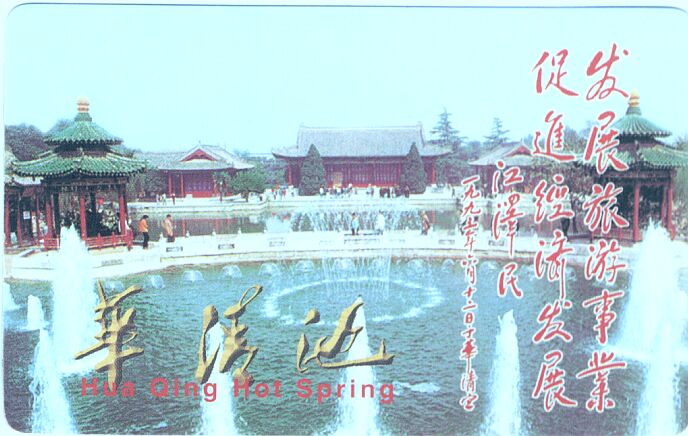
Located at the northern foot of Mt.
Lishan in Lindong County of Shaanxi Province, 30 kilometers from
Xian, Huaqing Hot Springs is a state place of interest as well as
scenic spot. Accor ding to the record, as early as the Dynasties
of Zhou, Qin, Han, Sui and Tang, temporary imperial abode was
constructed here. In the 6th year of Emperor Xuanzong\rquote s
Reign in the Tang Dynasty(747) it was expanded on a massive scale
by turning the hot springs into bathing pools, ringing the Mount
with palace buildings, which were to be protected by an outer
circular defensive wall and renamed it Huaqing Palace. As the
palace was built upon the hot springs, it was also called Hot
Spring Pools.
In 756, it was reduced to ruins by
the flames of war. Most of the existing buildings were
constructed in the Qing Dynasty and after the liberation of
China. Huaqing Pools is fascinating for its exquisite and
picturesque scenery characterized by pink peach blossoms, green
willows, dense foliage, beautiful pavilions and terraces,
magnificent halls, rolling towers, winding corridors and long
verandas, Jiulong(Nine Dragons) Lake is crystal clear and mirrors
the pavilions and towers. Huaqing Hot Springs was very famous and
use d to be bathing site for imperial families during the Zhou,
Qin, Han, Sui and Tang Dynasties. Lady Yang, the highest-ranking
imperial concubine was also "Privileged To Bathe In Huaquing
Pool In Time Of Freezing Spring, And In Slick Hot Spring Water,
Rinsed Her Soft Creamy Skin, as the poem goes. At the present,
there are four springs flowing out with a total capacity of over
110 tons of water per hour at the constant temperature of 43
degrees centigrade, which is good for bathing.
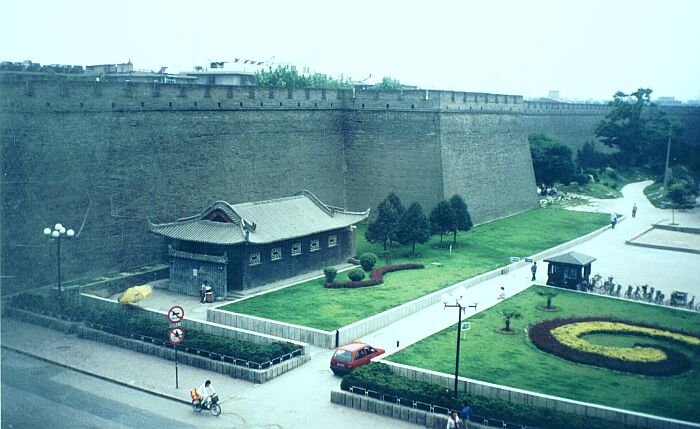
The Ming Walls. During the Ming dynasty
(1368 A.D.-1644 A.D.), Xi' an was refurbished and returned to
prominence as a center of politics and trade. The Ming emperors
rebuilt the walls, incorporating one corner left over from the
Yuan dynasty in their design. While the architecture of the Ming
is steadfastly angular, the curved rampart of Hun design adds
grace to the overall effect. The walls are flat and straight,
tempting one to a 15K jog.
There is a legend
that Han Emperor Wudi sent General Huoqubing to defend his
northern border which was under attack by Xiongnu in 120 B.C..
When the troops approached the Gaolan Hill with all soldiers
thirsty and tired, they found that there was no water. General
Huo was desperate to find the water himself, and when he whipped
upon a stone with rage, five pure springs gushed out! The springs
flow to this day. The highest one is called "Amrita
Spring". Legend has it that anyone who drinks the water will
become eternal. Another interesting spring is called
"Moziquan (Spring of Son)". It rumored that at the
bottom of this 10-meter-deep cave are screes and tiles. People
who retrieve the screes would get a son.
Most of the buildings
have been destroyed in warfare over the centuries, and there only
remains the Hall of Adamantine, which was built in 1372. Inside
there is enshrined a bronze statue of Adamantine, 5.3 meters in
height. Another attractive sight is a bell from the Jin Dynasty
(1115 - 1234). It is 3 meters high and weights 5 tons. Near the
park is a zoo.
During the late Song Dynasty and early Yuan
Dynasty, the area was under the rule of Western Xia regime.
Legend has it that in order to accomplish the cause of
unification of the country, Genghis Klan expressed his wish in a
letter to the founder of Sajiapai in Wusizang area in Tibet, for
the peaceful unification of Tibetan region through consultations.
The latter sent a famous monk to pay respects to Genghis Klan.
Unfortunately, the monk died of illness in Lanzhou on his way to
Mongolia.
In winter of 1226,
the Yuan Dynasty wiped out Western Xia and included Lanzhou into
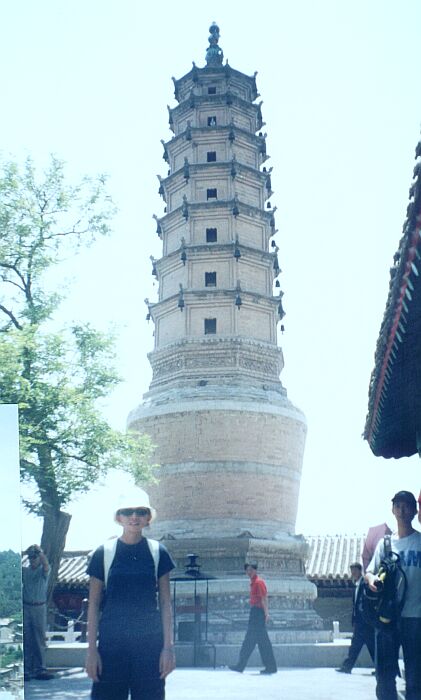
its territory. To commemorate the monk, a snow-white Buddhist
pagoda within a temple was constructed on top of the mountain,
hence the name of the mountain. Since then it has become a
well-known religious site. It's a pity that the original pagoda
fell apart in late Yuan Dynasty. "The Chronicle of the
Renovation of White Horse Temple" records that the existing
White Pagoda was reconstructed in Jingtai Reign of the Ming
Dynasty (1450-1456). It's a solid brick pagoda formed by two
well-joined parts: the lower part in the shape of an upside-down
basin, and the upper part, a tower, with a height of 17 meters in
total. Founded on a round base, it's seven-tiered and octahedral,
with upturned carved roof corners in dragon-head shape on each
tier.
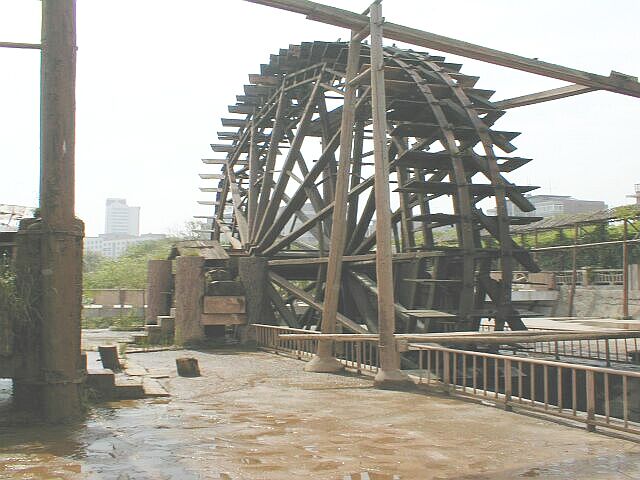
Inside the park lies a replica of a Water
Wheel, which is the oldest irrigation tool used by the peasants
who lived along the Yellow River in the ancient days. The
diameter of the Wheel was 16.5m and was usually turned by the
fast flowing river when the water level was high. The river water
was then transported via undulating ducts connecting the Wheel to
the lands.
Situated in the City of Wu Wei is a
majestic group of architecture that resembles that of the Chinese
Palace. It was started building in 1439 A.D. and was subsequently
rebuilt and enlarged. It now has an area of 1,500 square metres.
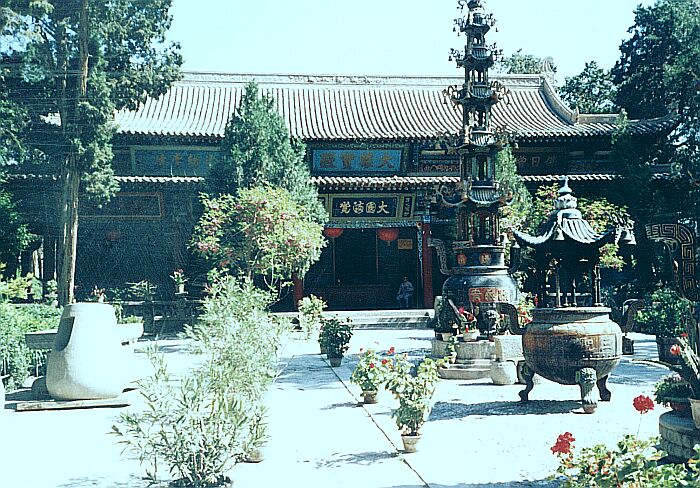
The temple is to commemorate the ancient wise man Confucius and
at the same time, serves as a museum. A unique part of the
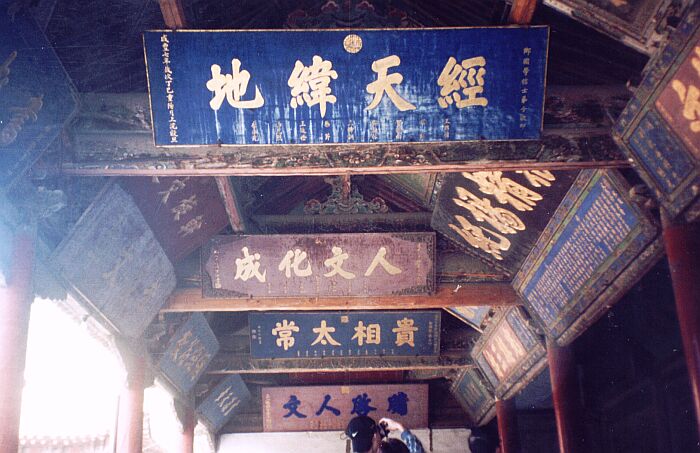
building lies in a roof which hangs a to t al of 44 ancient sign
boards of wooden tablets usually placed on top of a doorway at
the main entrance. They were discovered behind a false ceiling
deliberately hidden and hence survived the Cultural Revolution.
Their values are enhanced by the writings o n them, by famous
calligraphers. In the temple, there is also a precious stone
tablet which serves as the most complete tool for the translation
of unique Xi Xia language.
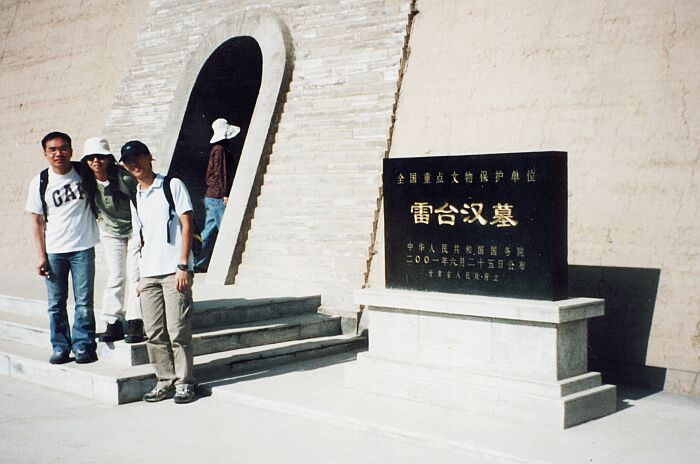
The owner of the tomb was unknown except
the fact that he\rquote s a General with surname
"Zhang". It was famous for the artifacts that were
excavated from it, which includes gold, silver, bronze, metal,
jade, bone and stone and Chinaware that gave a total of 231
pieces. Out of which the most famous will be a bronze f igurine
of a horse which was to become the emblem of the China Ministry
of Tourism. The original is now on exhibit in the Museum of Gan
Su.
The Big Buddha Temple lies in the
northwestern end of the city of Zhang Ye and was built during the
Xi Xia Dynasty around 1098 A.D. It is now the only known Buddhist
structure left from the Xi Xia era. It has an area of 23,000 sq
uare metres and once housed more than 10,000 monks. The Big
Buddha Temple is not only a valuable asset to the study of
western Buddhism with its numerous rare complete sets of Buddhism
manuscripts, but also the home to the Largest reclining Buddha in
China , with a length of 34.5m, together with his ten disciples.
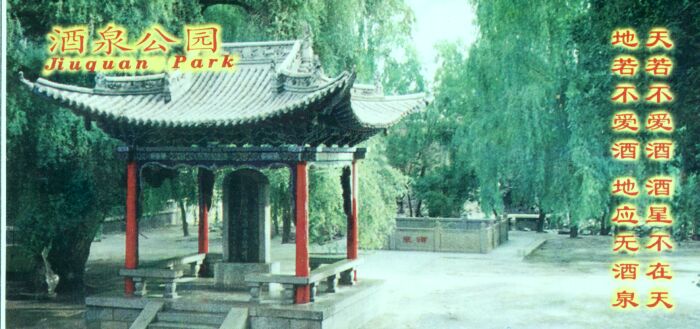
About 1 km from the east gate of the City
of Jiu Quan (meaning "wine spring" ), lies the Quan Hu
Park. Passing along a corridor made of grape vines and through a
door known as the "Moon door" , we will reach a famous
stone tablet. It was set up during the Qing dynasty and it
depicts a famous story about the spring which lies just behind
the tablet: The original name for the spring was Jin Quan
(Goldern Spring). In 121 B.C, General Huo Qiu Bing defeated the
barbarians and Emperial wine was awarded to the victorious
soldiers. However, there wasn't enough for the large numbers and
thus it was poured into a spring for every soldier to enjoy.
Hence the name "wine spring" . Two thousands from now,
crystal clear water still appears from the spring.
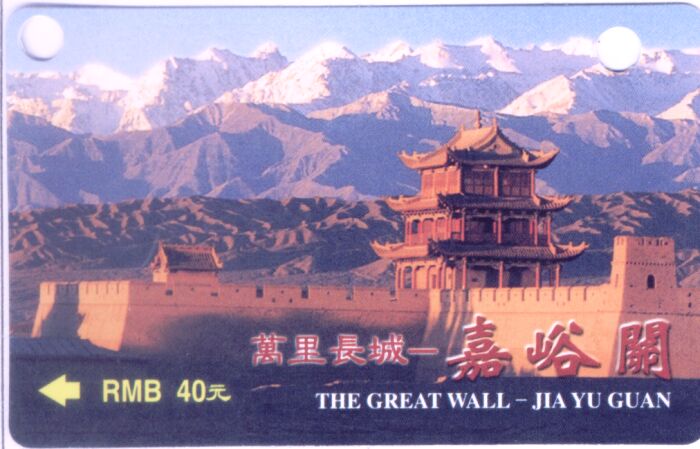
It is said that Laozi
was the earliest traveler to make the journey through the pass.
Back in the fifth century BC, Laozi, the supposed author of the
great Chinese classic of Taoist thought, the Dao De Qing, rode
his black buffalo out of the Hexi Corridor into the oblivion of
the Western Regions when he was disill usioned by the social
reality. It was not until 400 years later during the Han dy nasty
that Zhang Qian went through the Jiayuguan Pass, opening up the
route to traders, pilgrims and later envoys from the Western
Regions. \line However, according to records, Jiayuguan was a
pass, not a city, which served as a checkpoint against smuggling
til l the Ming dynasty.
During the 14th
century, the last of the Yuan armies were driven out of the Hexi
Corridor due to the great efforts of a Ming-dynasty army under
the command of General Feng Sheng. In order to keep the Mongol
out beyond the Great Wall, General Feng started to build and
reinforce the wall in 1372, along with which a fort was
constructed, known as "the Greatest Pass under
Heaven.". The complex, with the imposing walls 10.7 meters
high and 7333.3 meters in perimeter, formed the westernmost
extreme of the Great Wall during the Ming dynasty. It has inner
and outer ramparts, with bowmen's turrets and pavilioned watch
tower.
Once in the outer
ramparts there were barracks, storehouses, a temple to the God of
War, a theatre for entertaining the troops, and a freshwater
spring. However, little remains except the theatre and a museum
which was the temple in the past. At t he eastern end of the fort
is the three-storeyed Gate of Enlightenment and in the west the
Gate of Conciliation. Over each gate stand 17-meter-high towers
with upturned flying eaves. On the inside of both gates are horse
lanes leading up to the top of the wall. At all four corners of
the fort are the blockhouses, bowmen's turrets and watchtowers.
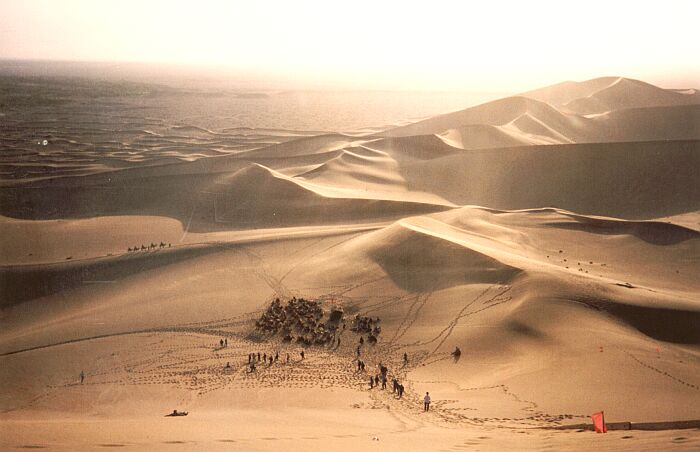
The climb to the top
of the dunes is sweaty work, but the dramatic view back across
the rolling desert sands towards the oasis makes the effort
worthwhile. Visitors can ride bicycles, hire a taxi and camel
rides usually can be arrange by local travel services. The
descent is quite simple - slide down. "Rumbling sands"
- a sound like thunder or a dr um-roll as the wind sweeps across
them. When you slide down along the sands, the thunder-like sound
is really fantastic!
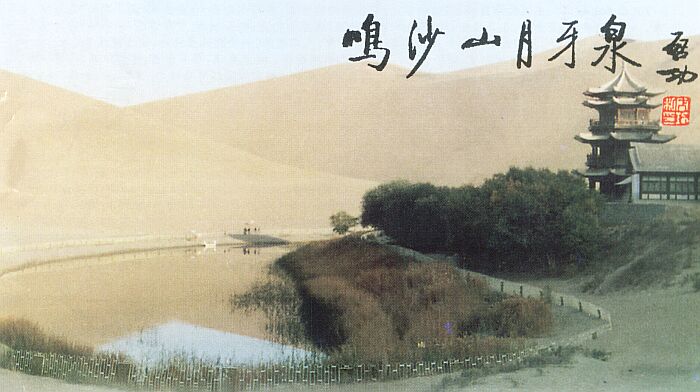
It has legend that in
ancient time a Chinese general had his army camped in the dunes
beside the Crescent Lake. Noise from the encampment attracted the
enemy, who attacked in the dead of night. The Han army be at
their war drums to call the troops to arms. Suddenly, in the
middle of the battle, a fierce wind blew up, filling the sky with
sand and burying both armies. This is why, to this day, the wind
blows across the sand's surface to the roll of war drums.
The lake is 6 kilometers (3.73 miles) south
of the center of Dunhuang nearby the Echoing-Sand Mountain, where
the oasis meets the desert. Spring water trickles up into a
depression between huge sand dunes, forming a crescent- shaped
pond (not to be confused with the concrete storage pool nearby).
The climb to the top of the dunes is sweaty work, but the
dramatic view back across the rolling desert sands towards the
oasis makes the effort worthwhile. Out here the recreational
activities include the predictable camel rides, the more novel
"dune surfing" (sand sliding) and paragliding (jumping
off the top of high dunes with a chute on your back). There is
also a tow-gliding operation closer to the entry gate: continue
past it if you want to jump off a dune.
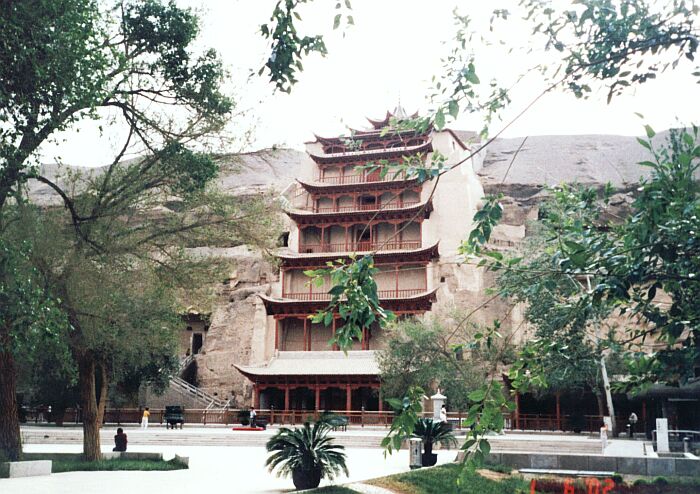
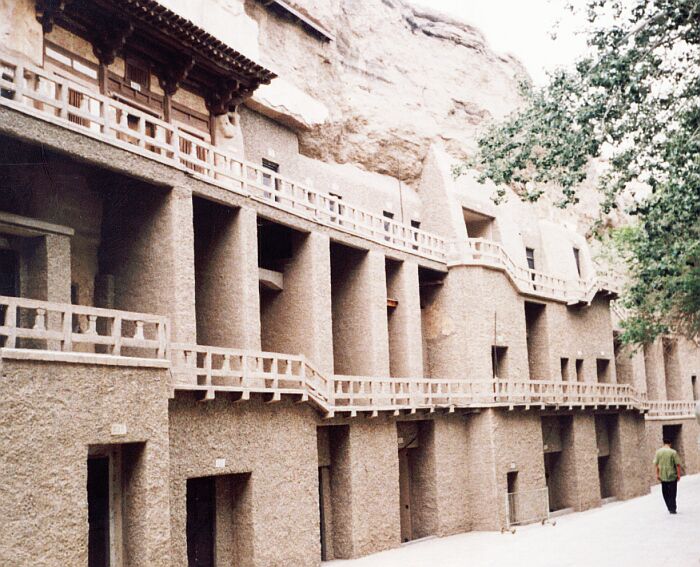
Mogao Caves, also called Mogao Grottoes or
the Caves of A Thousand Buddhas, are set into a cliff wall of
Echoing-sand Mountain about 25km southeast of the oasis city in
the Gobi desert, Dunhuang. Th e honeycombed caves, enjoying a
millennium long construction from the 4th to the 14th centuries
and marking the height of Buddhist art, are the world's richest
treasure house of Buddhist sutras, murals and sculptures.
At its height, the
cave complex had thousands caves. A total of 492 grottoes remain
after thousand years vicissitude, covered with
45,000-square-metre fascinating murals. There are also 2,400
painted statues and over 250 residential caves. Almost every
grotto exhibits a group of colorful clean-cut paintings of Buddha
and Bodhisattvas, and other religious paintings, or social
activities of different dynasties. The caves carved on the cliff
wall provide voluminous research materials for the study of all
aspects of the social life, such as religion, art, politics,
economics, military affairs, culture, literature, language,
music, dance, architecture and medical science in mediaeval
China.
The splendid culture
and art unearthed here stimulates worldwide interest and now a
new international subject called Dunhuangology forms. The mural
paintings remained can be divided into seven categories,
including the jataka stories depicting beneficence of Sakyamuni
in his previous incarnations, sutra stories depicting suffering
and transmigration, traditional Chinese mythology and so on.
Although the religious scriptures are primarily Buddhist, written
in Chinese, Uygur, Tibetan, Turkic and other languages, they are
not limited to Buddhist. Taoist, Manichean and Confucian scrolls
are also part of the collecti on.
Unfortunately, due to
the corrupt and impotent governments after the later Qing
dynasties, Mogao Caves has been plundered of most treasures of
the treasure trove by heinous thieves like Aurel Stein, Paul
Pelliot, Langdon Warner and Albert von Le Coq by theft, mostly,
and unfair transactions. Then they were transported to Britain,
Germany and other places.
According to history
record, in the year 336, a monk called Le Zun came near
Echoing-sand Mountain and suddenly had a vision golden rays of
light shi ning upon him like thousands Buddhas there. He started
to carve the first grotto to memorize the accident and show his
respect to the Buddha. Other pilgrims and travelers followed for
the next thousand years. During the Northern Wei dynasty found by
Turkic speaking Toba tribe, pilgrims restarted to hew grottoes
after proceeding years of turmoil with reflection of their ideal
heaven world of the painful material world. Now there are 40
Northern Wei caves left. Shadows of Indian Buddhism still can be
seen from the clothing, hair and facial features of Buddhas.
The finely chiseled
sculptures in the Wei caves show large heads, wide faces, large
noses, thin lips, high cheekbones and curly hair, with slim and
ethereal figures. The females are high breasted. The Buddhas,
bodhisattvas and disciples are quite and serene, in strong
contrast with the aggressive and fierce devilsThe Wei paintings
often depict the patrons who paid for cutting caves as servants
of Buddhas or supplicants, usually small in size.
In the short
lifespaned Sui dynasty, Mogao Caves continued to boom and marked
the end of foreign influence and transited slowly to the more
indigenous styles of central China. There are now 78 Sui caves
left. The statues produced then are mostly in good condition and
more formal than the Wei statues. Fuller face, longer earlobes,
loosely draped clothing and disproportionate upper body show
typical Sui style. Jataka stories are still the main theme while
more varied subjects appear. The feitian, or asparas become more
pretty and elegant and gain perfect images. Lotus flowers and
other symmetrical patterns are frequently used as decorations on
the ceilings.
By the Tang dynasty,
the caves welcome their most splendid time. There are still more
than 220 Tang caves. These caves reflect the highest artistic
achievements. Most caves are square and have three levels to
lodge bigger sculptures which were gradually neglected than
paintings during the Tang dynasty, but artistically successful in
accomplishment, gentle and realistic. The flying apsaras finally
reach highest artistic achievements. Buddhas come to have less
distinction with men and they wear ornaments and jewels and
dressed like Tang nobles. The images of patrons become bigger and
tend to occupy important places in the murals. The themes of
murals have more stories of Buddhist scriptures instead of jataka
stories. Cruising scene of aristocrats make its debut as painting
theme also.
During the Five Dynasties, there was no
place left on the cliff, some caves were enlarged or repainted.
As a result, old paintings have thus been discovered lying under
new ones. Surprise to the discovery is all these dynasties left.
Many caves were restored during the Yuan dynasty. The murals
depict various Indian mandalas and bodhisattvas. Some caves were
dec orated in Tibetan style. After the Mongol reign, there was no
artistic development. In the Ming dynasty, Dunhuang was once
abandoned, and the caves gradually faded into the sand of the
Gobi desert until the idiotic Taoist priest discovered the
treasure ho use in beginning of the 19th century.
Only one cave
concerned with this period dating back to the end of the Northern
and Southern dynasties.
Period 2
Caves numbered 14,
15, 16, 17, 28, 29 present main feature of the period from the
mid-Tang. Unique murals in Cave No. 17 called
"Transformation in the Hell" somewhat like paintings of
Manichean and the ancient instruments shown in the mural
depicting "Female Dancers on Performance" in Cave No.16
are known as the solo in Buddhist grottoes throughout China.
Period
No. 3
The period presents
murals and grottoes from the end o f Tang dynasty, Song dynasty
and Huigu reign of Gaochang Kingdom. Caves numbered 8, 9, 22, 23,
24, 27, 31, 33, 34, 35, 36, 37, 38, 45 , 46, 48, 49, 50 and 51
showed pictures depicting the King and Queen of Huigu and nobles
and the daily life of ancient Ui g ur people. The
thousand-year-old murals inside the caves were in superb
condition, their colors rich and fresh; some showed Indian monks
in yellow robes, their names inscribed in Brahmi script.
Huge portraits of
Buddhasat different periods throughout history, and figures of
foreigners presenting gifts to the Buddha have been found.
Inscriptions in the ancient Huigu, Chinese and Brahmi languages
are of high value for research on the history of Uigur and other
minority groups in Xinjiang. The murals depictin g "Buddhist
disciples wailing in mourning" and "Bhikku wailing in
mourning" on the back wall of the Grotto No.33 boast rare
artistic pieces expressing the insight feelings of the figures
with vivid images and individual characteristics.
Period
No.4
Cut during the end of
Huigu reign of Gaocheng Kindom and the Yuan, caves numbered 16,
39, 40, 41, 42 mainly yielded murals of figurines revealed such
aspects of daily life as traditional costumes, customs and riding
accoutrements of Mongolian Huigu. The Bezeklik Thousand-Buddha
Caves became an important cultural spot protected by the state in
1961.
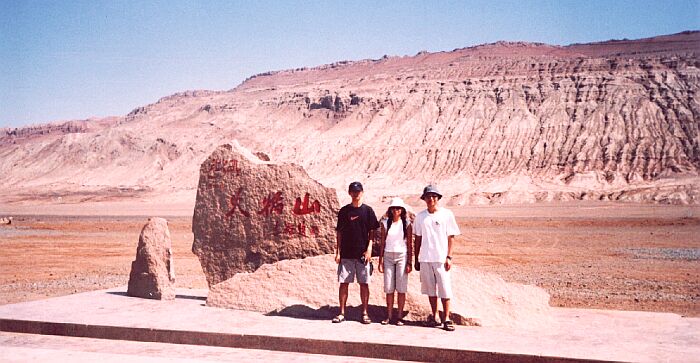
In the famous 16th
century Chinese classic novel Journey to the West by Wu Cheng'en
describing four monks in Tang dyna sty adventuring the west, Xuan
Zang and his companions, Pigsy, Monkey and Sandy, attempted to
cross the Flaming Mountains. They could not penetrate the flames
and Monkey procured a magical palm-leaf fan from Princess Iron
Fan, wife of the Ox Demon King (two fiction figures in the novel)
and waved it 49 times, causing heavy rains to extinguish the
fire. More anecdotes tell that to cross the Flaming Mountains,
Monkey burnt his tail, and ever since then all monkeys have had
red bottoms.
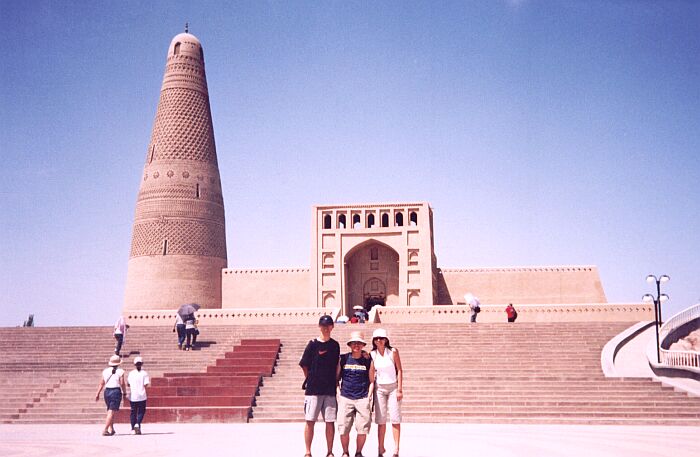
The plain sun-dried
bricks taper skywards in patterns of rhombuses , ripples and
varied four-petal flowers. On the surface of the cone small
windows open in all sides. A seventy-one-step stair spirals
upwards from the 10-meter- (32.8-foot-) diameter base to the top.
There is a good view of the area from the second-storied balcony
above the mosque. At the entrance a free-stand tablet records the
history of the tower both in Uigur and Chinese. The adjoining
mosque, the biggest mosque in Turpan, has a beamed ceiling
supported by simple wooden pillars and a domed scared area. The
hall in it can hold up 1000 people and serves as an important
hive for religious Festivals.
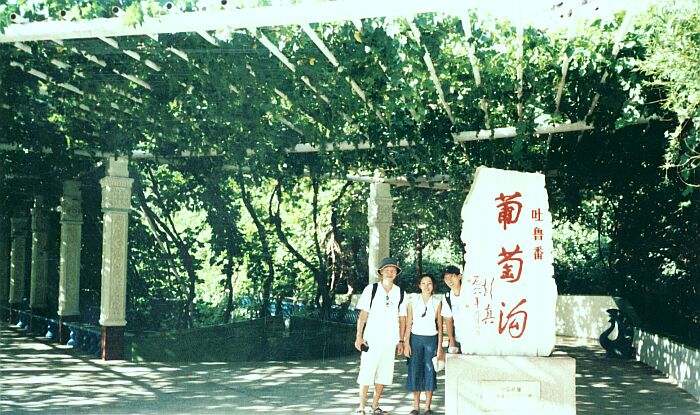
Fruit vinery nearby
produce purewines and canned grapes. Bicycle is an ideal choice
for the trip to the Grape Valley if you leave early enough to
avoid the intense afternoon sun. Trellised walkways overhung with
bunches of grapes, and patios with a poetic flavor to the idyllic
beauty give you refreshment and relaxation. Scattered everywhere
are trees: mulberry, peach, apricot, apple, pomegranate, pear,
fig, walnut, elm, poplar and willow; also watermelons and
muskmelons. Reception centers where dense grapevines paths lead
to secluded places provide visitors places for rest.
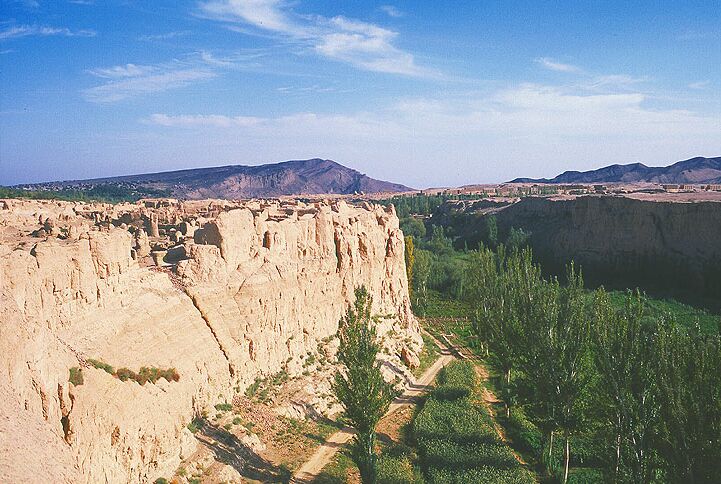
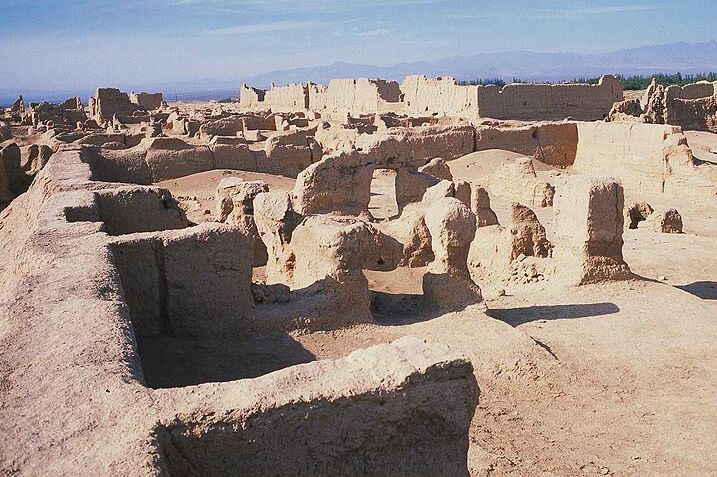
During the Western
Han dynasty, (an administrative division) was established and
from the period of Northern Wei to the beginning of the Tang, it
became Jiaohe Prefecture under the jurisdiction of Gaochang
Kingdom. Later, the Anxi Military Viceroy's Office, the highest
civil and military administrative organ in the Western Region was
set up here. During the mi d dle of the eighth and the ninth
centuries, Tibetans occupied the city. Afterwards, it was called
Jiaohe Prefecture under the jurisdiction of the Huigu Gaochang
Kingdom. At the end of the thirteenth century, it was destroyed
in Mongolian aristocratic rebel lions.
The dry climate
protects this ancient ruin. The enceinte, temples and workshops,
residential houses in the streets are still visible. A 350-meter-
(1148-foot) long, 10-meter- (32-foot) wide road divided the city
into the eastern and western parts. The road leads to a grand
Buddhist temple in the north-central part of the city. Forest of
towers in front of the temple remain intact, and the panoramic
view of the whole city on top of the tower is amazing. In the
southeastern part used to be office buildings and residences
built of bricks and tiles. A magnificent, half-underground,
two-storied complex is supposed to be the seat of Anxi's Military
Viceroy's Office.
Buildings in this
city have distinguished style that houses featured two-storied
without windows and doors on the wall facing streets and the
gates were hidden in deep lanes. The house was half-underground
and caves underground served as rooms. The city was brought under
the protectio n of the state in 1961.
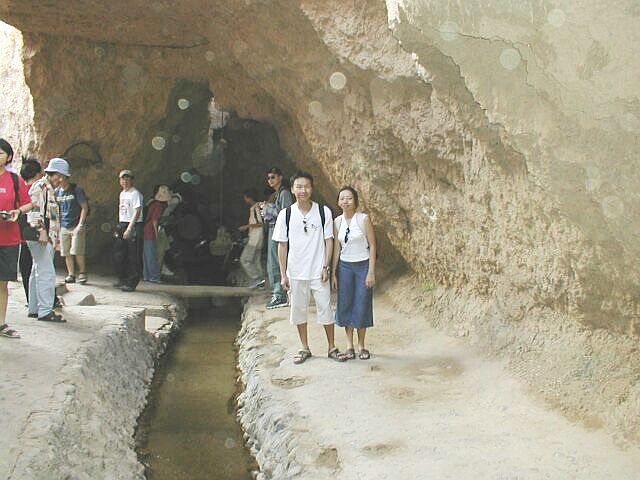
The ancient Karez
system is comprised of a series of wells and linking underground
channels that uses gravity to bring ground water to the surface,
usually far from the source. In Turpan county there are more than
470 systems, tota ling over 1,600 kilometers (1, 000 miles) of
tunnels. It is considered as one of the three great projects in
China with the other two being the Great Wall and the Grand
Canal.
Originally ancient
oasis towns depend on the streams and rivers nearby into which
glaciers in far-off mountains feed. As the glaciers gradually
shrank over the centuries, the streams they fed likewise
diminished, resulting in less or water flowing to the oasis
towns. Then people ingeniously created the karez to draw the
underground w a ter to irrigate the farmland. Wells begin at the
base of the mountains along the contours of the hillside. To keep
the underground channels unclogged, two men and a draught animal
work as a team - one man is lowed down to clear the tunnel and
buckets of mud are hoisted to the surface by the animal. The
tunnels slope less than the contours of the geographical
depression, so that the water reaches the oasis close to ground
level.
The water in karez
will not evaporate in large quantities even under the scorching
heat and fierce wind, hence ensuring a stable water flow and
gravity irrigation. The history of Karez can be traced back to
the Han dynasty. Recorded in the "Records of Historian"
- a chronological historical book writtten by Sima Qian, the great
Han dynasty historian known for his realistic records of
historical events, it was called "Well Canals". Most of
today's karezes in the Turpan were built in the Qing dynasty and
in after years. Nowadays, large stretches of fertile land are
still irrigated by karezes. The Wudaolin karez and the karez in
the Wuxing Town are open to visitors.
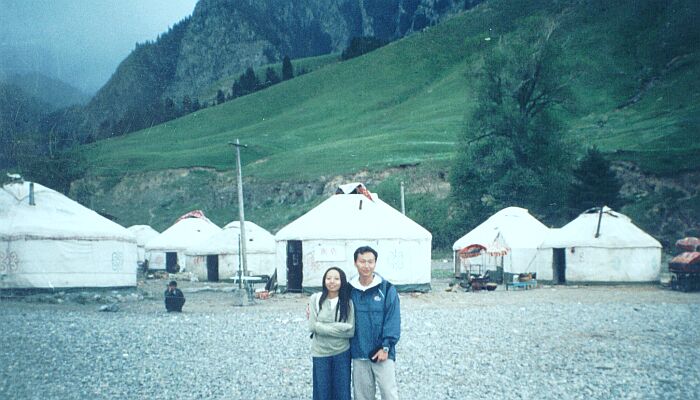
Screened by
snow-capped peaks and dotted with tall and straight dragon spruce
trees, it is an ideal place to have an excursion. The Kazakh
usually spend summer here between May a nd October and graze
their herds Visitors can take a horseback tour guided by local
Kazakh. In a traditional yurt, hospital host will welcome you
with fragrant milk tea, mare's milk, cheese and roasted lamb. The
horse-racing and traditional Kazakh dancing are amazing. More
spectacular landscape comes at the far end of the valley - a
2-meter- (6.6-feet-) wide waterfall cascades 40 meters (131 feet)
down, roaring with mist. It makes you feel refreshed and relaxed.
How to get there: Transport to this area can be a problem. There
are some buses from the north end of Renmin Park off Guangming
Lu.
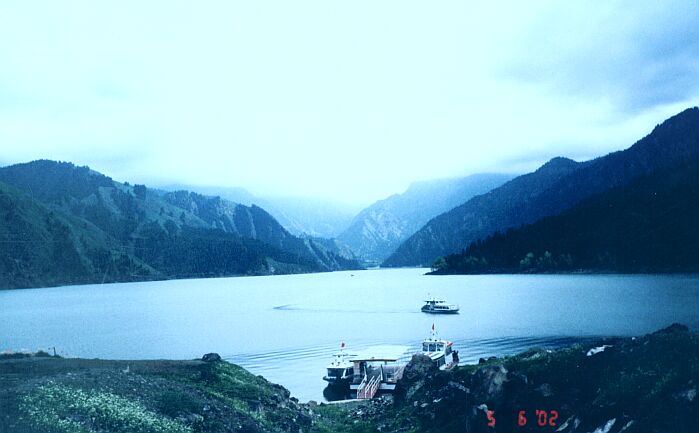
Covered firs, pines
and cypresses and white snow, it boasts a spectacular sight-
reminiscent of Switzerland or the Rocky mountains but somehow
with more vibrancy and color. Amidst fields of wild flowers grow
morel mushrooms, while peppermint and rhubarb, while higher up
the mountain are edelweiss and the rare, creamy Snow Lotus
(Saussurea involucrate), which grows from rock crevices and is
believed to have magical powers as medical cure. Tourists usually
spend one day, take a boat ride on the lake, ride or walk along
the lake shore. The wild and tranquil scene is stunning and
pristine. You can also stay in one of the many yurts owned by
locals, with a mat on the floor and a bowl of milk in the
morning. Buses leave daily from the bus station and the Hongshan
Park in Urumqi.
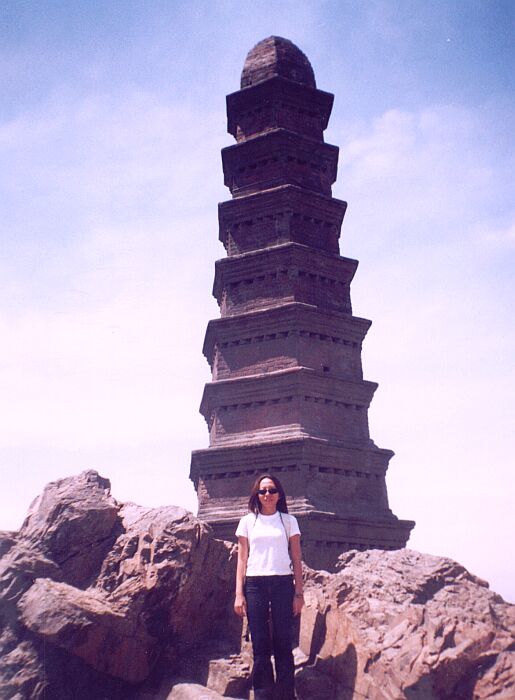
On the east bank of the Urumqi River, Red
Hill, 910 meters or 3,000 feet high, at the very center of the
city, resembles a mighty wriggling dragon. This reddish-brown
hill is dotted with small pavilions and at the top stands a
nine-storied, gray-brick pagoda called Zhenlong Pagoda (Pagoda to
Suppress Dragons), 8 meters (26.3 feet) high, facing Yamalike
Hill. It has a legend that in 1785 and 1786 the city suffered
from severe rive flood, caused, it was supposed, by a vicious
dragon. If the two mountains (Red Hill and Yamalike Hill) joined,
the Urumqi river would be blocked and drown the city. In 1788,
Shang An, the governor of Urumqi, had two pagodas built at the
top of each hill to suppress the dragon. Now the pagoda still
remains intact. There used to be many famous buildings on the
hill. During the time of the nomadic Oyrat Tribe, an
"Ebo" - the name for a kind of cairn used by the
tribesmen to worship and offer sacrifice to their gods was built
here; in the Qing, Temple of the Jade Emperor and Temple o f the
Great Buddha; Palace of the Dipper were built at the foot of the
hill. Those splendid temples used to hold Buddhist activities and
attracted swarms of worshippers. Unfortunately they were burnt
down by warlords later. Now with emerald greenery the Red Hill is
a landmark of the city.
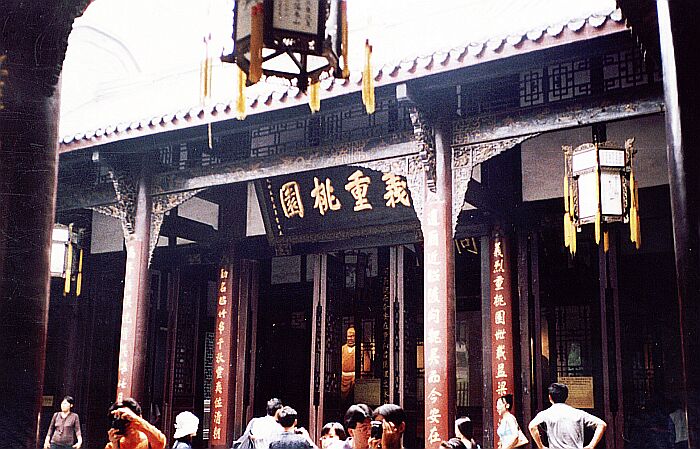 Temple of Marquis Wu, which is located in
the south of Chengdu, is a famous historical site dedicated to
the memory of both Liu Bei (161-223), Emperor of the Kingdom of
Shu in the Three Kingdoms Period (220-280), and Zhuge Liang
(181-234), Prime Minister of the kingdom.
Temple of Marquis Wu, which is located in
the south of Chengdu, is a famous historical site dedicated to
the memory of both Liu Bei (161-223), Emperor of the Kingdom of
Shu in the Three Kingdoms Period (220-280), and Zhuge Liang
(181-234), Prime Minister of the kingdom.