
Salamu Alaikum,
Prophet Muhammad[p] in Hindu Scriptures.
'Muhammad is not the father of any of your men, but (he is) the Messenger of Allah[GOD], and the Seal of the Prophets[Antim Rishi]: and Allah has full knowledge of all things.'
Al-Qur'an, 033.040 (Al-Ahzab [The Clans, the Coalition, the Combined Forces])
The following are few of many prophecies found of the Final Rishi, the Final Prophet, Muhammad[p] found the Hindu scriptures. All Hindus consider the Vedas, the Upanishads and the Puranas to be of Divine origin and the Words of GOD. If that is the case and the following prophecies are true then it becomes the duty of every Hindu to believe and follow the Antim Rishi who is without a doubt Prophet Muhammad[p].
Lets consider the following;
[Bhavishya Purana parv:3, Khand:3, Aday:3];
etasminnantare mleccha aacaaryayena samanvitam Mahaamad iti khyaatah shishya shaakhaa samanvitah
At that time a mleccha[foreigner] acarya, famous by the name Mahaamad [Mohammad], dwelt there accompanied by his companions.
raatrau sa devaruupashca bahumaayavishaaradah paishaacam dehamaasthaaya bhojaraajam hi soabravit
At night, he (Mohammad) of angelic disposition, this shrewd man in the guise of a Pishacha [desert], spoke to Bhoja Raja.
aaryayadharmohi te raajansarvadharmottamah smritah iishaagyayaa karishyaami paishaaca dharma daarunam
O Raja! Your Arya Dharma has been considered to be the best of all religions, but according to the commandments of the Supreme Controler[GOD], I shall enforce the strong creed of the Pishachas.
lingacchedii shikhaahinah shmashrudhaari sa dushakah uccaalaapii sarva bhakshi bhavishyati jano mama
My followers will see to it that men are circumcised[all muslims are circumcised] and that they wear no shikha on their heads. Instead they will wear beards[like muslims] and behave against brahminical principles. They will call out loudly in their prayers[Adhan]. They will eat all things.
binaa kaala caa pashavaasteshaaam bhakshyaa mataa mama naimusaleva samskaarah kushariva bhavishyati
According to my teachings, they will eat all animals except swine[Al-Qur'an 5:90]. They will not seek purification by sitting on Kusha grass, rather their purification will come by warfare. (Musal).
tasmaanmusalavanto hi jaatayo dharmadushakaah iti paishaaca dharmashca bhavishyati maya krutah
They shall be known as Musal[muslims] because of their battles with irreligious nations, and I shall be known as the originator of this pisaca-dharma.
Points to be noted;
1. He is a "mleccha"[foreigner, not an Indian].
2. The name of the Prophet above is "Muhammad."
3. A special mention is made of his companions.
4. His followers are circumcised.
5. They don't have a tail but rahter support beards.
6. They give the Adhan, the call for prayer.
7. They[muslims] do not have the flesh of swine.
8. They are called musalman[muslims].
There are many such prophecies about the advent of Prophet Muhammad[p] in Hinduism which will be posted soon inshallah. I think the above alone should be sufficient for any good Hindu to believe in the last Prophet, the last Rishi who is none other than Prophet Muhammad[p]. And this has been confirmed by many scholars such as Dr. Zakir Naik, A.H. Vidyarthy aswell by a well known Hindu Sri Sri Ravi Shankar.
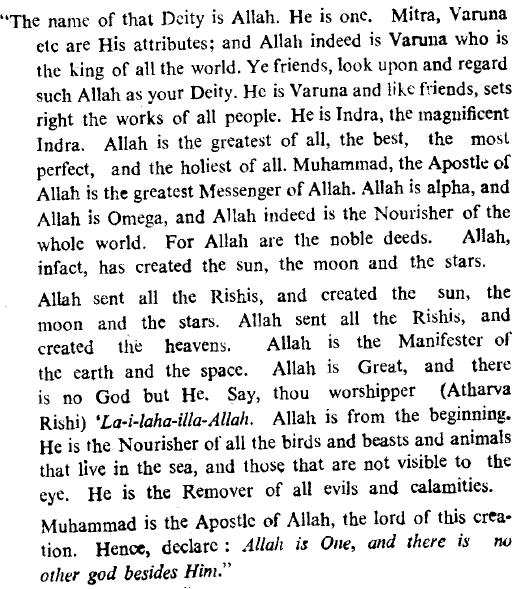
Allo Upanishad
Upanishads are one of the holiest scriptures of the Hindus. Some Hindu scholars even consider them above the Vedas. One of such Upanishads is the 'Allo Upanishad' and is translated as "Allah Upanishad." Its been translated in many languages and below is a print from a book by a Hindu scholar Nagendra Vasu [Vishwa Kosh (Encyclopedia Indica vol.2)];
Atharwa Veda
In the 20th Book of Atharvaveda, Hymn 127. Some Suktas (Chapters) are known as Kuntap Sukt. Kuntap means the consumer of misery and troubles. Thus meaning the message of peace and safety and if translated in Arabic means Islam. Kuntap also means hidden glands in the abdomen. These mantras are called so probably because their true meaning was hidden and was to be revealed in future. Its hidden meaning is also connected with the navel or the middle point of this
earth. Mecca is called the 'Ummul Qur�an' the mother of the towns or the naval of the earth in many revealed books it was the first house of divine worship where God Almighty gave spiritual nourishment to the world. The Holy Qur�an says in Surah Ale-Imran, Chapter 3, Verse 95.
'The first house (of worship) appointed for men was that at Bakka (Mecca) full of blessings and of guidance and for all kinds of beings'.
Another name for Mecca is �Becca�. Thus Kuntap stands for Mecca or Becca. Several people have translated these Kuntap Suktas like M. Blomfield, Prof. Ralph Griffith, Pandith Rajaram, Pandit Khem Karan, etc. The main points mentioned in the Kuntap Suktas that is Atharvaved, Book XX, Hymn 127, Verses 1-13 are:
Mantra 1: He is narashansah or the praised one (Muhammad).
He is Kaurama the prince of peace or the emigrant, who is safe, even amongst a
host of 60,090 enemies.
Mantra 2: He is a camel-riding Rishi, whose chariot touches the heaven.
Mantra 3: He is Mamah Rishi who is given a hundred gold coins, ten chaklets (necklaces),
three hundred good steeds and ten thousand cows.
Mantra 4: Vachyesv rebh, �Oh! ye who glorifies�
Mantra 5: The praying ones with their prayers hurry on like powerful bulls.
Mantra 6: O you who praises hold fast the wisdom which earns cows and good things.
Disseminate this among the divine.
Mantra 7: He is the king of the worlds, the best of men and guide for the entire mankind.
Mantra 8-9: He has procured a secure dwelling for the people, gives protection to every body and
has spread peace in the world.
Mantra 10: People thrive happily end prosper under his rule and from the depth of degradation
they rise to the height of glory.
Mantra 11: He is asked to wake up and warn the world.
Mantra 12: He is extremely bountiful and very generous.
Mantra 13: (His followers) have been saved from the hostility and robbery of the enemy and
May the Master not be harmed.
Mantra 14: We Glorify and praise the great hero with a song of praise and a prayer. Please
accept this praise so that evil may not befall us.
(i) The Sanskrit word �Narashansah� means �the praised one� which is the literal translation of the Arabic word Muhammad (pbuh).
The Sanskrit word �Kaurama� means �one who spreads and promotes peace� the holy Prophet was the �Prince of Peace� and he preached equality of human kind and universal brotherhood. �Kaurama� also means an emigrant. The Prophet migrated from Mecca to Medina and was thus also an Emigrant. He will be protected from 60,090 enemies which was the population of Mecca.
(ii) The Prophet would ride a camel, this clearly indicates that, it cannot be an Indian Rishi since it is forbidden for a Brahman to ride a camel, sacred Books of the east, Volume 25, Laws of Manu page 472 according to Manu Smriti, Chapter 11, Verse 202: "A Brahman is prohibited from riding a camel or an ass and to bath naked. He should purify himself by suppressing his breath."
(iii) (a) This Mantra gave the Rishis name as Mamah. No rishi in India or any other Prophet had this name �Mamah� is derived from �Mah� which means to esteem highly, on a revere, to exalt, etc. Some Sanskrit books give the Prophets name as �Mahamad�, but this word according to Sanskrit grammar can also be used in the bad sense. It is incorrect to apply grammar to an Arabic word. Actually Mamah has the some meaning and somewhat similar pronunciation as the word Muhammad (pbuh).
(b) He is given 100 gold coins, which refers to the believers and the earlier companions of the Prophet during his turbulent Meccan life. Later on due to persecution they migrated from Mecca to Abyssinia later when Prophet migrated to Madina all of them joined him in Madinah.
(c) The 10 chaplets or necklaces were the 10 best companions of the Holy Prophet (pbuh) known as �Ashra � Mubbashshira� (10 bestowed with good news). These were fore told in this world of their salvation in the hereafter i.e. they were given the good news of entering paradise by Prophets own lips and after naming each one he said (in Paradise). They were Abu Baker, Umer, Uthman, Ali, Talha, Zubair, Abdur Rahman Ibni Auf, Sad Bin Abi Waqqar, Sad Bin Zaid and Abu Ubeidah (May God be well-pleased with them).
(d) The third gift was 300 good steeds. These horses belonged to the Arab breed. The Sanskrit word �Arvah� means swift Arab horse, The 300 steeds refers to the 300 companions of the Holy Prophet who fought at the battle of Badar and came back victorious even though the enemies were thrice the number.
(e) The Sankrit word �Go� is derived from �Gaw� which means �to go to war�. A cow is also called �Go� and is a symbol of war as well as peace, the 10,000 cows refers to the 10,000 companious of who accompanied the Prophet (Pubh) when he entered Mecca during Fateh Mecca which was a unique victory in the history of mankind in which there was no blood shed. The 10,000 companions were pious and compassionate like a cow and were at the same time strong and fierce and are described in the Holy Qur�an in Surah Fatah, Chapter 48, Verse 29, �Muhammad is the Messenger of Allah, and those who are with him are strong against unbelievers, (but) compassionate amongst each other�.
(iv) This mantra calls the Prophet as �Rebh� which means one who praises which when translated into Arabic is Ahmed which is another name for the Holy Prophet (pbuh).
(v) He and his followers are always mindful of their prayers even in the battlefield. The Holy Qur�an says in Surah Baqarah, Chapter 2, Verse 45, "Nay, seek (Allah�s) help with patience, perseverance and prayer" The Holy Qur�an says in Surah Nisa, Chapter 4, Verse 102, �When thou (O Messenger) act with them, and standest to lead them in prayer, Let one party of them stand up (in prayer) with thee, taking their arms with them. When they finish their prostations, let them take their position in the rear. And let the other party come up which hath not yet prayed and let them pray with thee, taking all precautions, and bearing arms.�
(vi) The wisdom mentioned in this mantra refer to the Holy Qur�an. The Holy Qur�an earns good not only in this world but also in the here after. The Prophet (pbuh) is asked to propagate amongst his companions. Many of whom memorized the Qur�an.
(vii) All the attributes in this mantra apply to the Holy Prophet (pbuh) In Surah Al-Anbiya, Chapter 21, Verse 107 �We sent thee not, but as a mercy for all creatures� In Surah Saba, Chapter 34, Verse 28 �We have not sent thee but as a universal (Messenger) to men, giving them glad tidings, and warning them (against sin), but most men understand not.� In Surah Al-Qalam, Chapter 68, Verse 4 �And thou (standest) on an exalted standard of character.� In Surah Al-Ahzab, Chapter 33, Verse 21 �We have indeed in the Messenger of Allah a beautiful pattern (of conduct)�.
(viii) & (ix) During the reconstruction of Kaaba, the Prophet (pbuh) Through his wisdom prevented a war between the Arab tribe. The Prophet not only gave peace to the Arab land but also to the whole world. Even during the conquest of Mecca, the Prophet established peace without shedding a single drop of blood. He gave peace, shelter to the bitterest enemies and let them go by saying, �There shall be no reproof against you this day.�
(x) The Arabs were the most ignorant people 1400 years ago and it was referred to as
�Youmul Jahiliya�. The Prophet with his message brought prosperity and raised these
ignorant people and made them the torchbearers.
(xi) This Mantra gives the translation of the Holy Qur�an Surah Al-Mudaththir, Chapter 74, Verses 1-3 �O thou wrapped up (in a mantle)! Arise and deliver thy warning! And thy Lord do thou magnify!� The Prophet arose and warned the people and glorified the Lord.
(xii) The Holy Qur�an says in Surah Ale-Imran, Chapter 3, Verse 159 �It is part of the Mercy of Allah that thou don�t deal gently with them. Wert thou severe or harsh hearted, They would have broken away from about thee.� It was due to the Prophets (pbuh) kind-heartedness; mercy and generosity that people flocked around him otherwise the stubborn Arabs could never have been
won.
(xiii) This Mantra is a prayer of the Rishi for the Prophet (pbuh) a similar prayer is found in the last Chapter of the Holy Qur�an i.e. Surah Nas, Chapter 114, Verses 1- 3. �Say, I seek refuge with Lord and Cherisher of mankind, The King (or Ruler) of mankind, the God (or Judge) of mankind from the mischief of the Whisperer (of Evil), who withdraws (after his whisper) - (the same) who whispers into the hearts of mankind � Among Jinns and among Men.�
(xiv) In this last Mantra, the Rishi of the Veda makes it compulsory for the followers of the Veda to praise the Holy Prophet (pbuh) land follow him so that they will be saved from the evil of this world.
5. Battle of the Allies described in the Vedas. It is mentioned in Atharvaveda, Book XX, Hymn 21, Verse 6, �Lord of the truthful! These libatrous drinks these feats of bravery and the inspiring songs gladdened thee in field of battle. When thou renders vanquished without fight the ten thousand opponents of the praying one, the adoring one.�
Source: www.irf.net [Islamic Research Foundation]
Back to main