|
Think about the skills you have today - basic
motor skills like scratching your head, opening a jar of pickles, to
extremely complex functions like driving a car. Speech and language skills
are considered to be some of the most complex skills in the human
repertoire. And there are the more admired and highly regarded skills of
the advanced athlete, musician, and artist. Some of these skills appear
pretty mundane because we use them all the time and they don't bring us
big applause or sense of accomplishment (anymore) and others are just for
fun and some do bring us a level of exhilaration that keep us coming back
for more. All these things we have learned through what in the marshal
arts realm is called the path of mastery. Think about what it took to
learn anyone of these; parents (instruction) and hopefully enthusiastic
parents (made it fun) and repetition or practice. If you can learn these
skills you can become a master at just about anything.
George Leonard, in his book, Mastery,
outlines what Mastery really is and what it takes to accomplish some level
of mastery over just about anything. Most of his learnings and teachings
come from his experience as a long time marshal arts student and teacher.
His book has been extremely instrumental to me in becoming a significantly
better orienteer.
Leonard’s book is small, not a very difficult
read, and packed with lots of good stuff to think about and apply over
time. The book it divided into three parts:
1) The Master’s Journey (what is mastery)
2) The Five Master Keys
3) Tools For Mastery
And in several parts I’ll provide a summarized
version of Leonard’s ideas doing my best to map his ideas and analogies to
orienteering.
Part One: The Master’s Journey
I’m going to change the order of things for a
bit and talk first about what we really want to do in orienteering. There
is a decision to be made, if we haven’t already made it subconsciously. Do
we like orienteering and are we going to stay with it. Assuming you’ve
decided to stay with it the decision is what level will you participate?
You can dabble, you can obsess, or you can master.
Going for the Mastery means more than dabbling, more balanced and less
intense than obsessing, yet demanding time, consistency, and practice -
not like practicing for 30 minutes everyday - well, kind of - but more
like a doctor "has a practice". It's just what they do.
How we participate in life is a question that
comes up in our lives over and over. It’s ok to dabble – this allows us to
experience a number of different things in life without having to be a
professional at each of them. We live in fast times and like to do a lot
of things, however, time is limited and we can only do so much – which
activities will we choose and why? But it's good to have something, maybe
a couple of things, in life for which we go for some level of mastery.
Their is a richness that comes with the
territory of mastery that just can't be found on either of the other two
paths. Goals and accomplishments are good things. However, they usually
exist in the past or the future. The "practice" is always in the present.
The tough part of this decision is that we are
conditioned in our culture to value the quick fix – which can only provide
the illusion of accomplishment and only a scent of satisfaction. Leonard
makes a strong case that the only real short cut to true mastery is a
long-term approach – what I would call a moderate long-term approach. What
happens when you take a short cut off the short cut? We either never get
to our intended destination or we end up taking a much longer route. (And
if you are going to take a true short cut it really helps to double check
that you are in fact on the right path; I tried taking a short cut my
first time climbing King’s Peak in Utah. 30 minutes up a bolder field only
to have to climb down at least 30 minutes to get back on the trail and
then double-timing to try to catch Jim- now about an hour ahead.)
Mastery starts with baby steps – identifying the primary tools and skills
needed; where are all the controls on the car and what do they do; doing
laps in a parking lot with someone watching and instructing us. In
orienteering – what are the essential tools – the map, the compass, and
the coach or mentor. The primary skills – map reading, taking a bearing,
pace counting and later (a strategy skill) route choice. The former
needing to be mastered before the later. That is, route choice isn't going
to be incredibly valuable if you take off in the wrong direction or you
don't know what the green hash marks mean.
Leonard recommends not competing to win until
you have a reasonable control over these primary skills. The process is
incremental and you can’t skip stages. Leonard also makes the case that
barring medically diagnosed mental limitations, we are all geniuses and we
can all achieve mastery. There will be moments of frustration and moments
of exhilaration – most importantly you will learn more about yourself in
the process than you can imagine - if you're paying attention.
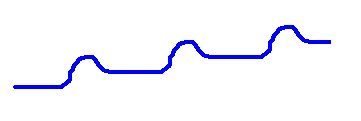
Here is a quick summary of the Master’s Curve.
The generalized curve is a plateau (over time) with short spurts in
growth, immediately followed by what looks like a minor set back. In other
words, lots of time at one level, then all of a sudden it looks like 4
steps forward and then a settling into 1 step back (or only three steps
forward.) And then, more time at the next plateau. Again, the process is
incremental. You can’t work on route choice (effectively) until you have
foundational skills pretty well under control (map reading, taking a
bearing, and pace counting.) And at each new level we probably experience
another round of frustration as we have to start “thinking” again – at
least thinking again in a new way - taking our "practice" to a new level,
which may give the illusion that things are temporarily falling about.
.
Over
time, the
journey, for many, seems to achieve a certain richness or higher quality (as does the student)
when the whole person becomes involved and integrated into the activity –
a graceful sense of purpose when the muscles, mind and spirit join
together in unison – which orienteering offers quite naturally.
¨
|