 Boards Boards
|
I do a lot of programming and electronics work at home. I have the capability to design and fabricate printed circuit boards, and to write code to use them with Windows based PCs. Before I had a CAD program to help, I used standard 8 bit PC cards, wire wrapping, or the tape method. Here are some of my past projects. |
MIL-188C/RS-232C Converter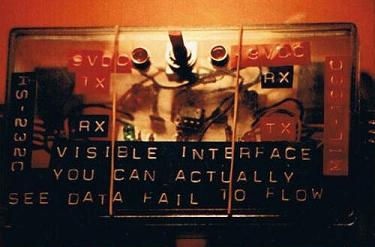
This device allows the use of PCs in US military communications. At the time I created it, there was no other way to do this. It was extremely useful. Return to top |
RS-232C Breakout Box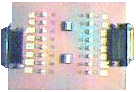
This is essential if you plan to write RS-232 communications code, or if you just want to troubleshoot an RS-232 connection. Return to top |
8 Channel 8-bit Analog to Digital Conversion Board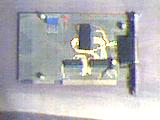
I purchased an Analog Devices AD7828 chip for about $25 in 1993, and built this board for about $60 total. It performs very well, and with the proper input scaling and isolation, it can digitize just about anything you'd like. The code was very simple to write. I have written routines that enable QuickBasic 4.5 to use the card, and if the chip weren't such a dinosaur, I'd write a Windows driver for it. If you'd like to build boards like this, I recommend Interfacing to the IBM Personal Computer, by Lewis C. Eggebrecht as a good starting point. Return to top |
HAL-4 EEG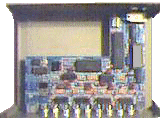
HAL-4 isn't one of my projects. It was built from a Circuit Cellar kit. I have a project involving HAL and my SoundBlaster PCI-128. It uses the DirectSound API, which I really like. DirectX is an excellent set of APIs to work with, and the research has been going very well. I have been able to use the system to sleep learn material, and am attempting to incorporate the Lozanov learning method into the code. It is also able to record and play affirmations as background audio behind an audio CD. If you want to use DirectX, check out the book Inside DirectX, by Bradley Bargen and Peter Donnelly. I highly recommend the Inside series. Return to top |
X-Y Table for PC Board Drilling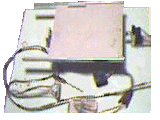
This project is a good example of synchronicity. I had this idea about using stepper motors for drilling PC boards, but I hadn't acted on it much. I had used an 8255 (This is the chip that PC printer ports are based on.) and built a 24-bit digital I/O card. A few months later, I read a series of articles on the same thing. At some point later, I found the book PC Hardware Projects, Volume 2, by James "J.J." Barbarello. He had the mechanicals down while I was still noodling around. I substituted 1/4"-20 threaded rod because I had used 100 step per revolution motors. It is a good arrangement because each step will be .0005 inch. The only real trouble with this system is that is is slower because the motors stall if you step them too fast. Here I have the drill transport axis removed. I am modifying it to add a Z axis. (This way I can leave the system unattended.) Return to top |