The information paradox
Research by:
RAdm. R.M. Wey
and
FCapt. D.L. Wey
of the Office of Scientific Research
Various articles on the subject of black holes have been written over the years by the OSR, from their existence as a whole, to their existence as the explanation for galaxy formation. It is considered by many to be an axiom that ‘nothing’ ever escapes the gravitational pull of a black hole. Yet, research conducted by this office has shown that ‘theoretically,' this is not necessarily so.
Recently, a paradoxical problem with relation to black holes came to the attention of the OSR. What happens to information that has fallen into the gravitational influence of a black hole? Is it forever lost, or can it somehow be retrieved? One must consider ones answer carefully; For depending on ones' position, a serious conflict between the general theory of relativity and quantum mechanics arises.
Yet throughout the scientific community, many of its members have taken opposing views. Dr. Stephen Hawking, of the University of Cambridge, is a noted authority who favors the ‘all is lost’ position, while Dr. Gerard ‘t Hooft of Utrecht University, another authority, ascribes to the tenet that ‘if one accepts that ALL is lost, then quantum mechanics is lost as well’; And they are not alone.
It has been said of the black hole, that it is
likened to a river leading to the cascade of a waterfall. There comes a point where the flow of rushing water is greater than an objects' ability to oppose it. When that happens, the object is lost.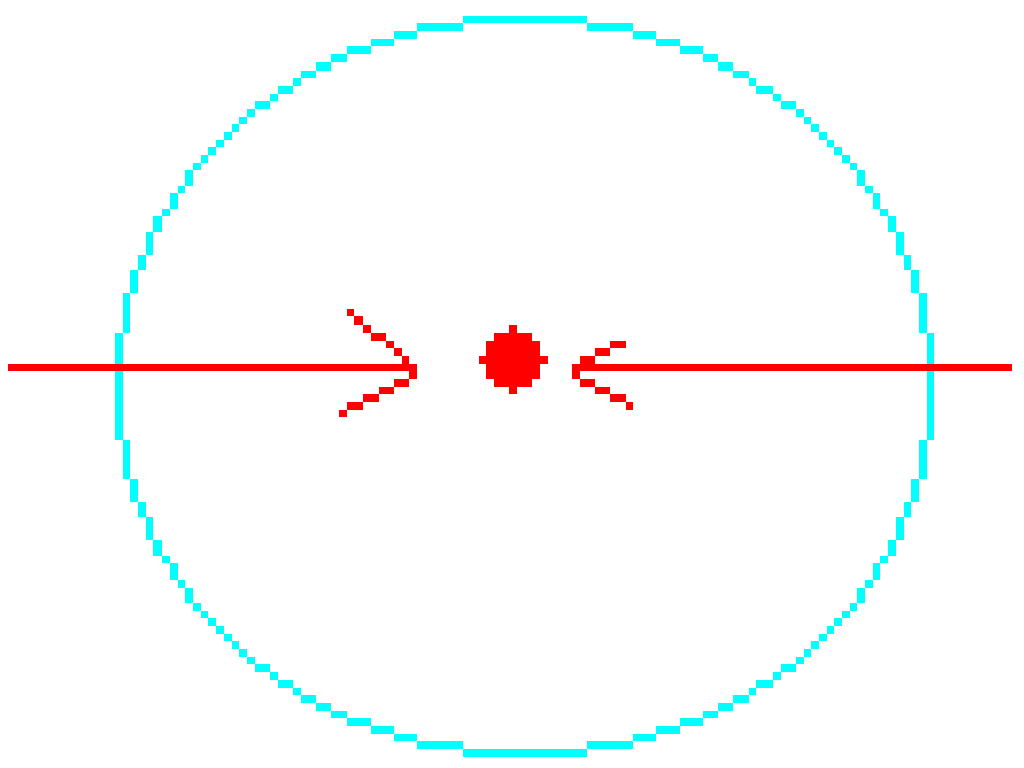
singularity [dot in center] rising pull of gravity [arrows]
Horizon: Point of no return[outer circle]
Of course, there are those who believe that all this talk of what happens inside a black hole to be merely academic…or[dare I say it]theological. However, there are processes that occur within a black hole that are extreme examples of the interactions of elementary particles.
For if such particles possess sufficient ‘Planck’ energies[named for the German physicist(one of the originators of quantum mechanics)], those above 1028 electron volts, head on collisions would subsequently create and annihilate black holes almost immediately. However, it is the separation of the event horizon from the singularity itself that is of interest here[see diagram, previous page].
For it has been postulated that, if an object were traveling at the speed of light, and it were to ‘skirt’ the event horizon, it could escape with more velocity than it arrived with. However, were it to miss, and cross over, the object would never notice[much like the diagram on the previous page], yet it would forever be lost.
This is, in essence, due to the properties of a black hole at its event horizon; These consist of electrical conductivity and viscosity, as well as heat. Referred to as the Hawking temperature[named after the Cambridge Professor, and postulated by Dr.’s Hawking, Unruh and Bekenstein], it is measured as an inverse proportion of a black holes' mass.
Subsequently, a black hole of one solar mass would have a temperature of 10-8 degrees[which is far colder than intergalactic space], yet the closer to the horizon one measures, the higher such measurements get. Such hot objects are endemic to entropy. Thus, like other hot bodies, a black hole must radiate energy and particles into the surrounding space.
Such ‘bleeding off’ of energy is confined to the event horizon, and therefore does not violate the rule that says ‘nothing escapes a black hole’. However, it does cause the black hole to lose energy and mass, so that over time, an isolated black hole would radiate away all its mass and vanish.
In the theory of black hole complementarity[a new principle of relativity]it is possible for information to be both destroyed and radiated back. It is in the discipline of ‘string theory’, that the possibility arises. Each minute segment of string[which measures a mere 10-33 centimeters across]functions like that of a bit[a term used in computing to describe a unit of information storage capacity], thus strings provided the means in which the event horizon could hold immense amounts of information during its existence.
It is this merging of both string theory and quantum mechanics which may well bring about a quantum theory of gravity and fuel the ongoing revolution of physics.

