5-28-98
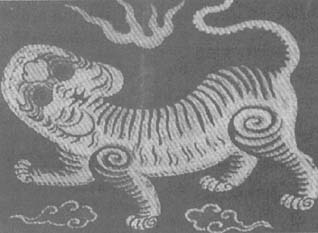
Original Taiwan Republic Flag of 1895
A lot has been said about "The Taiwan Question" or "The Taiwan Problem". But in reality the problem is not with Taiwan, but with the mainland and their one party communist party government.
Here is an opinion-analysis piece that presents a view from Taiwan about this "mainland problem". In a nutshell, the "mainland problem" is that Taiwan is a free prosperous country. But the communist party of mainland China just 100 miles or so to the west of Taiwan, claims that Taiwan is part of the People's Republic of China. And they have threatened to use military force to invade Taiwan if the people of Taiwan don't acquiesce to their wishes. The Chinese communist party (CCP) have tried to reinforce this point by shooting missiles at Taiwan in just the last three years.
The article delves into the history of this situation where the old time Nationalist Party that lost the Civil war on the mainland shared the communist's conviction that Taiwan was part of China and how this has lead to all countries having a "one China policy" where either the Republic of China (Taiwan) or the People's Republic of China (mainland China) is recognized. This comes from pragmatism on the part of the other countries, not any true belief that Taiwan and the mainland are part of the same country.
The article also touches on some of the bogus analogies made by the pro-CCP side in their arguments and the counter-productiveness of the hardline CCP policies. One possibility is that if the CCP actually got its' way, it could lead to violent situations akin to that of the Middle East or Northern Ireland.
It also touches on one of the stranger aspects of the CCP policy toward Taiwan in that the issue is couched in quasi-religious terms when they refer to Taiwan being part of the "sacred territory" of the PRC.
Please read it and enjoy and be free to comment. Our thanks to Mr. A for submitting it.
by
Mr. A
Most people are familiar with independence and self-determination movements throughout the world. Occasionally one may hear about Tibet, Quebec, Palestine, and Northern Ireland. Many Americans can identify with the conflicts in Palestine and Northern Ireland because a significant part of the American population are of Irish and Jewish origin. In Hollywood, actors like Richard Gere champion the cause of Dalai Lama and Tibet. Yet, there is another independence movement that Americans are probably less familiar with: the Taiwan independence movement.
Many Americans who are unfamiliar with the conflict between China and Taiwan probably think that Taiwan is an independent country because many reference books and maps do categorize it as independent and because visitors and immigrants from Taiwan claim that they come from Taiwan rather than from China. However, there are sources that suggest Taiwan is not a country. According to the World Business Directory, Taipei, Kaohsiung, and other Taiwanese cities are located in the People's Republic of China (PRC) (Vittachi 42). News wire services often use the phrase "China considers Taiwan as a renegade or rogue province and has threatened to use force if it declares independence" (Taiwan Communique "Press Distortions"). Additionally, the US official position of Taiwan is "There is one China. Taiwan is part of China. The People's Republic of China is the sole legitimate government of China." In books published by the Taiwan government, Taiwan is said to be part of the Republic of China (ROC), although sometimes these books treat Taiwan and the Republic of China to be synonymous.
All the conflicting information about Taiwan leads to obvious questions about Taiwan's ambiguous status: is Taiwan a country, state, or province? Does Taiwan belong to an alternative China rather than the People's Republic of China? Is Taiwan trying to secede from the People's Republic of China? Some of these questions may be answered through a history of Taiwan's relationship with China in the Appendix. As for the answer to the question "Is Taiwan a country?", Taiwan, regardless of its official name , is an independent country and should remain an independent country; the PRC can actually gain some long term advantages by accepting and tolerating Taiwan's sovereign independence rather than forcing it to become part of the PRC.
A political geographic theory called the nation-state theory helps defend the claim that Taiwan is a country and that it is not part of the country known as the PRC. The theory provides separate, distinct definitions of a nation and state, even though most people use the words interchangeably. A state is an independent political unit that has the following attributes: sovereignty, land, economy, a central government, and people that pledge allegiance only to that state and no other state. More precisely, a state is a country. As for the United States, it is a state composed of 50 sub-states or second-order states. Sometimes political geographers use the term "sovereign state" to emphasize that a certain state is a country rather than a sub-state (Glassner 37-41).
A nation is related more to a group of people with the same culture, ethnicity, and language (Glassner 40). Nation is synonymous with people (i.e. the Navajo nation or the Navajo people). A nation can span through many countries: the Kurdish nation, for instance, spans through Turkey, Iran, and Iraq (Keyfitz 212). A country can contain many nations: the United States, for instance, is a toss salad of nations. Ideally, one's identity with a nation should not affect one's allegiance to a sovereign state, although this idealism certainly does not apply to the former Yugoslavia.
A few other fundamental definitions need to be applied in the nation-state theory. A nation-state is a country that contains members of only one nation; additionally, nearly all members of that nation must live within that country (Glassner 41). Very few countries of the world are truly nation-states. The terms international and nationality generally have nothing to do with a nation. International really means "between countries"; nationality concerns with one's country of citizenship.
Given all the political geographic ground rules, Taiwan meets all the above criteria for sovereign statehood. It has a world-class economy and a democratic system in which the government derives its sovereignty and mandate to rule through its citizens.
The people in Taiwan have pledged allegiance to the ROC rather than the PRC for nearly fifty years and consider Taipei to be their country's capital. Taiwan also has a large permanent military force to defend its sovereignty from being threatened by China.
Now, the PRC claim on Taiwan rests on the principle of irredentism (coming from the Italian word irredenta or unredeemed) (Glasnner 42). The PRC points out that since 1949, it controls nearly every territory that was once part of the ROC. Because of this, the PRC claims that its sovereignty naturally extends to Taiwan (Chiu 366). American scholars F.P. Morello and Arthur Dean counter the PRC's logic, however. They argue that by the ROC's occupation, and effective control over Taiwan for so many years , the ROC has a legal right of sovereignty over Taiwan (Chiu 128-129). Hence, a government's ability to exercise sovereignty on certain territory helps form a government's legitimacy of controlling the territory. As a proof that the PRC has never exercised sovereignty over Taiwan, consider the fact that no PRC flag has ever flown on top of a Taiwan government building.
The PRC also argues that since President Lincoln could force the southern states back into the United States during the Civil War, China (the PRC) can justifiably force Taiwan back to China ("Questions and Answers"). The problem here is that Taiwan was never part of the current China, namely the PRC. Taiwan remains part of the country known as the ROC, which existed before the founding of the PRC. Additionally, the historical analogy the PRC offers would be more compatible if the Confederate States defeated the United States, decreased the size of the Union, to say Massachusetts and Rhode Island combined, and claimed that these two states were breakaway states of the Confederacy.
On the basis that Taiwan lacks foreign diplomatic recognition and that many international organizations do not recognize Taiwan as a country, most people would instantly dismiss the above arguments that defend Taiwan's statehood. For instance, the Asia Pacific Economic Cooperation forum (APEC), regards Taiwan, a member of the forum, as an economy and not a country (Ching 31). In the Olympics, Taiwan cannot participate under the ROC flag and must have its country title changed to "Chinese Taipei."
However, foreign recognition is a sufficient, but not necessary condition to determine if a territory is a sovereign state. As Taiwanese politician Peng Ming-min argues, "When diplomatic recognition-- or non-recognition-- is doled out based on ideological favoritism and economic opportunism rather than political realties, it's not a reliable indicator of statehood" (29). For instance, the PRC was not recognized as a country by the United States, the United Nations, and most of the non-communist states until the early 1970's because of the Cold War. Before many non-communist states established diplomatic relations with the PRC, these countries considered granting parallel recognition to the PRC and ROC based on the reality that China and Taiwan are effectively two different countries. In 1966, the Canadian Secretary of State for External Affairs said: "We are prepared to accept the reality of the [Communist] victory in mainland China in 1949 . . . We consider, however, that the effective political independence of Taiwan is a political reality too" (Chiu 140). Unfortunately both the PRC and the ROC did not tolerate parallel recognition, forcing non-communist countries to establish ties in favor of the PRC because of the PRC's growing dominance in the world arena. These countries would have still maintained diplomatic ties with the ROC if the ROC renounced its claim of sovereignty over the mainland at that time. Even though the ROC now permits parallel recognition of the ROC and the PRC, most countries are still unable to recognize Taiwan's existence as a country. These countries continue to perpetuate the open-sesame phrase "there is one China (a.k.a. the People's Republic of China) and Taiwan is part of China" in order to maintain their access to China's potential economic market and resources. In other words, most countries refusal to recognize Taiwan's statehood does not mean that these countries morally believe that Taiwan's statehood is truly bogus. Rather, these countries realize that recognizing Taiwan as a country will jeopardize their strong economic links and interests in China.
Having Taiwan being totally independent from the country known as China does not in any way mean that the citizens of Taiwan do not belong to the nation known as China. Arthur Zich, a National Geographic correspondent, notes that people in Taiwan love being part of the Chinese nation: "Taiwan's Chineseness is best reflected in a kind of joie de vivre at simply being Chinese among other Chinese, the more the better . . . it was jen-ching-wei-- that intangible joy of being Chinese" (13-14). Yet the Taiwanese love for being Chinese does not mean that they want to become part of the PRC: people in Taiwan identify themselves as Chinese the same way that the Australians identify themselves as British (Long xviii). Many Taiwanese also compare their sense of identity with the Americans. They note that the Anglo Saxons in America broke their political ties with Britain through the Declaration of Independence because the thirteen colonies felt that a distant government, located at a distant capital, violated t heir rights as British citizens (Chiu 93). These Taiwanese, who compare themselves with the Americans, do not want to become part of a country controlled by a repressive regime located at a distant capital known as Beijing. In any case, Taiwan's independence will unlikely make general reference books like the Information Please Almanac to change the fact that ninety-eight percent of Taiwan's population is ethnic Chinese.
Unfortunately the PRC is infatuated with the idea that the entire Chinese nation must reside in one country; with religious like passion, it considers the reunification of Taiwan with China into one nation-state as a manifest destiny. Consider PRC official Hu Taobarg's comment in 1986: "Unification is the last frontier for China" (qtd. in Long xv). Another official considers the separation of China and Taiwan as a sin: "if the disunity of China cannot be ended soon, how can we answer our ancestors and explain to our descendants? Who among the descendants of the Yellow Emperor [the respected Chinese ancestor of a thousand years ago] wishes to go down in history as a traitor?" (qtd. in Wong 42). Even the preamble of the 1982 constitution of the PRC has some religious intonation: "Taiwan is part of the sacred territory of the People's Republic of China. To accomplish the great task of reunifying the motherland is the sacred duty of the entire Chinese people, including our compatriots in Taiwan " (Peasl ee 95). To further boost its "moral" claim over Taiwan, the PRC argues that ninety eight percent of the people in Taiwan are ethnic Han Chinese, or the race that dominates China. In other words, in order for the people of Taiwan to be truly ethnic Chine se, they must be citizens of the PRC. As for the two percent Gaoshans (the PRC's racist reference to Taiwan's aborigines as "mountain people"), the PRC somehow claims that "China is their motherland" (Chiu 366).
Chester Bowles, Undersecretary of State in the Kennedy administration, urged the materialization of a "Sino-Formosan State" on Taiwan (Chiu 140). His view can be extended today. If the ROC and the PRC both fear of Taiwan breaking its cultural and historic ties with the Chinese nation through a formal declaration of independence, why not have an independent "Chinese Republic of Taiwan" or a "Sino Republic of Taiwan" instead of a plain "Republic of Taiwan"? Having the modifier "Chinese" can suggest that the people in Taiwan strongly feel that they are part of the Chinese nation, even though they refuse to pledge allegiance to country known as the PRC.
Curiously, the PRC offers a similar, yet self-contradictory solution to Taiwan's ambiguous status: unifying Taiwan with the PRC under one country, two systems. Under the one country, two systems formula, Taiwan would become a Special Administrative Region (SAR) of the PRC. By becoming a SAR, Taiwan would not be ruled by the socialist authoritarian system that currently applies to mainland China. Instead, Taiwan would enjoy an extremely high degree of autonomy: it could have its own army, currency, fla g, and passports. It could maintain its own democratic and capitalist way of life. Additionally, the PRC government would not station troops nor administrative personnel in Taiwan. However, Taiwan could not conduct its own foreign affairs because it would fall under PRC sovereignty. Should Taiwan SAR become financially bankrupt, the PRC government would provide a financial rescue package to Taiwan (Wang 48-51 and Long 163). In other words, Taiwan would functionally be a country in all but name under the one country, two systems formula. The PRC has been trying to convince the people of Taiwan that this formula does work by showing the effectiveness of this formula on Hong Kong. By trying to get Taiwan unified with the PRC in name only, the PRC is apparently desperately trying to put itself in the history books as the government that succeeded in unifying the entire Chinese nation into one country.
Despite the apparent success of the one country, two systems formula in Hong Kong, it is still unlikely that Taiwan will accept such formula and that such a formula would be successful as in the case of Hong Kong. The two major reasons include the fact that Taiwan, under the name ROC, considers itself a sovereign state based upon the consent of the governed and that Taiwan has a strong independence movement; Hong Kong possesses neither of those qualities (Wang 57). If Taiwan/ROC does renounce its sovereignty and enslaves itself under PRC sovereignty, this does not necessarily imply that the Taiwan independence movement gets crushed. Yet, despite the PRC's promise that under one country, two systems, "the interest and wishes of the people of Taiwan would be fully considered and protected" and that the freedom of speech would be maintained as part of Taiwan's democratic system (Wang 43), the PRC vows to suppress by all means anyone who peacefully advocates Taiwan's independence. Note that the ROC considers the suppression of the peaceful advocacy of Taiwan independence as unconstitutional because such suppression violates free speech. This partially demonstrates the inherent incompatibility of having an authoritarian system of government and a free, democratic system of government coexisting within a country: the authoritarian side will always try to find ways to suppress any aspect of the democratic side that it does not like.
Considering the fact that the PRC has been violently suppressing the independence movement in Tibet, an autonomous region of China, controlling Taiwan as another autonomous region of the PRC could be just as costly and difficult as controlling Tibet (Lon g 173). If Taiwan does become a SAR of the PRC and the PRC violently tries to destroy the Taiwan independence movement (even though it promises not to send PRC troops to Taiwan under the one country, two systems formula), then some people in the independence movement might start believing that Taiwan's independence movement cannot be achieved through peaceful means. Though this may initially sound far fetched, these people might even start terrorist groups similar to the Irish Republican Army (IRA) or t he Palestinian Liberation Organization (PLO). Such terrorist groups could terrorize cities in mainland China and remind people that ultra pan-Chinese nationalism comes at a bitter price. Given this potential source of instability, the PRC should reconsider if it is really worth unifying the entire Chinese nation into one country just simply for the sake of nationalism.
Besides, the PRC fails to show any real benefits of unifying Taiwan with the PRC, other than the fact that Chinese nationalism gets gratified. In 1991 PRC President Yang Shangkun warned that if Taiwan did declare independence, it "would have no way out and would be inevitably seized by certain foreign forces. Whoever plays the fire will perish by fire . . . 'splittism' [Taiwan independence] will never come to a good end" (qtd. in Kaye 20-21). Yang never clarified who are the so-called foreign forces that would seize Taiwan if it declares independence. Perhaps the PRC fears that after declaring independence, Taiwan will become a US protectorate; if so, the PRC should demand that the US never station a military base in Taiwan as a condition for Taiwan' s independence.
The PRC claims that if Taiwan unifies with the PRC, Taiwan will gain the "benefit" of not being invaded by the PRC. As mentioned in the Appendix, the PRC vows to invade Taiwan if it formally declares independence. However, the PRC has to realize that it is not worth invading and occupying Taiwan for the sake of Chinese nationalism. The PRC currently enjoys massive investments from Taiwan business people; an invasion will certainly jeopardize these investments. While the PRC military force outnumbers the ROC military force by a ratio of 10 to one, the ROC military can at least give the PRC military a bloody nose. Should the PRC resort to using missiles, there would always be the danger that they might injure foreigners stranded on the island, which could draw international condemnation. Additionally, a PRC invasion would disrupt critical international sea and air lanes between North and South Asia, which would certainly make many neighboring countries unhappy (Holloway 21). Finally, an invasion could leave an indelible scar between the Chinese people in China and Taiwan; many in Taiwan would ask themselves why do they belong to a nation that is so willing to butcher its own people.
Although the PRC claims that it probably will not invade Taiwan because the majority of Taiwan's people want to unify with the "motherland" (a.k.a. the PRC), K.W. Milhinch, a foreigner living in Taiwan, questions the common belief of both the PRC and the ROC that it is "the wishes of the Chinese people" that Taiwan not declare its independence. He notes that the Chinese people in China and Taiwan have never been invited to register their opinion on whether or not they wish Taiwan to declare independence . He believes that Taiwan independence would probably have no effect on China's 1.2 billion people and would only effect Taiwan's 20 million people. Therefore, he does not understand why the issue should be voted by the Chinese people as a whole. Milhinch concludes that the position that the ROC and the PRC take on the status of Taiwan cannot be justified without solid evidence of the people's consent (7).
Milhinch's position happens to reflect the platform of the Democratic Progressive Party (DPP), Taiwan's largest opposition party. The DPP argues that Taiwan's final status should be resolved through a plebiscite among Taiwan's voters. Unfortunately, the PRC warns that it will not tolerate such plebiscite because it claims that the majority of Taiwan's population have already made it clear that they oppose independence ("Press Distortions"). Perhaps the nationalist-minded PRC does not want to face voting results that contradict its claim.
The PRC also fails to face the reality that isolating Taiwan diplomatically, ironically, strengthens the Taiwan independence movement. Part of PRC's reasoning that it can isolate Taiwan from the international community is that the ROC isolated the PRC from the international community from the 1950's to the 1970's. While the ROC action of claiming to represent China in international organizations when it really only controlled Taiwan was an extremely unjust and wrongful act, the ROC has since the early 1990's renounced its claim of sovereignty over mainland China. The PRC, however, still continues to claim that the PRC truly represents Taiwan in international organizations, which is also an extremely unjust and wrongful act. The PRC also continues to declare in international organizations that Taiwan is an economy and not a country. Far Eastern Economic Review commentator Frank Ching warns that the PRC's actions can backfire: "while the Kuomintang (Taiwan) government continues to pay lip service to t he concept of one China, the opposition DPP points to China's unceasing efforts to isolate Taiwan internationally and asks why Taiwan should still want to be a part of China " (31). He adds that PRC pressure has actually strengthened the determination o f Taiwan's people to strongly assert that Taiwan is really an independent country. This is because Taiwan's people no longer tolerate the conditions internationally imposed by the PRC: "Can Taiwan survive simply as an economy-- as Taiwan, Inc.-- recognized by no government? When [the citizens who live in Taiwan] travel abroad, what would they say when people ask where they are from? They will have to respond: 'I am from Taiwan, which is an economy, not a country'" (Ching 31).
Overall, the PRC should abandon its nationalistic and irredentist ambitions and leave Taiwan alone. Blackmailing Taiwan to unification will only cause the people of Taiwan to despise their Chinese identity. Invading Taiwan will only cause eternal bitterness in Taiwan and perhaps result in the undesired formation of terrorist movements similar to the PLO and the IRA, which will endanger the PRC's security. The PRC, being one of the largest countries of the world, should focus more on the challenges of modernizing itself and becoming a superpower; it should not burden itself though the acquisition of more territory populated by people who do not want to be part of the PRC. Having an independent Taiwan does not have to mean that Taiwan is splitting itself from the Chinese nation; the PRC must learn to tolerate this fact rather than to keep on screaming the so-called mantra that "there is one China and Taiwan is part of China." While the political divorce of China and Taiwan is probably a sad event for the Chinese people, divorces should not be forced to end up in superficial remarriages. This does not mean that the divorced couple cannot remain to be close friends, however.
Taiwan's history begins with the settling of a variety of ethnic groups on the island. The present day Taiwanese aboriginal tribes of Taiya and Vonum arrived in northern Taiwan around 1000 BC to find refuge from their original home in northern Japan (Goddard 13). Southern Taiwan was settled by Proto-Malayans from the Philippines around the first century AD (Goddard 6). Although the Chinese did explore the island as early as the Qin Dynasty (221-206BC), massive Han Chinese settlement of Taiwan did not begin until the tenth century AD (Goddard 15 and 43). Later, Taiwan became a place of refuge for many Chinese facing social or political persecutions from the mainland. It formally became part of the Chinese empire in the seventeenth century (Chiu 12).
In 1895, the Qing Empire of China ceded Taiwan to Japan as a result of war. Although the Chinese in Taiwan initially tried to resist Japanese rule by declaring the establishment of the short lived Formosan Republic, the Japanese squashed the rebellion a nd ruled Taiwan for fifty years. The Qing Dynasty collapsed in 1911 and was replaced by the Republic of China (ROC).
The Cairo Declaration and the Potsdam Proclamation made by the Allied powers during World War II stated that Formosa (Taiwan) would be placed under the sovereignty of the National Government of the Republic of China (ROC) after the Japanese surrendered (Chiu 207-208). By 1945, any non-Japanese who lived in Taiwan during the Japanese occupation became citizens of the Republic of China (Chiu 213).
Just when Taiwan became part of China again, a bitter civil war erupted, which would again separate Taiwan from the mainland. The Chinese Communist Party and the ruling Chinese National People's (Nationalist) Party wrestled for control over China. In 1949, the Chinese Communists Party won the Chinese Civil War, establishing a new country known as the People's Republic of China (PRC) to replace the ROC. With the establishment of the PRC on the mainland, the Nationalist or Kuomintang-led ROC government fled into exile on Taiwan: from then on the sovereignty of the country known as the ROC was limited to mainly Taiwan. US patrol of the strait separating Taiwan and China for several decades prevented the Communists from invading Taiwan.
In Taiwan, a split between the newly arrived mainland Chinese refugees and the Chinese Taiwanese occurred and has to a minimum extent persisted up to now. Both the mainland Chinese and Chinese Taiwanese are of the Han race, the majority race in China, and share a common culture; yet both have different social and historical experiences. The "Taiwanese" are descendants of the Chinese from Fujian and Guangdong Provinces who migrated to Taiwan before Japanese occupation. They speak either the Hakka or Fujian Chinese dialects. The "mainlanders" are those who arrived in Taiwan after 1949. Living in urban centers of Taiwan, the "mainlanders" speak Mandarin or the Beijing dialect and have dominated in the island's military, academics, and politics until the late 1980's (Chiu 91-92).
This split occurred because of early ROC incompetence in administrating Taiwan. In February 28, 1947, Chinese Nationalists soldiers beat an old Taiwanese woman for selling black market cigarettes and fired at a crowd that protested the action. An island-wide riot occurred, killing 28,000 (Zich 13). This made many Taiwanese believe that any regime in China that tried to exert influence on the island, whether it was the Qing Dynasty, the Nationalists, or the Communists, was bound to be corrupt (Zich 15) . Therefore despite Nationalist or Communist claims to the contrary, some Taiwanese demanded independence (i.e. Taiwan is neither part of the country known as the ROC or the country known as the PRC) because they wanted to have nothing to do with the corruption ever again. The PRC, however, believes that the Taiwan independence movement aims at emphasizing that Taiwanese and Chinese belong to a different race. A triangular conflict then formed between the PRC, the ROC, and the Taiwan independence movement (Chiu 91).
Although the ROC and the PRC remained ideological enemies, both agreed that there could only be one country known as China and that Taiwan could only be a province of China. Not facing the reality of losing the civil war, the ROC government continued to claim that it was the sole legitimate government of all China. It held the UN Security Council China seat until 1971, when it was expelled in favor of the PRC. The United States recognized the Republic of China over the People's Republic of China until 1979.
Being diplomatically isolated and recognized by less than 30 countries, the ROC government implemented measures to justify its legitimacy of ruling Taiwan. The government shed its authoritarian system in favor of a fully democratic one, hoping that popular sovereignty would justify its control of Taiwan. It also hoped that by being democratic, it would win international sympathy.
At the same time, Taiwan started opening up unofficial, indirect contacts with China in 1987. Since then, millions of Taiwanese have visited China, and cultural exchanges between the two sides of the Taiwan Straits continue to proliferate. Although Taiwan still bans direct flights and shipping to China, indirect trade between China and Taiwan has flourished.
In the early 1990's, the ROC unofficially dropped its claim that there was one China ruled by one government, namely the ROC. The ROC admitted that both the ROC and the PRC are sovereign only on the territories that they effectively rule. In other words, the ROC admitted that it does not have sovereignty over the mainland and that it only has sovereignty over Taiwan. Still, the ROC stopped short of saying that Taiwan and China are separate Chinese countries. It continues to claim that there exists only one Chinese country known as China and that Taiwan is part of China. The reason for this ambiguity is that if the ROC officially claims that China and Taiwan are separate Chinese countries then the PRC will view this as an act of promoting Taiwan independence and splitting the "motherland" (Wang 55).
The PRC continues to claim that it has the moral right to invade Taiwan under the following scenarios: if Taiwan independence is declared, if Taiwan says that "it is not part of China," if there is a serious social disturbance in Taiwan, if Taiwan become s a US or foreign protectorate, if it enters a military alliance with China's enemies, or if the people of Taiwan vote for government officials that are "unpatriotic" (Long 239).
Tensions between Taiwan and China rose in 1995 when the United States granted ROC President Lee Teng-hui a US visa to visit his alma mater, Cornell University. The PRC viewed the visit as an act of promoting Taiwan independence and responded by conducting missile tests near Taiwan to intimidate Taiwan's population from seeking formal independence. The missile tests continued on to March 1996, when the ROC held its first direct presidential elections. Although the PRC hoped that the tests would discourage voters from re-electing Lee, the strategy backfired because Lee won a majority of votes. After the missile tests, the relationship between China and Taiwan became and remains lukewarm.
Ching, Frank. "China Tightens the Noose." Far Eastern Economic Review 18 Aug. 1994: 31. Chiu, Hungdah, ed.
China and the Question of Taiwan. New York: Praeger, 1973.
Glassner, M.I. and H.J. deBlij. Systematic Political Geography. New York: Wiley, 1989.
Goddard, W.G. Formosa. London: Michigan State Press, 1966.
Holloway, Nigel. "Playing With Fire." Far Eastern Economic Review 14 Mar. 1996: 21.
Kaye, Lincoln. "Double 10th Double-talk." Far Eastern Economic Review 24 Oct. 1991: 20-21.
Keyfitz, N. "Subdividing national territories: The drive to live in a political community whose boundaries are congruent with the cultural community." Geographical Analysis 1995: 208-229.
Long, Simon. Taiwan: China's Last Frontier. New York: St. Martin's Press: 1991.
Milhinch, K.W. "Independence Question Needs to Be Answered." The China News 21 May 1993: 7.
Peng, Ming-min. "Taiwan, Front and Centre." Far Eastern Economic Review 14 Mar. 1996: 29.
Taiwan Communique "Press Distortions." http://www.taiwandc.org/twcom/80-no4.htm#Press (Apr. 1998).
NandoNet "Some Questions and Answers on the China-Taiwan Dispute." http://www.nando.net/newsroom/nt/312cxchiqa.html (12 Mar. 1996).
Vittachi, Nury. "Divided We Stand." Far Eastern Economic Review 8 Sept. 1994: 42.
Wang, Enbao. Hong Kong, 1997: The Politics of Transition. London: Lynne Rienner, 1995.
Zich, Arthur. "The Other China Changes Course: Taiwan." National Geographic Nov. 1993:10-32.
