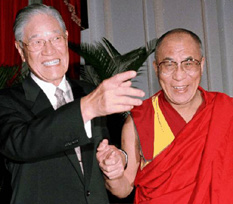
The Dalai Lama has visited the Republic of China for the first time. More than 80,000 Republic of China citizens went to see him and hear him talk. He met with President Lee Teng Hui, Vice-president Lien Chan and Hsu Hsin-liang, Chairman of the Democratic Progressive Party. These are three political bigwigs for the Dalai to meet if this was a purely religious visit.But because of who he is, nothing the Dalai Lama does is purely religious as far as the Chinese Communist Party is concerned. The whole saga of the Dalai Lama's visit to is long and wrought with bumps, starts and stops. At first when the trip was first announced there seemed to be some disagreement in the Dalai Lama camp about whether or under what conditions he would go. (See Dalai Lama Say What? on the main Ms TKG page). What is interesting is that everything the Dalai Lama said before proved accurate. The only thing the Dalai Lama didn't do that was talked about was that he didn't address the ROC legislature.
The visit was successful it seems in that upwards of 80,000 people went to see the Dalai Lama, and they contributed $500,000 to the Dalai's organization. That sounds like a lot, but considering 80,000 people went to see him, that's only about five bucks a piece. Taiwan has a lot of serious Buddhists and this Buddhist love fest probably made a lot of people feel good. 500K, I am sure, made the Dalai Lama feel good.
But the big story is the political aspects of the visit. Ever since this visit began to be planned, the mainland communist government made statements against it. Maybe there most colorful were these almost poetic words from a XinHua spokesman quoting a spokesman for the Taiwan Affairs Office of the State Council:
The invitation to the Dalai Lama to visit Taiwan fully indicates the Taiwan authorities and the Dalai Lama are ganging up and using each otherA lot was made of the fact that the ROC Mongolian and Tibetan Affairs Office stated that the Dalai Lama was going to Taiwan as a citizen of the ROC, not as a head of state. It was implied that this wouldn't make the Dalai Lama or the CCP very happy to hear it. But it seemed not to matter to the Dalai Lama.The Taiwan authorities and the Dalai Lama . . . publicly engage in evil deeds and walk further and further away along the road of splitting the motherland
An informative article appeared in the Asia Times about the Dali Lama's visit. It was titled the Dalai Lama's Long Road to Taipei. It describes the original cordial relationship between Tibet and the KMT, before the end of the civil war and the Tibet uprising of the late fifties that led to the Dalai Lama's exile and the call for Tibetan independence. Underscoring the former cooperation between the two groups was a KMT ceremony for the Dalai Lama Tenzin Gyatso back in 1940 when he was only five years old. Also, the Dalai Lama's brother Gyalo Thondup attending a political school in Nanjing and associate with Chinag Kai Shek and other KMT members before the end of the Civil War in 1949, and he went to Taiwan with the KMT in 1949 and stayed there two years.
This history indicates the relative closeness of the KMT and Tibet back in the early part of the fifties. Apparently after the uprising of the late fifties and the increased calls for Tibet Independence the relations between the KMT and the Tibet government in exile eroded. Chiang's KMT did not favor Tibet independence any more than the CCP. Also the Tibetan affairs bureau of the ROC alienated the Dalai Lama group by dealing with other Tibetan exile groups making them think that the KMT was trying to cause schisms. The defrosting that of the relations that culminated with the Dalai Lama's trip to Taiwan began in the 90's when the Tibet Affairs office suggested the Dalai Lama could come as a religious leader. The Dalai Lama's brother returned to Taiwan to visit after decades and the road was paved for the visit. Eventually the Dalai Lama visited through the Religious Affairs office, not the Tibetan office.
The visit caused the CCP to cry that this was splittism running rampant, out in the open. There were reports that some sort of military exercises near Taiwan would be held by the PLA, but these did not occur. Most likely due to the CCP knowing that with the Hong Kong takeover coming up they don't need the bad publicity. But they will remember.
The pro Taiwan Independence groups also stressed the splittism of the visit (although they don't call it splittism, or don't think splittism is bad). They held up Tibetan National flags when the Dalai Lama arrived along with their envisioned future flags of the Republic of Taiwan.
The Dalai Lama for his part used the occasion to stress he was not for Tibetan Independence and sought autonomy for Tibet similar to the system envisioned for Hong Kong.
So what about the splittism? The CCP don't believe the Dalai Lama when he says he is not a splittist. They still think Lee Teng Hui and the Dalai Lama were doing their "evil deeds in public". But the Dalai Lama's trip to Taiwan leads us to ask who are the actual splittists?
Just who are the splittists? The Dalai Lama's trip to Taiwan and the good vibes it seemed to engender in everyone seems to me to be more of a force for Chinese unification than the hard handedness of the CCP. It is true that now Tibet is part of the PRC. But it is that way due to force and occupation. There is still a lot of rebellion taking place there. Tibet may be part of the PRC but the situation can hardly be said to be one of unity. This unrest can be seen in a report of a day ago where Xinhua said that the Dalai Lama was "bewitching" Tibetans into believing things they shouldn't. This report indicated the Xinhua dispatch could be a sign of unrest in Tibet.
Compare this tense mood with that on Taiwan. It is true that many in Taiwan who are pro-independence used the occasion to campaign for Taiwan independence by tying it to Tibet's campaign for independence. But at the same time a real breakthrough in non-coerced true unity between the Tibetan and Taiwanese took place. One of the Tibetans who went to Taiwan with the Dalai Lama's entourage made the comment that it was just like being at home.
On a more down to earth level the visit has brought about a Tibet Office in Taiwan. A real one that will have actual impact because it will be run by Tibetans. Here is an article about this new Tibetan office in Taiwan. This article came out before the visit. The ROC government has long had the Mongolian and Tibet Affairs bureaucracy, but it is widely considered to be obsolete. This new office may actually serve as a Tibetan affairs office that could contribute to a free and truly unified (in spirit rather than by force) China.
I write this on April 22, 1997. Tomorrow the Dalai Lama is scheduled to be in Washington D.C. to meet with Clinton and Gore. The Dalai Lama hopes to visit mainland China next. This seems a very difficult obstacle to overcome, but a few years ago it probably seemed unlikely that he would ever be visiting the Republic of China.
Back to Impasse and Integration Page
