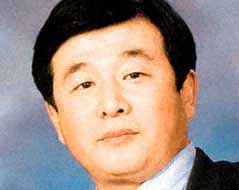
Li Hongzhi, founder and leader of Fa Lun Gong
BBC Summary of World Broadcasts
April 27, 1999, Tuesday
HEADLINE: Ten thousand religious sect members demonstrate in Beijing
SOURCE: Source: Broadcasting Corporation of China, Taipei, in Standard Chinese 2300 gmt 25 Apr 99
Text of report by Taiwan radio on 26th April
More than 10,000 members of a religious sect called Falun Gong, who came from various mainland provinces, gathered in front of Zhongnanhai [leadership compound] to stage a peace demonstration in protest against the detention of their 50 fellow members. They also demanded that the government respect their freedom of religious belief, release the detained sect leaders, and stop arresting their leaders and suppressing their religious activities.
Closely watched by communist Chinese public security personnel, this demonstration continued until midnight. Now the situation has returned to normal. This was the biggest demonstration in Beijing since the 1989 pro-democracy movement in Tiananmen. The demonstrating Falun Gong disciples demanded a meeting with Premier Zhu Rongji to express their indignation and wishes. As learned, Zhu Rongji agreed to meet their representatives but there was no further confirmation later, and there is no knowing whether both sides had met or reached an understanding.
To prevent the demonstration from becoming a riot, many public security personnel were sent to the scene, but they did not crack down on the demonstrators or take any action. They only helped to keep public order so that the demonstrators did not disrupt traffic and onlookers did not gather to watch.
Due to its powerful influence, Falun Gong has long been on the watch -list of the Communist Party, fearing that it might constitute an unstable factor in society. Some mainland media pointed out that Western countries are highly concerned about the banned Chinese Democratic Party, thinking that this party has been banned because it poses a threat to the Communist Party. But they believe that the most serious threat to communist Chinese rule is the Falun Gong religious sect, not the Chinese Democratic Party.
BBC Summary of World Broadcasts
April 27, 1999, Tuesday
HEADLINE: Sect members deliver their demands to Beijing in huge petition
SOURCE: Source: 'Ming Pao', Hong Kong, in Chinese 26 Apr 99 pA1
Fearing that the authorities would ban Falun Gong (a movement dedicated to the practice of a type of qigong intertwined with Buddhist tenets), 10,000 Falun Gong followers staged a petition in Beijing, reported the Hong Kong paper 'Ming Pao'. The paper said that top officials were shocked by the incident and Tiananmen Square was forcibly sealed until the petition ended. The petitioners had two demands: The central government must accept the status of Falun Gong; the Falun Gong followers detained by Tianjin public security organs must be released. The paper noted that Falun Gong followers recently organized a counterattack on the Internet against anti-Falun Gong articles which appeared in official media. It said that the total number of Falun Gong followers in China could be as many as 100 million.
Text of report by Hong Kong newspaper 'Ming Pao' on 26th April; subheadings as published
The largest peaceful petition incident since the 4th June incident in 1989 has taken place in Beijing. Out of fear that the authorities would ban "Falun Gong," more than 10,000 followers from the northern provinces and municipalities, including Beijing, Tianjin, Hebei, Henan, and Shandong, contacted each other through the Internet and other channels and yesterday "encircled" Zhongnanhai, the centre of CCP [Chinese Communist Party] leadership. They asked the authorities to squarely face their status. The two km-long procession dispersed late at night and the crowds were sent away in buses arranged by authorities. Tiananmen Square in Beijing was forcibly sealed until the petition ended.
A source disclosed that top CCP levels were shocked by the incident. As the sensitive period of the 10th anniversary of the 4th June incident is approaching, the authorities decided to give the incident the "cold treatment." Luo Gan, secretary of the Political Science and Law Commission of the CCP Central Committee held an emergency meeting yesterday and decided to send the petitioners back to their homes by bus and also promised to ensure their safety.
The more than 10,000 Falun Gong followers who joined the petition yesterday made the following requests to Premier Zhu Rongji:
- The central government must squarely face the status of Falun Gong; and
- Release Falun Gong followers detained by Tianjin public security organs.
According to news from the site, when informed of the request, Zhu Rongji personally went to the west gate of Zhongnanhai yesterday afternoon to inquire about the case of the Falun Gong petitioners. He promised to give them a reply in three days. However, the news remains to be confirmed.
Government buses send petitioners to railway station before midnight
Meanwhile, officials from the Beijing Municipal CCP Committee and Complaints Office of the State Council were holding talks with representatives of the petitioners. The Office of the State Council to Handle Complaint Letters and Visits and the Beijing Public Security Bureau also told the petitioners that it is normal for them to build up their health by practising qigong. If they had any different views, they could report them to the higher authorities through normal channels rather than choosing to do so through a sit -in demonstration. "Zhongnanhai is the location of the CCP Central Committee and State Council, so please go home as early as possible."
Through hours of negotiations, the petitioners eventually promised to end the petition at 2330 that night. They then embarked on the scores of buses arranged by authorities and left the site. The petitioners from other provinces all were sent to the railway station. Public security officers reportedly told the representatives that they must leave Zhongnanhai before midnight; otherwise, they would be forced to clear the mess.
A Falun Gong follower who took part in the demonstration told a 'Ming Pao' reporter that followers from southern Hainan, northern Heilongjiang, and western Taiyuan, voluntarily "gathered" at Zhongnanhai at 0400 yesterday to stage a sit-in demonstration to express their request to the central government. They complained about the authorities'" distorted" description of Falun Gong, which has developed and has been practised by people over the years.
Official media says, it is superstitious
Reportedly, the direct cause triggering the petition is the criticism of the followers of Falun Gong by China Central Television and ' Beijing Youth Daily', which blamed the followers for publicizing superstition. In addition, a scientific and technological periodical published by the Tianjin Education Institute carried an article by He Zuoxiu, who is known for his opposition to sham science. He Zuoxiu said he is against young people practising qigong. As a result, 10 days ago the followers of Falun Gong organized a counterattack through the Internet and other channels against relevant reports. They also proposed staging a demonstration in Beijing. As some of the Tianjin followers were dispersed by the police on 23rd April after staging a sit-in protest for six days beginning 18th April at the Tianjin Education Institute, they moved to the gate of the Tianjin Municipal CCP Committee last weekend to lodge their protest. However, dozens of the petitioners were detained by the local public security departments.
Chang'an Avenue blocked to prevent riots
According to what the reporter witnessed, most of the Falun Gong followers who staged the sit-in came from Beijing, and in particular the suburbs. According to these people, Beijing has 400,000 to 500,000 followers and the number in the whole country could reach 100 million.
In order to prevent the incident from spreading further, the public security bureau sealed Fuyou Street and then blocked Tiananmen Square, not allowing any vehicles to pass by. The vehicles passing through Tiananmen Square had to take a roundabout tour through Qianmen Avenue. Local drivers said that the blockade was lifted at around 2330.
A large number of people taking part in a sit-in demonstration has been a rare occurrence since the 4th June incident. The large scene of the sit-in protest also has been rare since the 4th June incident. In order to prevent riots, the police dispatched more than 1,000 public security personnel and plainclothes officers to maintain public order. Luckily, both sides exercised great restraint in their behaviour.
Heavy guard
Although yesterday's sit-down protest did not lead to serious clashes, under the central slogan of "stability overrides everything else," the Beijing authorities have taken strict precautions against the abrupt protest.
It was understood that, under the auspices of Luo Gan, secretary of the Central Commission of Political Science and Law, the Beijing Municipal CCP Committee, the State Council Letters and Visits Handling Bureau, and the Beijing Municipal Public Security Bureau, had contacted the protesters. Public security officers from Dongcheng, Xicheng, and other districts were placed on alert.
As this reporter saw yesterday, nearly 20 police and plainclothesmen guarded several entrances for central leaders in Beimen and Ximen, Zhongnanhai. Police vehicles were deployed in the areas surrounding the main entrance. The road along Fuyou Street was lined with over 100 police vans and other public security vehicles, in which policemen sat awaiting orders.
There basically was one policeman for every metre to maintain the order of protesters queuing from Xibanqiao in the north of Zhongnanhai to Xi Chang'an Avenue in the south of Zhongnanhai, near Xidan Street North. Pedestrians were barred from approaching or joining the protest.
At around midnight, though all the protesters in the Fuyou Street area were gone, dozens of police vehicles remained on alert.
The Washington Post
April 26, 1999, Monday, Final Edition
HEADLINE: Silent Protest Draws Thousands to Beijing; Followers of Martial Arts Master Li Hongzhi Stir Political Waters With Apolitical Agenda
BYLINE: John Pomfret; Michael Laris, Washington Post Foreign Service
DATELINE: BEIJING, April 25
More than 10,000 Chinese followers of a cult-like figure who lives in the United States massed on the streets outside the Communist Party headquarters today in the largest, and most unusual, protest since the student-led demonstrations rocked Beijing in 1989.
Clutching the writings of Chinese martial arts master Li Hongzhi, the protesters entered Beijing in the pre-dawn hours in buses and flooded the streets around the Zhongnanhai compound. There they sat almost silently -- five or six deep on the sidewalk, many of them meditating -- throughout the day as their leaders negotiated with government officials. Scores of police looked on.
The protesters were demanding the government take action against a Chinese magazine that last week published an article critical of the cult called "Falun Gong." Followers of Li, who lives in New York, said they were concerned that the article, which argued that Falun should not be practiced by young people, was the government's first step toward banning the cult -- which involves group meditation, exercise and spiritual training. They also said they wanted the government to recognize the sect, granting it legal status.
Today's protest underscored Chinese leaders' fears of unrest in the weeks before the 10th anniversary of the June 4 bloody crackdown at Tiananmen Square. Demonstrations have become commonplace in China as a restive population -- concerned about corruption and unemployment -- appears increasingly willing to take to the streets to press its demands.
The protesters dispersed late tonight after organizers assured them that the Chinese cabinet would negotiate with them Monday. The government had no comment on the protests, which went unreported by China's official media.
"This was an apolitical protest but it also is a very political act," said one senior Chinese academic who has written extensively about China's growing number of cults. "By moving 12,000 people into the center of Beijing, this group was making a very strong statement. By picking this time to move these people, so near to June 4th, the statement had that much more power."
The protest also illustrates a new set of challenges facing the Communist Party, which traditionally has been bedeviled by Western-oriented democracy groups. Cults and religions have proliferated in China, offering a spiritual anchor amid economic and social upheaval. Controling these groups is a huge problem for the party, as shown by the fact that without warning more than 10,000 people surrounded the red-walled party headquarters today.
Indeed, security services in the past six months have cracked down against attempts to form China's first opposition party, a movement of less than 200 people. But tens of millions are believed to be Falun practitioners in China.
Today's protest was meticulously organized. Throughout the day, as protesters squatted in orderly rows, ate Popsicles and nibbled on fruit, others collected wrappers and apple cores to prevent littering.
The Falun protests began last week in the coastal metropolis of Tianjin, 90 miles east of China's capital. There, thousands of Falun followers protested in front of the offices of the Youth Science and Technology Reader and the city government, demanding that the monthly's editors apologize for the article. The magazine refused.
When the protesters tried to surround Tianjin's city hall, police dispersed them, using what one source called "tough tactics." No one was seriously injured, he added, but dozens of people were arrested and the group decided to take its protest to Beijing.
Protesters said they received calls Saturday from local cult leaders and some arrived in the city at 4:30 a.m. Others came from as far away as Zhejiang province, 800 miles south of Beijing.
Falun Gong, or the law of the revolving wheel, advertises itself as "an advanced system of cultivation and practice" -- incorporating elements from the Chinese martial art t'ai chi ch'uan, Buddhism and Daoism. As such, it's a kind of New Age movement with Chinese characteristics. By cultivating an "orb" of energy around the stomach, the theory goes, disease can be cured and spiritual rapture achieved.
Practitioners rejected the charge that they belong to a sect.
"It's not like a sect or a religion. It is not even registered. No money is involved. It is not extremist. It teaches people to be good citizens. Cults and sects have negative connotations," said Zhang Erping, a follower in the United States who runs a translation business in the New York borough of Queens.
Li began preaching Falun Gong in China in 1992, during one of the high-points of a craze here for Qigong, a type of martial art that emphasizes breathing exercises and the concentration of the body's energy in certain places, like the fingertips or the eyes. His sect quickly became popular. The exercises are relatively simple, and he emphasized that anyone could participate.
Li moved to the United States and gave his first seminar in Houston on Oct. 12, 1996, the date of a partial solar eclipse. Since then he generally has picked celestially significant days for his teachings -- often to crowds of thousands. Li's writings have been translated into seven languages; Falun organizations are active around the world and in 18 U.S. states and the District of Columbia. More than 80 Web sites are devoted to the practice.
She Qingsheng, 26, a physician from Beijing who was at today's protest, said Falun is a good way to address the problems in Chinese society and the world, from drugs to the war in Yugoslavia. He said that China's ultra-radical Cultural Revolution destroyed traditional values, creating a moral vacuum.
People need something to believe in, he said, "like Christianity in your country," although he stressed that he did not believe Falun was a religion.
"Why did so many people come today?" he said. "It's a problem of the social system, and a problem of recognition." Hundreds of Chinese stand on a bridge near the headquarters of the Communist Party, protesting a magazine article critical of Falun Gong. The protest outside the Zhongnanhai compound was the largest in Beijing since the Tiananmen Square pro-democracy demonstrations were crushed nearly 10 years ago. Chinese sit on a sidewalk during the silent protest in support of Falun Gong, a blend of meditation and martial arts developed by Li Hongzhi.
Monday April 26 1999
Sect vows to stop 'evil tide sweeping mankind to catastrophe'
ASSOCIATED PRESS and REUTERS
The Fa Lun Gong movement promises to cure sickness and reverse a tide of evil sweeping mankind to the brink of catastrophe.
It is one of numerous cults and folk religions which, along with more traditional beliefs such as Christianity and Buddhism, are filling a spiritual void in society as China abandons socialism.
"Your diseases will be eliminated directly by me," leader Li Hongzhi, 47, wrote in one of his five books, regarded by devotees as sacred.
Some followers believe the end of the world is near.
Mr Li's cult claims more than 100 million members and sees human corruption in everything from homosexuality to rock music and drug addiction.
His teachings hark back to ancient Chinese civilisation before the advent of modern science, medicine and technology.
He claims power of healing from the Chinese martial art form of qigong, whose practitioners tap into an "inner energy".
The Fa Lun Gong - or "Buddhist Law" cult - is rooted in the notion of karma, which holds that people's good and bad deeds determine their fate in the next life. Society is in such steep decline that humans are actually being reincarnated as demons, many disguised as monks, according to Mr Li, who lives in Houston, Texas, devotees said.
"Especially in Taiwan, many famous monks or lay Buddhists are actually demons," he wrote.
Other qigong masters in China were "possessed with foxes or yellow weasels, and some with snakes".
Although the Fa Lun Gong is anti-science, members use the Internet to propagate Mr Li's teachings.
It appears to be tapping into deep public resentment, and fear of the unknown, as China undergoes wrenching social change and upheaval in its march to capitalism.
Hou Huilan, a 55-year-old factory worker at yesterday's demonstration, said Mr Li's teachings had taught her lessons in family values and civic virtues.
Evicted tenants voice anger in second Beijing protest
By Pamela Pun and AFP
People's anger: Demonstrators are being ordered to move away from the front gate of Zhongnanhai. Picture: AFP
DOZENS of people have protested outside the party and government headquarters in Beijing after being expelled from their homes, the second demonstration in the capital in two days.
``We were expelled from our homes to make way for a hospital,'' one of the 50 protesters said as they gathered outside the west entrance to Zhongnanhai, the Central Government's seat of power.
The protest came a day after Beijing saw its biggest demonstration since the 1989 pro-democracy protests, when more than 10,000 members of a banned sect besieged Zhongnanhai from dawn to dusk in a silent protest against the detention of 50 fellow members.
The protesters said 800 disgruntled residents from their community in south Beijing had gathered earlier, before dispersing after one of their delegation was authorised to enter the headquarters.
Compared to the silent, disciplined protest on Sunday, Monday's demonstrators noisily shouted slogans calling for their houses and money back.
The 50 demonstrators from the Nanyuan area, were still on the pavements by late morning waiting for the delegation to re-emerge.
Dozens of protests have been held on the mainland in recent months, ranging from peasant demonstrations against corruption to workers claiming backpay.
Security remained tight around the exclusive Beijing leadership compound besieged by followers of a religious sect over the weekend, but police re-opened a number of surrounding roads.
Traffic controls near the walled inner sanctum of the political elite were lifted, but police remained on edge, wary of a repeat of Sunday's sit-in by believers of the Falun Gong sect.
