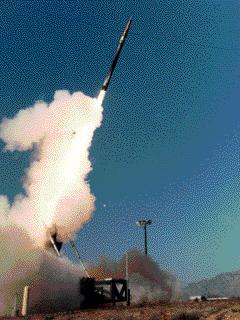
 The Theater High-Altitude Area Defense [THAAD]
system will provide extended coverage for a greater diversity and dispersion of
forces and the capability to protect population centers. But the principal
additional capability provided by this system is the ability to deal with
longer-range theater missile threats as they begin to emerge. THAAD also reduces
the number of missiles that the lower-tier systems must engage and provides us
with a shoot-look-shoot capability--the ability to engage incoming missiles more
efficiently.
The Theater High-Altitude Area Defense [THAAD]
system will provide extended coverage for a greater diversity and dispersion of
forces and the capability to protect population centers. But the principal
additional capability provided by this system is the ability to deal with
longer-range theater missile threats as they begin to emerge. THAAD also reduces
the number of missiles that the lower-tier systems must engage and provides us
with a shoot-look-shoot capability--the ability to engage incoming missiles more
efficiently.
THAAD is the most mature upper-tier system. The President’s Budget 1997 schedule for this program had LRIP beginning in fiscal year 2003, with a FUE in fiscal year 2006. However, DOD subsequently added $690 million to this program over the FY 1998 FYDP, which moves the FUE to late fiscal year 2004. This additional funding also: (1) completes the funding for the second Engineering and Manufacturing Development (EMD) radar, (2) decreases schedule and technical risks during EMD, and (3) decreases the total acquisition cost by $457 million.
The THAAD Program was restructured in 1996, though there was a decision to keep the UOES portion of the program on track. DOD planned to be able to deploy an initial limited THAAD UOES capability in the second quarter of FY 1999 should a contingency arise. The final UOES capability would include about 40 missiles and two radars, which will be used for user testing, but which could be maintained in theater if needed.
Recent testing difficulties have led to the slip of this capability from the fourth quarter of FY 1998 to the second quarter of FY 1999. THAAD faces significant system engineering challenge. The fact that recent THAAD flights have not met all their objectives, stretching out testing and delaying the start of EMD by over fifteen months, illustrates the difficulty of this task. Since the seventh THAAD test was not successful, it was necessary to reevaluate the program’s schedule and content.