A View of Non-NPT Nuclear States from Space:
Nuclear and Missile Facility Satellite Images and
Their Implications for the NPT
Related Resources
|
For the first time outside government intelligence agencies, the FAS Public Eye Project is using photographs obtained from the SpaceImaging Corporation IKONOS satellite to show the full scope of Indian and Pakistani nuclear programs. Along with declassified photos of Israeli facilities, the images visibly demonstrate that the three NPT holdouts have committed themselves to long-term and highly-integrated networks of military institutions geared towards the full deployment of nuclear weapons. "The NPT Review Conference has failed to come to grips with this reality, and the future of all non-proliferation efforts hinge on this fact," says John Pike of the Federation of American Scientists. FAS consultant Michael Kraig says, "The international community’s exclusive focus on rolling back these nuclear programs has blinded policymakers to policy options that would reduce the risk of nuclear escalation in future regional crises. The world community should not assume that immediate de-nuclearization through the NPT regime is the only palatable foreign policy, or that it is the policy most likely to achieve concrete results."
 The
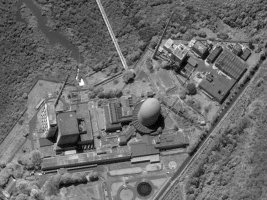
Bhabha Atomic Research Centre (BARC) near Trombay
is the nerve center of the entire nuclear weapons program and includes
facilities for weapons design; plutonium production (Dhruva and Cirus research
reactors); plutonium separation; conversion of fissile materials into metallic
form for warheads; and bomb core fabrication. BARC also houses extensive
chemical production plants to support the entire fuel cycle, as well as a
facility for extracting tritium from heavy water for increasing the explosive
power of thermonuclear weapons. BARC personnel were instrumental in designing
and building the nuclear devices that were tested in May 1998.
The
Bhabha Atomic Research Centre (BARC) near Trombay
is the nerve center of the entire nuclear weapons program and includes
facilities for weapons design; plutonium production (Dhruva and Cirus research
reactors); plutonium separation; conversion of fissile materials into metallic
form for warheads; and bomb core fabrication. BARC also houses extensive
chemical production plants to support the entire fuel cycle, as well as a
facility for extracting tritium from heavy water for increasing the explosive
power of thermonuclear weapons. BARC personnel were instrumental in designing
and building the nuclear devices that were tested in May 1998.
 The
Hyderabad Defence Research Complex at Kanchanbagh houses the
primary institutions responsible for developing and testing the new Agni-II IRBM
and the short-range Prithvi missiles, both of which are leading candidates for
nuclear warhead delivery vehicles. With help from over 20 other institutions and
partners outside the Complex, the Defense Research and Development Laboratory (DRDL)
represents the R&D component of the missile programs. Also in the Hyderabad
Complex, the government-owned Bharat Dynamics, Ltd. manufactures the Prithvi
with assistance in special metals from the Defense Metallurgical Research
Laboratory (DMRL) and the government-owned special metals industry Mishra Dhatu
Nigam Ltd. (MIDHANI). Satellite images reveal that India has
recently expanded a storage area that is almost certainly devoted to rocket
propellant and fuel assemblies for these missile systems. Images also confirm
that DRDL has erected a large facility dedicated to ground-based stress testing
and flight simulations involving the actual missile components.
The
Hyderabad Defence Research Complex at Kanchanbagh houses the
primary institutions responsible for developing and testing the new Agni-II IRBM
and the short-range Prithvi missiles, both of which are leading candidates for
nuclear warhead delivery vehicles. With help from over 20 other institutions and
partners outside the Complex, the Defense Research and Development Laboratory (DRDL)
represents the R&D component of the missile programs. Also in the Hyderabad
Complex, the government-owned Bharat Dynamics, Ltd. manufactures the Prithvi
with assistance in special metals from the Defense Metallurgical Research
Laboratory (DMRL) and the government-owned special metals industry Mishra Dhatu
Nigam Ltd. (MIDHANI). Satellite images reveal that India has
recently expanded a storage area that is almost certainly devoted to rocket
propellant and fuel assemblies for these missile systems. Images also confirm
that DRDL has erected a large facility dedicated to ground-based stress testing
and flight simulations involving the actual missile components.
 New
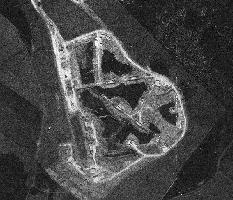
photographs of the Kahuta uranium enrichment complex reveal significant
additions in the last 10 years. The Kahuta complex is now a multipurpose
"one-stop shopping" weapons production area, with expansion and
refurbishment of existing uranium enrichment facilities and construction of new
sites for development and ground testing of the Ghauri II/Nodong
intermediate-range ballistic missile (IRBM).
New
photographs of the Kahuta uranium enrichment complex reveal significant
additions in the last 10 years. The Kahuta complex is now a multipurpose
"one-stop shopping" weapons production area, with expansion and
refurbishment of existing uranium enrichment facilities and construction of new
sites for development and ground testing of the Ghauri II/Nodong
intermediate-range ballistic missile (IRBM).
According to FAS Space Policy Project Director John Pike, "Pakistan has laid the groundwork for a force of dozens of nuclear-tipped missiles capable of striking Indian cities and military bases. But Pakistan is in danger of having most of its nuclear eggs in just two baskets, which would make tempting targets for pre-emptive Indian attack in time of crisis."
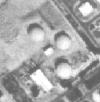
 FAS was unable to acquire recent high-resolution satellite imagery for Israel
because the U.S. Congress passed a 1997 law barring the commercial acquisition
of photographs by American-owned companies. Older declassified photos show that
the Dimona site houses a heavy water reactor and an installation for
processing spent fuel to produce weapons-grade plutonium. Israel probably has
also used the same site to produce the tritium and lithium deuteride necessary
for thermonuclear weapons. Estimates of the potential arsenal vary widely
between 50-60 weapons to 200 or even 400 warheads, with some estimates including
both tactical and thermonuclear missile weapons as well as gravity bombs. At the
Sedot Mikha base 45 km south of Tel-Aviv, the Israeli Air Force
reportedly has three squadrons equipped with up to 50 Jericho I nuclear-tipped
MRBMs. The Jericho I has been successfully tested several times and is fully
operational.
FAS was unable to acquire recent high-resolution satellite imagery for Israel
because the U.S. Congress passed a 1997 law barring the commercial acquisition
of photographs by American-owned companies. Older declassified photos show that
the Dimona site houses a heavy water reactor and an installation for
processing spent fuel to produce weapons-grade plutonium. Israel probably has
also used the same site to produce the tritium and lithium deuteride necessary
for thermonuclear weapons. Estimates of the potential arsenal vary widely
between 50-60 weapons to 200 or even 400 warheads, with some estimates including
both tactical and thermonuclear missile weapons as well as gravity bombs. At the
Sedot Mikha base 45 km south of Tel-Aviv, the Israeli Air Force
reportedly has three squadrons equipped with up to 50 Jericho I nuclear-tipped
MRBMs. The Jericho I has been successfully tested several times and is fully
operational.
News media wishing to reproduce this copyrighted imagery for publication or broadcast should contact Mark Brender at SpaceImaging at 703-558-0309 or Amy Opperman at 303-254-2078.