MISSILES
SLBM: 20 Makeyev SS-N-20 (RSM
52/3M20) Sturgeon; three-stage solid fuel rocket; stellar inertial
guidance to 8,300 km (4,500 n miles); warhead nuclear 10 MIRV each of
200 kT; CEP 500 m. 2 missiles fired from the first of class in 15
seconds. Being modified to take Grom SS-N-28, which has improved
accuracy.
SAM: There are suggestions that this class may have an SA-N-8 SAM
capability.
|
TORPEDOES
4 - 25 in (630 mm) and 2 - 21 in (533 mm).
Combination of torpedoes (see table at front of section). The weapon
load includes a total of 22 torpedoes and A/S missiles.
|
MINES
Could be carried in lieu of torpedoes.
COUNTERMEASURES
ESM: Rim Hat; radar warning. Park Lamp D/F.
WEAPONS CONTROL
3R65 data control system.
|

RADARS
Surface search: Snoop Pair; I/J-band.
|
SONARS
Shark Gill; hull-mounted; passive/active
search and attack; low/medium frequency. Shark Rib flank array; passive;
low frequency. Mouse Roar; hull-mounted; active attack; high frequency.
Pelamida towed array; passive search; very low frequency.
|
MODERNISATION
The class is being modernized to take an
SS-N-28 missile, which has improved accuracy. This is a very slow
program starting with TK 208, which is planned to complete in 1997.
|
STRUCTURE
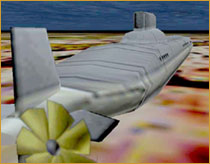
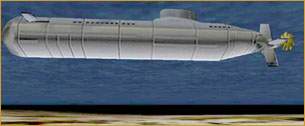
This is the largest type of submarine ever
built. Two separate 8.5-m diameter hulls covered by a single outer
free-flood hull with anechoic Cluster Guard tiles plus separate 6 m
diameter pressure-tight compartments in the fin and fore-ends. There is
a 1.2-m separation between the outer and inner hulls along the sides.
The unique features of Typhoon are her enormous size and the fact that
the missile tubes are mounted forward of the fin. The positioning of the
launch tubes mean a fully integrated weapons area in the bow section
leaving space abaft the fin for the provision of two nuclear reactors,
one in each hull. The fin configuration indicates a designed capability
to break through ice cover up to 3 m thick; the retractable forward
hydroplanes, the rounded hull and the shape of the fin are all related
to under-ice operations. Diving depth, 1,000-ft (300 m).
|
OPERATIONAL
Strategic targets are within range from
anywhere in the world. Two VLF/ELF communication buoys are fitted. VLF
navigation system for under-ice operations. Pert Spring SATCOM mast, Cod
Eye radiometric sextant and Kremmny 2 IFF. All are based in the Northern
Fleet at Litsa Guba. TK 17 damaged by fire during a missile loading
accident in 1992 but the damage has been repaired. A refit cycle started
in 1994 with TK 208. The second pair are non-operational awaiting
refits. |