 Asian
nations as they crumbled in the face the West's superior military technology. It
joined in the Euro-American pillaging of the weakened Chinese empire, surprising
Western nations with its ability to wage modern warfare. That surprise turned to
astonishment when Japan's untested navy annihilated the Russian Empire's
fleet-the first time an Asian nation decisively defeated a Western power.
Asian
nations as they crumbled in the face the West's superior military technology. It
joined in the Euro-American pillaging of the weakened Chinese empire, surprising
Western nations with its ability to wage modern warfare. That surprise turned to
astonishment when Japan's untested navy annihilated the Russian Empire's
fleet-the first time an Asian nation decisively defeated a Western power.
Japan quickly showed it had learned all too well from the West. As the 20th century continued, the Japanese pushed further into China, created a puppet state in Manchuria, and turned its eyes toward the rest of the Far East. An island nation, like Britain, Japan also knew its existence depended upon naval supremacy. While other nations rested and withdrew after the First World War, Japan had embarked on an aggressive expansion of its naval strength, building from scratch a force easily rivaling the traditional dominance of Pacific powers such as Britain and the US.
Japan finally overplayed its hand in 1941 when the ambitions of its ruling military cadre led it to attack the US fleet at Pearl Harbor and enter the Second World War allied with Nazi Germany and Italy. Its powerful navy, complete with a state-of-the-art air wing, quickly spread Japanese power throughout the Pacific and Southeast Asia. But its moment of superiority faded as the economic might of the US went into high gear. As Japan's naval losses grew; it found itself unable to replace its battleships and carriers. By attrition and force of numbers, the US turned the tide and destroyed the once-mighty Imperial Navy. The end of the war saw a humiliated Japan occupied by its former foe and barred from rebuilding its military. Its new constitution, written by the US, expressly forbade the means to wage an aggressive war. The rise of new rivals in the form of the Soviet Union and mainland China soon made the US reconsider a Japan left totally defenseless. The Self-Defense Force, an undeclared military, was built up as a supplement to the US forces based in Japan. The naval branch, the Maritime Self-Defense Force, was born from the ashes of the old Imperial Navy.
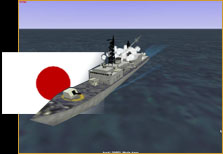
Despite its modest title, the JMSDF force grew into a formidable power. By the end of the 20th century it is regarded as the most sophisticated and well-trained navy in the region, with 16 modern submarines, 20 frigates, and over 50 destroyers-a potent deterrent to the growing strength of its western neighbor China.
With the end of the Cold War and the coming of a multi-polar world, it remains to be seen how the JMSDF will evolve as Japan begins to assert itself once again on the world political stage. Japan's commitment to peace remains firm, but regional considerations may find it drawn into battle as nearby flashpoints burst into conflict.
Major Combatants
Surface Ship