 |
SPECIFICATIONS
|
| MISSILES SLCM: Reduga SS-N-21 Sampson (Granat) fired from 21 in (533 mm) tubes; land-attack; inertial/terrain-following to 3,000 km (1,620 n miles) at 0.7 Mach; warhead nuclear 200 kT. CEP 150 m. Flies at a height of about 200 m. SAM: SA-N-5/8 Strela portable launcher. 18 missiles. A/S: Novator SS-N-15 Starfish (Tsakra) fired from 53 cm tubes; inertial flight to 45 km (24.3 n miles); warhead nuclear 200 kT or Type 40 torpedo. Novator SS-N-16 Stallion fired from 650 mm tubes; inertial flight to 100 km (54 n miles); payload nuclear 200 kT (Vodopad) or Type 40 torpedo. |
|
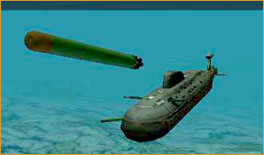
| TORPEDOES 4 - 21 in (533 mm) and 4 - 25.6 in (650 mm) tubes. Combination of 53 and 65 cm torpedoes. Tube liners can be used to reduce the larger diameter tubes to 533 mm. Total of 40 weapons. In addition the Improved Akulas and Akula Iis have six additional 533 mm external tubes in the upper bow area. |
|
| COUNTERMEASURES ESM: Rim Hat; intercept. RADARS SONARS |
 |
| PROGRAMME First of class launched at Komsomolsk and operational at the end of 1985. The class was then in series production at Severodvinsk and Komsomolsk with a construction rate of between one and two per year. The first seven are classified as Akula Is, Vepr and the last pair building at Severodvinsk are Akula IIs and the remainder (including Gepard) are Improved Akula Is. Total of 16 built or building of which one has already been paid off. There is some doubt about the name/number designations as official Russian sources conflict. |
|
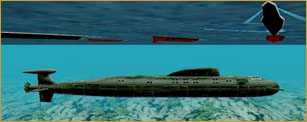
| STRUCTURE The very long fin is particularly notable. Has the same broad hull as Sierra and has reduced radiated noise levels by comparison with Victor III of which she is the traditional follow-on design. A number of prominent non-acoustic sensors appear on the fin leading-edge and on the forward casing in the later Akulas. These are similar to devices tested on a `Hotel II' class from the early 1980s. The engineering standards around the bridge and casing are noticeably to a higher quality than other classes. The design has been incrementally improved with reduced noise levels, boundary layer suppression and active noise cancellation reported in the later units. The Improved hulls have an additional six external torpedo tubes and Akula IIs have been lengthened by 3.7 m to incorporate further noise reduction developments. Operational diving depth, 1,300 ft (400 m). |
|