I.P.F. TECHNICAL RULES
Part 6.
ORDER OF COMPETITION
1. The Round System
(a) At the weigh in, the lifter or his coach must declare a starting weight
for all three lifts. These must be entered on the appropriate first attempt
card, signed by the lifter or his coach and retained by the official conducting
the weigh in. The lifter will then be given eleven blank attempt cards for
use during the competition.
Three for the squat, three for the bench press and five for the dead lift.
Each lift distinguished by using a different coloured card. Having made his
first attempt at a lift, the lifter or his coach must decide upon the weight
required for the second attempt. This weight must be filled in where indicated
upon the card and submitted to the competition secretary or other appointed
official before the one minute time allowance has elapsed. The same procedure
is to be used for second and third attempts on all three lifts. Responsibility
for submitting attempts within the time limit rests solely with the lifter
or his coach. Under the round system, the need for numerous marshals is
eliminated, the attempt card being handed directly to the designated official.
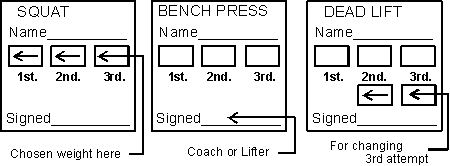
Examples of attempt cards are illustrated below. Remember that the box for
first attempts on the cards in the lifter's possession are only to be used
for the permitted first attempt change if required. Similarly, the fourth
and fifth boxes on the dead lift card are only to be used for the two permitted
changes on the third attempt dead lift if required.
(b) Where 10 or more lifters are competing in a session, groups may be formed
consisting of approximately equal numbers of lifters. However, groups must
be formed when 15 or more lifters are competing in the same session. A session
can be composed of a single bodyweight category or any combination of bodyweight
categories at the discretion of the organizer for purpose of presentation.
(c) Grouping shall be determined by examining the lifters' best totals achieved
at national or international level during the previous twelve months. The
lifters with the lowest totals will form the first group to lift with
progressively higher totals forming further groups asnecessary. Where a lifter
has not provided a total for the previous twelve months, then that lifter
shall automatically be placed in the first group to lift.
(d) Each lifter will take his first attempt in the first round, his second
attempt in the second round and his third attempt in the third round.
(e) When a group consists of less than 6 lifters, compensatory time allowances
shall be added at the end of each round as follows:for 5 lifters add 1 minute;
4 lifters add 2 minutes; 3 lifters add 3 minutes. 3 minutes is the maximum
allowance permitted at the end of a round.
(f) The bar must be loaded progressively during each round on the principle
of a rising bar. At no time will the weight of the bar be lowered within
a round except for errors as described in item (i), and then only at the
end of a round.
(g) Lifting order within each round will be determined by the lifter's choice
of weight for that round. In the event of two lifters choosing the same weight,
the lifter with the lowest lot number drawn at the weigh in, will lift
first.
(h) If unsuccessful with an attempt, the lifter does not follow himself,
but must wait until the next round before he can attempt that weight again.
(i) If in a round an attempt is unsuccessful due to a wrongly loaded bar
or spotter error, the lifter will be granted a further attempt at the correct
weight. However, the extra attempt can only be taken at the end of the round
in which the error occurred.If the lifter also happened to be the last lifter
in the round, he shall be granted a three minute rest prior to making his
attempt.
(j) A lifter is permitted one change of weight on the first attempt of each
lift. The change of weight may be higher or lower than that originally submitted
and the order of lifting in the first round will be changed accordingly.
If he is in the first group, this change may take place at any time up to
within five minutes before the start of the first round of that lift. The
following groups are accorded a similar privilege up to within five attempts
from the end of the previous group's last round of that lift. Prior notice
of these deadlines shall be announced by the speaker.
(k) A lifter must submit his second and third attempts within one minute
of completing his preceding attempt. If no weight is submitted within the
one minute time allowance, the lifter will forfeit his next round attempt.
If the lifter forfeits a second attempt under this rule, then his third attempt
must be submitted within one minute of such forfeiture being declared.
(l) Weights submitted for second round attempts on all three lifts cannot
be changed. Similarly third round attempts on the squat and bench press cannot
be changed.
(m) In the third round of the dead lift, two weight changes are permitted.
The change of weight may be higher or lower than the lifter's previously
submitted third attempt. However, these are only permitted provided that
the lifter has not been called to the bar already loaded to his previously
submitted weight.
(n) In bench press single lift competitions the rules in general are the
same as for three lift competitions. However there are two exceptions to
this statement. In the third round, two weight changes are permitted as stated
in 1(m) above for the deadlift apply equally here. It follows that the attempt
card must be as for the normal deadlift attept card in that provisions is
made for the two permitted changes on the third attempt.
(o) If a lifting session consists of a single group, i.e. up to a maximum
of 14 lifters, an interval of not less than 10 and not exceeding 15 minutes
shall be allowed between the lifts. This is to ensure adequate time for warm
up and platform organization.
(p) When two or more groups take part in a session upon a single platform,
lifting will be organized on a group repetition basis. No time interval will
be allowed between rounds other than that necessary for arranging the platform.
For example, if there are two groups taking part in a session, the first
group will complete all three rounds of the squat. They will be followed
immediately by the second group who will complete their three rounds of the
squat. The platform will then be set up for the bench press and the first
group will complete their three rounds of the bench press, immediately followed
by the second group who will similarly complete their three rounds ofthe
bench press. The platform will then be set up for the dead lift and the first
group will complete their three rounds of the dead lift, immediately followed
by the second group who will similarly complete their three rounds of the
dead lift. This system thus eliminates any time waste other than that necessary
for arranging the platform between the lifts.
2. The organizer will appoint the following officials:
(a) Speaker/Announcer.
(b) Technical Secretary (an international referee preferably fromn the host
nation). (c) Time Keeper (preferably a qualified referee).
(d) Marshals/Expeditors (not required when using the round system, an official
seated at the administration table will be designated to receive attempts).
(e) Scorers.
(f) Spotter/Loaders.
Additional officials may be appointed as required, i.e.doctors,paramedics,
etc.
Responsibilities of the Officials are:
(a) The speaker is responsible for the efficient running ofthe competition.
He acts as Master of Ceremonies and arranges the attempts chosen by the lifters
in an orderly fashion, dictated by weight and, if necessary, lot number.
He announces the weight required for the next attempt and the name of the
lifter. When the bar is loaded and the platform cleared for lifting, the
Chief Referee will indicate the fact to the speaker, who will in turn announce
that the bar is ready and call the lifter by name to the platform.
Attempts announced by the speaker should be displayed upon some form of
scoreboard erected in a prominent position.
(b) The technical secretary is responsible for attending the technical meeting
prior to the competition and compiling the referee schedules from the names
of those referees declared available for duty throughout the competition.
He will complete the necessary "Duty Referees and Jury Members" lists for
the competition and inform referees of the categories to which they have
been allocated. After the technical meeting when final team nominations have
been compiled the technical secretary will initiate a score sheet, equipment
check sheet, rack height sheet and order of weigh in sheet for each category
in the competiton, entering the names of all lifters nominated in that category.
He will also make out the speakers competition cards for every lifter in
the category. The above paperwork together with an adequate supply of lifters
attempt slips will be placed in the appropriate envelope for each bodyweight
category in the competiton and handed to the chief referee for that category.
The technical secretary will attend each weigh in and advise the duty referees
upon procedure and any other matters that may require attention. He should
be a qualified international referee, preferably from the host nation and
able to deal effectively with any problem that may arise due to language
difficulties at the venue. It is the responsibility of the meet director
to provide all the necessary blank forms and paperwork to enable the technical
secretary to carry out his work.
(c)The time keeper is responsible for accurately recording the time lapse
between the announcement that the bar is ready and the lifter starting his
attempt. He is also responsible for recording time allowances whenever required,
e.g. after an attempt the lifter shall leave the platform within 30 seconds.
Once the clock is running for a lifter, it can only be stopped by the completion
of a time allowance, by the start of a lift, or at the discretion of the
Chief Referee. Consequently, it is of great importance that the lifter or
his coach check the height of the squat racks prior to being called, as once
the bar is announced as being ready, the clock will be started. Any further
adjustments to the racks must be made within the lifter's one minute
allowance.
The lifter is allowed one minute in which to start his attempt after being
called to the platform.If he does not start his attempt within this time
allowance, the time keeper will call time and the Chief Referee shall give
the audible command "rack". The lift will be declared "no lift" and the attempt
forfeited. When the lifter starts the lift within the prescribed time allowance,
the clock will be stopped. The definition of the start of anattempt depends
upon the particular lift being performed. In the squat and the bench press,
the start is to coincide with the Chief Referee's commencement signal. Refer
to "Referees" item 3. In the dead lift, the start is when the lifter makes
a determined attempt to raise the bar.
(d) Marshals/Expeditors are responsible for collecting the weight of required
attempts from the lifters or their coaches and passing the information without
delay to the speaker. The lifter is allowed one minute between completing
his last attempt and informing the speaker, via the marshal, of the weight
required for his next attempt.
(e) Scorers are responsible for accurately recording the progress of the
competition, and on completion, ensuring that the three referees sign the
official score sheets, record certificates or any other document requiring
signatures.
(f) Spotter/Loaders are responsible for loading and unloading the bar, adjusting
squat racks and benches as required, cleaning the bar or platform at the
request of the Chief Referee, and generally ensuring that the platform is
well maintained and presents a neat and tidy appearance at all times. At
no time shall there be less than two or more than five spotter/loaders on
the platform.
When the lifter prepares for his attempt, the spotter/loaders may assist
him in removing the bar from the racks. They may also assist in replacing
the bar after the attempt. However, they shall not touch the lifter or the
bar during the actual attempt, i.e. during the period of time that elapses
between the commencement and completion signals. The only exception to this
rule being that if the lift is in jeopardy and likely to result in injury
to the lifter, the spotter/loaders may, either at the request of the Chief
Referee or the lifter himself, step in and relieve the lifter of the bar.If
the lifter is deprived of an otherwise successful attempt by the error of
a spotter/loader and through no fault of his own, he may be awarded another
attempt at the discretion of the referees at the end of the round.
3. Application for participation at a World or Regional Championships must
include the lifter's best total, with date and competition where performed,
during the past 12 months. Only totals achieved at International or National
Championships will be considered.
4. During any competition taking place on a platform or stage, only the lifter
and his coach, members of the Jury, officiating referees and spotter/loaders
will be allowed around the platform or on the stage. During the execution
of a lift, only the lifter, spotter/loaders and the referees are permitted
to be present on the platform. Coaches shall remain within the designated
coaching area as defined by the Jury or technical officer in charge.
5. A lifter shall not wrap or adjust his costume within the vicinity of the
platform. The only exception to this rule is that he may adjust his belt.
6. In international matches between two lifters or two nations contested
in different bodyweight categories, the lifters may alternate irrespective
of weight required for the attempts. The lifter requiring the lighest weight
in his initial lift shall lift first and thereby set the order for the alternate
attempts throughout that particular lift.
7. In IPF recognized competitions, the weight of the barbell must always
be a multiple of 2.5 kg. The progression must be at least 2.5 kg between
all attempts. The weight shall be announced in kilograms.
Exceptions to this rule:
(a) In a record attempt the weight of the barbell must be at least 500 grams
in excess of the current record. This record attempt must be taken in the
normal sequence of increasing weight during the competition.
(b) During the course of competition a lifter may request a record attempt
that is not a multiple of 2.5 kg but is to be attempted within his prescribed
attempts. If the attempt is successful, then only the lower closest multiple
of 2.5 kg will be recorded on the score sheet, the exact weight will appear
on the record application. For example if 333 kg is requested for a squat
lift on the lifter's second attempt and the lift is successful, then 332.5
kg will be entered on the score sheet and 333 kg will be entered on the record
application.
(c) Record attempts may be taken on any or all of a lifter's prescribed attempts
provided that he maintains a minimum increase of 500 grams. For example if
the current record is 100 kg, then a lifter may take the following attempts:
1st - 100.0kg, 2nd - 101.0kg, 3rd - 101.5kg, 4th - 102 kg. Attempts 2, 3,
and 4 if successful will all be records irrespective of the fact that he
did not increase the weight for competition purposes from 100 kg.
8. The Chief Referee will be solely responsible for decisions taken in the
case of loading errors or incorrect announcements by the speaker. His decision
will be given to the speaker who will make the appropriate announcement.
Examples of Errors in Loading
(a) If the bar is loaded to a lighter weight than originally requested and
the attempt is successful, the lifter may accept the successful attempt or
elect to take the attempt again at the originally requested weight. If the
attempt is not successful, the lifter will be granted a further attempt at
the originally requested weight. In both the above cases, further attempts
may only be taken at the end of the round in which the error occurred.
(b) If the bar is loaded to a heavier weight than originally requested and
the attempt is successful, the lifter will be granted the attempt. However,
the weight may be reduced again if required for other lifters. If the attempt
is not successful, the lifter will be granted afurther attempt at the originally
requested weight at the end of the round in which the error occurred.
(c) If the loading is not the same on each end of the bar; or any change
occurs to the bar or discs during the execution of the lift; or the platform
is disarranged, if despite these factors, the lift is successful, the lifter
may accept the attempt or elect to take the attempt again. If the successful
attempt is not a multiple of 2.5 kg, then the lower closest multiple of 2.5
kg will be recorded on the score sheet. If the attempt is unsuccessful, thelifter
will be granted a further attempt. Further attempts may only be taken at
the end of the round inwhich the error occurred.
(d) If the speaker makes a mistake by announcing a weight lighter or heavier
than that requested by the lifter, the Chief Referee will make the same decisions
as for errors in loading.
(e) If for any reason it is not possible for the lifter or his coach to remain
in the vicinity of the platform in order to follow the progress of the
competition and the lifter misses his attempt because the speaker omitted
to announce him at the appropriate weight, then the weight will be reduced
as necessary and the lifter allowed to take his attempt, but only at the
end of the round.
9. Three unsuccessful attempts in any lift will automatically eliminate the
lifter from the competition.
10. Other than initial removal of the bar from the racks, the lifter will
not receive any help from the spotter/loaders in positioning himself for
an attempt.
11. On the completion of an attempt, a lifter shall leave the platform within
thirty seconds. Failure to comply with this rule may result in disqualification
of the attempt at the discretion of the referees.
12. If, during warm up or competition, a lifter suffers injury or in any
other way exhibits signs of a condition which may unduly or significantly
jeopardize the competitor's health and well-being, the official doctor has
the right to examination. If the doctor considers it inadvisable for the
lifter to continue, he may, in consultation with the Jury, insist upon the
lifter retiring from the competition. The team manager or coach must be
officially informed of such a decision.
13. Any lifter or coach, who by reason of his misconduct upon or near the
competition platform is likely to discredit the sport, shall be officially
warned. If the misconduct continues, the Jury, or referees in the absence
of a Jury, may disqualify the lifter and order the coach to leave the venue.
The team manager must be officially informed of both the warning and
disqualification.
14. In international competition, all appeals against referee's decisions,
complaints regarding the progress of the competition or against the behaviour
of any person or persons taking part in the competition must be made to the
Jury. The Jury may require the appeal to be made in writing.The appeal or
complaint must be lodged with the Chairman of the Jury by the team manager,
or in his absence, by the team coach. This must be done immediately following
the action upon which the appeal or complaint is based.
If deemed necessary, the Jury may temporarily suspend the progress of the
competition and retire to consider its verdict. After due consideration and
upon reaching a majority verdict, the Jury will return and the Chairman will
inform the complainant of its decision. The Jury's verdict will be considered
final and there will be no right of appeal to any other body.
Upon recommencement of the competition which has been suspended, the next
lifter shall be given three minutes in which to commence his lift.
In the event of a complaint being made against a lifting member or official
of an opposing team, the written complaint shall be accompanied by the cash
sum of GB50 or its equivalent in any currency. Should the Jury in its verdict
consider that the complaint is of a frivolous or mischievous nature, then
the whole or any portion of the said sum may be retained and donated to the
IPF at the discretion of the Jury.