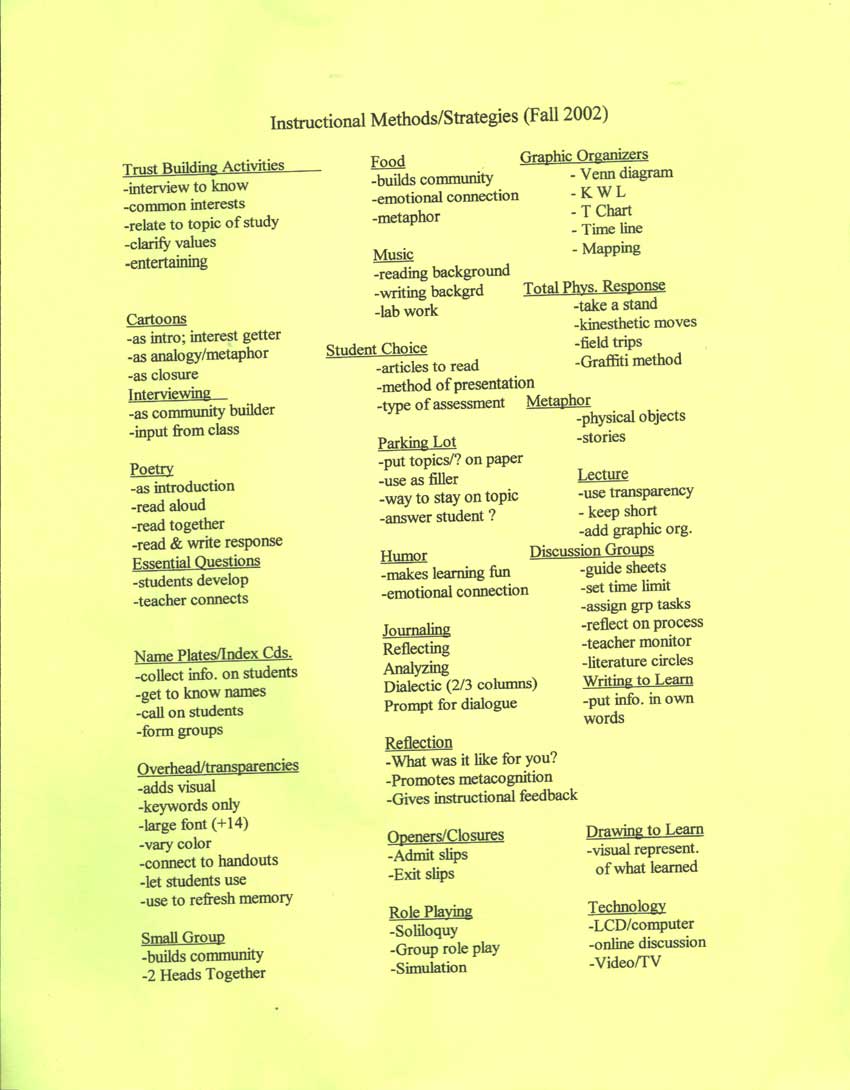
Computer
Lab
-Take Learning Styles Survey
Multiple
Intelligences
See last page of this section.
Multiple
Intelligence Survey
To see the best ways my students
will learn.
Presentations
-Poster Board
-Power Point
Jigsaw
Several groups of students read a section of
an assignment together, then the class comes
together and each group shares what they have
learned with the entire class.
Graffiti
Write down different topics related to lesson on
big sheets of paper - one topic per paper - and then
have students walk around room, piling their thoughts
on each topic onto the paper.
Guest Speakers
A wonderful authentic experience that benefits all
types of students.
Direct Instruction
More Ways
to Use a Notebook
-Journaling
-Taking a Stand>
-Start Up/Warm Up
-Freewriting
-Listing/List Storming
-Fact/Values Lists<
-"K-W-L"
-Graphic Writes>
-Written Conversation / Dialogue<
-Learning Logs
-Exit Slips
-Admit Slips
-"Stop-n-Write">
-Poetry
-Dialogues
-"Faction"
-Definitions
-Paraphrases
-Predictions
-Dialectics / Double-Entries
-Metacognitive Analysis
-Instructions/Directions
-Observation Reports
-Class Minutes
-Problems, Questions, Exercises
Community
Building and Grouping
-Find groups via humming
-Lining up by birth month<
-Clock partners>
-Colored Shapes>
-Each person in group has definitive rolle
-Literature Circles
-Thinking About Thinking
-Reciprocal
Teaching
-Grammar: Have students do a quiz in pairs. This is a small
quiz, perhaps ten points. After everyone has finished, a student
volunteer then gives the answers that pair has gotten. The rest of
the students in the class say whether that answer is correct
or not.
If not, they must prove why. The class has a majority of the vote
for the correct answer. Even if the class majority
says the
answer is right and the answer is indeed wrong, the entire class gets the
answer wrong. In the end, the entire
class receives
the same grade on the quiz.
******
TITLE: Spotting Details
GRADE LEVEL/SUBJECT: English for secondary students
OVERVIEW: This lesson is aimed at victim awareness.
OBJECTIVES:
To pay closer attention to details, and
subtleties
of same.
RESOURCES/MATERIALS:
Pencil and paper. If no window and
street
available, a contrived exhibit could be developed.
PURPOSE:
While the guise of the lesson is creative
writing,
the subject can be construed to apply to witnesses
and witnessing,
and ultimately to a better understanding of
others'
perspectives.
ACTIVITIES
AND PROCEDURES: Observe changing objects - in my
case, the
cars passing on the street - for a limited time
(2-3 minutes).
No discussion is permitted until lesson is
completed.
On cue, the students return to their desks and
record
as many details of items (vehicles) observed, and in
proper
sequence of appearance.
TYING IT
ALL TOGETHER: Reports are collected and read back
to class.
These are compared with either a video taken on
occasion
- if possible to do discreetly - or withh
documentation
recorded by instructor.
******
TITLE: INTRODUCTION TO AMERICAN LITERATURE
AUTHOR:
Shannon McBride, Sweet Home High School;
Sweet Home, Oregon
GRADE LEVEL : 11th grade
OVERVIEW/PURPOSE:
Students will be reading literature
written
by American authors through out this year long
English
class. Each of my students comes with
different
views on America, literature and reading in
general.
I try to grab their attention and motivate
them by
this lesson and activity.
OBJECTIVE(s):
1.
TSW decide what freedom means to them by
freewriting and discussing the topic.
2.
After listening to a tape of the The Star Spangled
Banner, TSWBAT freewrite about what the National
Anthem means to them as teenagers and to our
country.
3.
By collaborating with a group, TSW create a new
and original verse for the National Anthem.
RESOURCES/MATERIALS:
Tape of the Star Spangled Banner
sung by
Whitney Houston, Poster of Whitney, Lyrics of
the National
Anthem.
ACTIVITIES
AND PROCEDURES:
Set: FREEDOM
IS . . .
a. Freewrite and discuss their answers
b. How did people of the past feel about
freedom? Differently than us of today?
TRANSITION:
Today we are very lucky to have the famous
musical
artist Whitney Houston with us. We will listen
to her
sing The Star Spangled Banner And then do some
free writing,
discussing and a group activity.
While the
tape is playing think what this song is
saying
to you and what it means to Americans.
A. Freewrite what this anthem means to you and
our country.
DISCUSS AS A CLASS!
A. Think back to the words or the anthem,
what do you think they say about our
country? What did this piece mean to
people of the past? Do they still apply
today? How ? Why? DISCUSS!!!
TRANSITION:
Many things have happened and changed in
our country
since the National Anthem was written. So
here is
your chance to bring an important part of our
country
history up to date. Get into groups of two or
three for
this project. As a group, work together to
rewrite
or create a NEW verse for The National Anthem
that fits
your life or our society's life today.
A. Show my example (OVERHEAD)
B. Review Group Procedures
C. Brainstorm and Group Activity.
CLOSURE:
Get with a partner that was NOT in your group
and share
what you've written.
EVALUATION:
My observation, their freewrites,
discussion
and final creation.