Text: Including Students With Special Needs. Marilyn Friend and William D. Bursuck
Case Study / Pre-Clinical Paper
Part I
Painting A
Picture
Special Education at Addison Trail High School
At Addison
Trail (AT), District #88, Special Education has it's own wing dedicated
to it. There are several categories in which a student with specials
needs can fall under: Social and Occupational Development One (SOD1),
Social and Occupational Development Two (SOD2), and Behavior Disorder (BD).
Students who have low-incidence disabilities such as Down Syndrome (159)
are included in the SOD1 program. There are 21 students included.
SOD2 includes those students with high incidence disabilities such as learning
disorders and Attention Deficit Hyperactivity Disorder (ADHD), and make
up the brunt of the entire Special Education department. Behavior
Disorder students have been described as "the kids nobody else in the school
wants in their classrooms" by some teachers. They often have emotional
disturbances as well and may have trouble interacting with peers and adults
alike (224). Many classes are offered through all these programs:
Physical Science, Biology, Global Studies, English Literature, Self-reliance,
Pre-Occupational Skills, both Consumer and General Mathematics, Economics,
Political Science, American History, and just this year, Reading.
Each
student must be tested yearly via the Kaufman Test of Educational Achievement.
Last year, AT used two different versions: a test that is approximately
one hour in length for the yearly reevaluation, and a test that is approximately
three hours long for the three year reevaluation. This year, the
school as decided to follow it's sister school, Willowbrook, in disposing
of the three hour long test. Now each student is required to take
the short form test as close to their reevaluation date as possible.
Every
student included in the Special Education program has one hour a day set
aside as a resource period to get help from teachers with homework and
projects. These periods are adjacent to the program in which they
are in. For example, those in SOD2 have what is called Individual Curriculum,
which is basically like a normal study hall. Those in the BD program
ILR, Independent Learning Resource, which houses few students per class
and most always has at least one teacher and one teacher aide.
The
decision making process for Special Education is much like the diagram
Friend and Bursuck provide (49). Mostly where District #88 functions
is included at the bottom of the chart, for most students in Special Education
have already been identified and placed there years before by the Multidisciplinary
Team of their grade school or middle school. Teaching in a Special
Education setting continues, a meeting for reevaluation occurs every year,
and finally Individual Education Plans are updated.
Edgar - A Typical Day in a Special Education Setting
The student I observed, whom I shall call Edgar, is included in the SOD2 program, although he is mainstreamed into other classes such as Reading 10 for Sophomores. He has been receiving Special Education services since the first grade. Edgar is a Caucasian 16 year old male, five feet six inches tall (seven if you include his brown hair, which he wears in little spikes which peak off of his head and stick straight up.) He is pudgy, but not fat with a round face, brown eyes. He usually comes to school dressed comfortably, matching sweat suits or jeans and a T-shirt or windbreaker the norm. Here is a vivid example of Edgar in an everyday classroom setting. I use this one example because thought my observations I saw much of the same behavior. I believe this class is the best example of how Edgar functions.
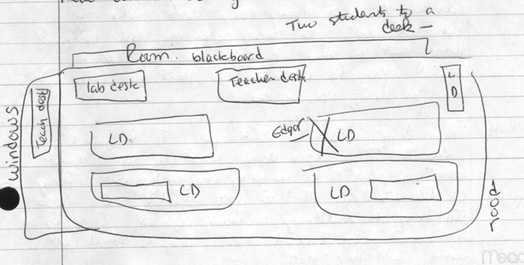
8:35 AM in Physical Science, room 133. Both Physical Science and Biology are taught in this classroom, and the walls are caked with posters depicting the subjects. Here is a quick drawing I made of the class, and my observation student's seat in it:
The class consists of four female and five males. Edgar laughs loudly
in the hallway with his friends, going out of his way to hit his friend
Mike in the shoulder roughly as they call insults out at each other.
The two are friends. I could tell because they are laughing as they
drift into the classroom as the bell rings. He sits down at his lab
table where he sits alone. He looks bored before class has even begun.
Edgar has a habit of picking his lips when he's uninterested in whatever
may be going on. I can tell he is daydreaming whenever he does this,
which is very often. The teacher, Mr. Saravin, starts the class off.
He is a young teacher, only 24. But this has nothing to do with his
teaching skills which I found excellent. He joked with the students
and was able to tolerate most of Edgar's tomfoolery through crafty classroom
management skills. Mr. Saravin tells everyone to settle down, but
Edgar fails to comply, and has to be told independently to please stop
talking. Edgar is the type of student who has a sarcastic, out of
turn comment for most everything the teacher has to say. For example,
as the teacher hands back the tests the students had taken a few days before,
Edgar says "I can't take this, it's too heavy." He whips out these
comments, talking a little bit faster than normal speech. For the
next five minutes, he remarks things such as "My stomach hurts," and "That's
all we do is work," when the teacher is getting ready to start a lab.
Most of his comments are spoken directly over the teacher. By 8:50,
he is picking once again and staring off into the distance. Soon
however, he starts to draw, probably hoping the teacher will think that
he is taking notes on the lab. As Mr. S gives more directions, Edgar
finds it funny to tell other students what to do when they ask Mr. S to
reiterate, mimicking him. The teacher refuses to acknowledge such
behavior, and nicely asks Edgar to read from the next set of directions
for the lab, which he does without trouble. With 35 minutes of Period
2 remaining at 8:55, Edgar asks "Are we done now?" A female student
sitting behind him sighs, and although she is generally a nice girl, cannot
help herself from calling him a "moron" (throughout my observation, it
was obvious to me that Edgar unfortunately annoyed both teachers and students.
Teachers were more apt to put up with it to a certain degree, but students
were less tolerant). A few minutes later, Mr. S finds himself getting
more frazzled with Edgar because he asked about something Mr. S had just
finished saying. The result: an annoyed "Edgar, will you pay attention?!"
After this, the students gets rather quiet. He picks at his lips
and looks at his fingers almost constantly, concentrating much more on
that then anything the teacher had went on to discuss about the lab the
class was about to partake in. At 9:06, all the other students were
moving about to get their lab materials and hook up with their partners,
except Edgar. When coaxed by the teacher, he finally begins to participate.
As the lab goes on, I was surprised to see that he wore the required goggles
with no trouble or comments. Although he liked to fiddle with the
materials when it was not proper to do so, I noticed that Edgar did work
well with his partner, the friend from the beginning of class named Joe.
At 9:09, Edgar engages in singing a rap song as he works, and then broke
out into "shake it up baby!" when he started to shake water inside of a
bottle, which was a step in the lab. Again he starts to bolt out
comments every few moments: "Oh, my eyes hurt!" "It smells!"
"Oh my god use your brain!" and the like. It's obvious Edgar likes
to make sure everyone is paying attention to him-for good reasons and for
silly ones. The class goes over the questions to the lab once it
is finished. Edgar asks "What's number four?" Mr. Saravin understandably
replies with "I said number four a million times!" which was true.
It was hard to tell if Edgar was just trying to annoy the teacher or now.
In my observations, I noticed that Edgar's retention skills are low.
When being taught one on one, he often grasped the concept after a while
and was able to do work on his own. However, the next day that same
skill was completely gone once again. Still, I doubt his memory skills
are so low that he cannot remember something that was said literally a
few seconds later. Now there is but ten minutes of the class time
left, and the lab is over. Edgar carelessly tosses the goggles onto
the teachers desk, and when Mr. Saravin asked him kindly not to do so,
he bluntly replied "I didn't." He stood up and adjusted his clothing.
I noticed that appearance is very important to Edgar, for upon other observations
I've seen him often use mirrors (if one was hung somewhere in the classroom)
to check his hair. The remaining five minutes seem to be a free for
all. The students are suppose to stay seated until the bell rings,
but Edgar gets up to walk around, fools around with his friend at the sink,
doesn't listen to Mr. S when asked to sit down, shakes his desk, takes
a piece of tape for no apparent reason. Finally, the bell rings and
him and his friend jolt out of the classroom, much unlike the way the sauntered
in at the beginning.
Edgar - A Typical Day in a Mainstreamed Setting
The other class I observed Edgar in was Reading 10, taught by Mrs. Moninger. Being a reading room, her walls were splattered with posters about why it's good to read, tips on spelling, and how to write journal entries. Here is a rough sketch of Mrs. Moninger's room:
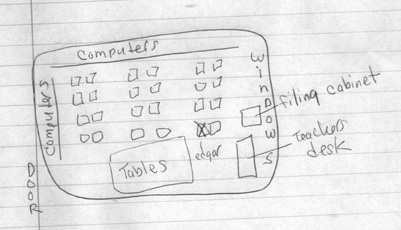
As the class name suggests, the room is full of sophomores, an even number of males and females. Mrs. M is an older, more experienced teacher who has been teaching many years. Sometimes, she can be just as jokey and sarcastic and snappy at her students as they are to her, or other students. She does not tolerate any mischief in her classroom to say the least. I was amazed at the difference between Edgars behavior here and his behavior in the Special Education classroom. Of course, I believe it is because Edgars knows he can get away with more in the Special Education setting. Here is a quick look at a typical day for in Reading 10, Period 3, 9:40 AM:
From
9:40 until 10:00, this class has a ritual of doing SSR (sustained silent
reading) every day. The class is always very quiet as the students
read. Most of the time I noticed Edgar was not reading, but staring
at something, or picking at his lips instead. Edgar is someone who
does not like to read at all. He is very good at keeping his book
open and pretending to read as well. On this particular day, Edgar
had the task of finding a new book to read (there are several racks of
books not pictured above inside the classroom), for he had just finished
a book. Even after SSR was completed for the day, he continued to
half-heartily browse the books. Another student, a friend named Andy,
joins him. Both act slyly as if they were looking for books, but
they were really talking about cars. Neither of the boys took their
seat as Mrs. M was giving instructions on the debate project the class
was currently working on. Once told to sit however, they did, and
a few minutes later Edgar was on task working on the in class assignment.
Of course, his partner was a friend, and they socialized just as much as
they actaully worked, if not moreso. At 10:15, Mrs. Moninger called
him up to her desk to talk to him personally. Edgar needed 13 more
journals on his last book just to pass that book. He nodded, but
both I and I'm sure Mrs. M could tell it was nonchalant, as if Edgar really
didn't care. Back at his desk he continues to do the work at hand
until just a few minutes before the bell, when he starts fooling with friends.
A Quick Sum-Up
From
my observations, Edgar is a witty, energetic boy who uses those strengths
mostly in negative ways. He is smart when it comes to knowing what
he can get away with, pulling out all the stops when it comes to being
in the Special Education classroom. In Mrs. Moninger's class, some
impishness abounds, but in comparison to the Edgar I saw in Physical Science,
it was hardly anything to be concerned about. There was no talking
over the teacher and no absurd comments every few moments. There
was no playful punching of friends or mimicking of other students or Mrs.
M. Again I must state that I do not chalk this up to lack of classroom
management skills on Mr. Saravin's part, but to Edgar know where he can
get away with stuff, and when to stop pushing those buttons at just the
right moment.
Part II
Data
Edgar's Individual Education Plan
I acquired two of Edgar's IEP's, one from spring of his eighth grade year, and his most recent, from April of 2002. In both, the goals and information is very similar, so I will discuss further the most recent IEP. The IEP was created from an annual review meeting in which the Director of Special Education, Edgar, two school social workers, counselor, two psychologists, and a dean. At the time of the meeting, Edgar was 15 years, 7 months old.
Here are some key points from the IEP:
Disability:
Mental Impairment.
Edgar has
good social skills. He is very personable and well dressed.
He likes dirt bikes and mechanical things.
At this time,
Edgar had four D's and three C's in his classes (three of the D's were
mainstreamed classes, the C's were all SOD2 classes.)
The mean grade
level of his KTEA score: 3.0.
Friendly,
gets along with peers and adults, has difficulties with group activities.
He is a little shy.
Expressive
language is adequate.
Motor Skills
are age appropriate.
Works with
Uncle in snow plowing business.
If permitted
to let his mind wander, Edgar has much difficulty learning.
Attitude is
declining.
Math is the
most difficult subject area for Edgar.
Classes for
this year discussed. Six out of seven classes are now SOD2, differing
from his freshman year, where only four of seven were.
Here are some key goals included in the IEP:
When working
in groups, Edgar will use the time to work and not socialize.
Edgar will
read assignments before attempting to answer questions.
Edgar will
earn C grades or higher.
Tony will
show his written work to his resource teacher and rewrite as needed.
Unfortunately,
all of these goals were recorded as being not met yet.
A Sample of Edgar's Work
In the picture seen here, Edgar answers two questions (from 10/02):
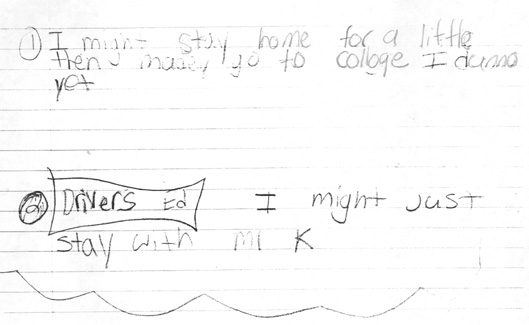
1)What do you
plan on doing after you graduate high school?
2)Name one
class you have trouble with and one thing you could do to improve your
performance in that class?
The first question makes sense, but when I ponder his answer to the second, I imagine that Edgar may not of understood, failed to ask for help, or quite possibly didn't care and wrote the first idea that came to mind just so he could be finished with this simple survey assignment.
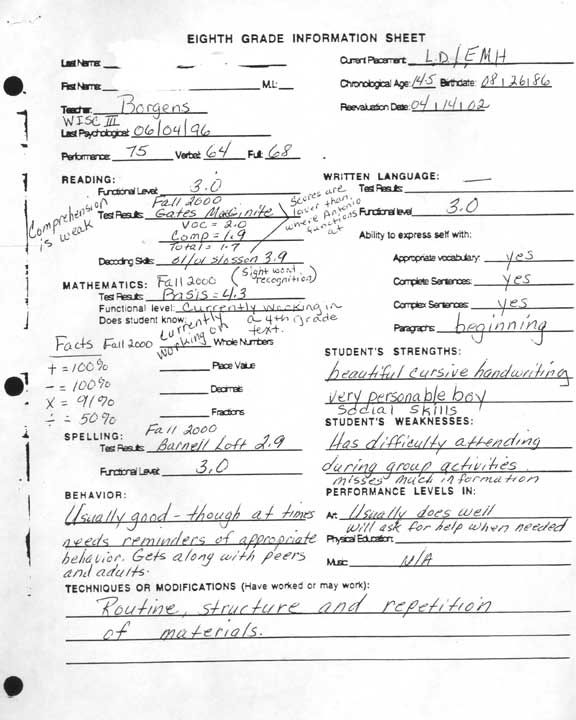
Edgar's Eight Grade Information Sheet
Part III
Analysis of
Data
Students
who are learning disabled have trouble achieving when it comes to academics
because they have trouble in several areas needed to do so. According
to Friend and Bursuck, Edgar would most likely be labeled a student with
a mild cognitive disability (205). He struggles with both the decoding
and comprehension parts of reading (206), although the latter more than
the former. His written language skills are low as well, as seen
in the example above. Edgar spells "maybe," "madey," and "I don't
know," "dunno." Edgar also lacks memory and reasoning skills (214).
Edgar's
IEP data has both fluency in what I saw in him in the classroom as well
as discrepancies. First of all, the IEP states that his attitude
was declining. I believe this is true, and that much of it most likely
happened over the summer. It is also mentioned that peers and teachers
both get along well with Edgar, and just the opposite is what I witnessed,
aside from a few peers who were practically just like him.
Another
discrepancy comes from the comment that Edgar is a well dressed individual.
Perhaps nice jeans and a T-Shirt would fit loosely under this category,
but I would not include sweat pants outfits, sometimes dirty. I believe
this change in dress parallels the change in attitude.
On the
other hand, there are things that flow. It is stated that Edgar is
interested in mechanical things. His freshman year he took Industry
and Technology 9 to learn more. It was said that he would like to
continue in the program, although he struggled through the first part and
received a D in the class. I&T 9 was a mainstream class, of course,
and very challenging for Edgar.
From
eighth grade to his last evaluation in April of 2002, Edgar's grade level
performance has stayed relatively the same. Also, the same comment
is made here about Edgar having trouble working in groups, just as it is
said on the IEP. However, a differences occur here too. On the Eight
Grade Information Sheet, the following is said about Edgar's behavior:
"Usually good - though at times needs reminders of appropriate behavior.
Gets along with peers and adults." Again, from eighth grade to sophomore
year his behavior as declined. Still, this may be true for only a
Special Education setting and not a general education one. Finally,
it is stated on the Eighth Grade Information Sheet that Edgar does indeed
ask for help. In both the IEP and my observations, he has not.
Judging
from my observations, the goals stated in Edgar's IEP have still not yet
been met. His grades currently are predictable: three D's, three
C's, and an F in Reading. Much of his time in groups is still spent
socializing instead of concentrating on the task at hand. Because
of his dislike for reading, Edgar still attempts to find answers the easy
way or get others to tell him instead of trying to read the assignment
first.
Part IV
Interpretation
and Recommendation
From
all this data, I believe Edgar would benefit most by keeping on the path
he is on right now. In a perfect world, I would say that he would
benefit most from being included in all general education classes, if he
were to have a one on one aide at all times to help him stay on task and
remember key points about learned material. As mentioned above, just
this year a Special Education Reading program had been added to the variety
of classes already included at Addison Trail. Believe it or not,
this new class was incorporated in early October. Student were struggling
were pulled from their general education reading classes and placed in
SOD2 Reading. Based on my observations of Edgar in Reading 10, I
would recommend that he be placed in this reading class as well.
I often wonder why he hadn't. Edgar is currently flunking his reading
course. The novel that was currently read was on the difficult side
for him. The test created around it was in essay format. Edgar
could most likely not remember the detailed information Mrs. Moninger wanted,
and no adaptation was made. Since he is bound to stay in this class
the rest of the year, I would suggest the teacher do her best to create
adapted tests for Edgar and students like him.
I have
some recommendations for the area of Edgar's behavior. Perhaps if
the Physical Science class as a whole would of created rules for the class
to be based on, it would be harder for Edgar to get away with all that
he does. Rarely did I ever hear a teacher compliment Edgar, or catch
him being good (437). He is the type of student who would benefit
greatly from positive reinforcers, especially primary (441). However,
I would not go as far as to say that a Behavior Intervention Plan or Behavior
Contract was needed.
There
are many other adaptations I could recommend if they weren't already being
attended to. This year, Edgar participates in seven classes,
six of them being part of the SOD2 program. This program hires trained
Special Education teachers who already adapt their curriculums to fit their
students needs almost to a tee.
Edgar
needs to learn about the benefits of school and why he needs to stay in
school. He shows qualities of learned helplessness (222) and is a
passive learner (214). I have often heard him say "I don't
know," "I can't do this," and "It's too hard." In other words, he
gives up before he even begins to try in most cases. Working to enhance
his self-image when it comes to academics (228) would greatly increase
his performance.
My final
recommendation would be for Edgar to keep up with his Industry and Technology
classes. As the IEP stated, he has a continuing interest in mechanics.
Unfortunately, he is not currently taking I&T, but with the right reinforcers
and help from his resource teacher I believe he could be successful.
The potential is there.
******
Short
Paper
Where do I
stand when it comes to inclusion, integration, least restrictive environment,
and appropriate placements?
11.11.02
My Personal
Values and Beliefs
Regarding
Students with Disabilities
This opinion is derived from a normal, older general education teacher's standpoint. The teachers represented are those who have been teaching several years. Mainstreaming/Inclusion is not an all together new term for them, but however they never thought of it quite as we do. They did not have the unique experience of taking a special education based class at National-Louis University. They are familiar with the law and what it states, but unfamiliar with such strategies for including students with special needs such as INCLUDE. How would a teacher such as this feel about integrating different students with variables of needs? Is there a difference between when students can be mainstreamed and when students should not?
"The physical, social, and instructional assimilation of students with
disabilities in general education settings." This is how Friend and
Bursuck define the word "integration."
"Term to describe a professional belief that students with disabilities
should be integrated into general education classrooms whether or not they
can meet traditional curricular standards and should be full members of
those classrooms." This is how the same pair defines the word "inclusion."
A goal of many schools? Yes. Best for the student? Possibly.
It all depends on the situation.
What I mean by this is that inclusion is a wonderful goal for schools to
have, but only within reason. Many factors come into play and each
student's situation is different. A provision of P.L. 94-142, Free Appropriate
Public Education, states that the Least Restrictive Environment is the
area in which students must be educated for this is where they best succeed
with support. An LRE, for most students, includes the general education
classroom.
Let's take into mind an example. According to the law of LRE, a student
with severe cognitive and mild physical disabilities should be integrated
into a general education setting. We shall call this student Jon.
The idea of Jon being included has both positive and negative factors in
different situations. He is a victim of traumatic brain injury.
His language writing skills are very low, and it is often required that
someone write for him, or be there to constantly spell out words for him
to copy on a separate piece of paper. Jon has trouble focusing on
the teacher, rocks in his desk, and is prone to have seizures although
it does not happen very often. His initiative is low, in that he
needs to be reminded several times to do a task. He is a freshman
in high school.
Should Jon be mainstreamed into a general education class with other freshman?
No. Jon would not benefit from this integration, as nor would the
teacher or the students. This case may be too extreme for a
general education teacher, who most likely has little or no training in
how to deal with students like Jon who have such a particular disability.
In addition, where comes the time to make appropriate adaptations in the
curriculum for Jon? How will the teacher, whom we will call Mr. Krugman,
concentrate on teaching an entire class of 30 students and individually
help Jon write, focus, and stay on task? An impossibility.
On the other hand, let us imagine that Jon has a one on one paraprofessional
who follows him through the day, helps him stay on task, take notes, and
the like. Then is it appropriate for Jon to be included in a Least
Restrictive Environment? Maybe. Of course, it would help Mr.
Krugman tremendously to have the paraprofessional there with Jon at all
times. Nevertheless, there is the issue of the teacher being required
to construct what may be an entirely different curriculum just to suit
Jon and his needs. Practical? Unlikely. Suppose Mr. Krugman
has other students in different classes that have traumatic brain injury
as well? Then perhaps, it is practical. But what if Mr. Krugman
has other students with special needs that require adaptations in curriculum,
but a different adaptation from Jon because their need is not as extensive,
or possibly moreso?
Although a teacher should love what he/she is doing enough to spend many
hours with students, planning lessons, and grading homework, there is a
reality to the limit of time that can be spent. Teachers do, or at
least try, to have lives outside of their professional career. In
some cases, teachers struggle with having time for themselves with just
their regular class duties to be concerned about, let alone having to develop
separate curriculums for students who need special adaptations.
Now let us look at Jon's situation from a students perspective. In
the case that a paraprofessional could not be provided, whether it be for
school funds or limited availability, how would this effect the rest of
the students in the classroom? Mr. Krugman would have to stop
often to make sure Jon was focusing on the lesson, taking notes, etc.
The average students in this class would become unfocused themselves from
the constant need to stop. In more harsh words, they would be slowed
down tremendously, become bored, agitated, and all the while probably trying
to cover it up to have respect for their peer (we'll come back to this
later). The teacher has the duty of teaching standards and the students
have the duty of learning them. The standards are so widespread that
it is a challenging enough task for Mr. Krugman to teach them all and the
students to learn them all in the given time without needing to be there
for Jon.
This situation changes slightly when there is a paraprofessional provided.
As I mentioned above, it becomes easier all around to conduct class.
But how will the students react emotionally? Most would hopefully
accept Jon and be there to help him as well, such as when Mr. Krugman decides
to work in groups or in pairs. However, let's face it, some students
can be cruel. Should it be risked that Jon is placed in a class where
he may have to be subjected to other students negative behaviors or comments?
No.
In this particular situation, it would probably better if Jon were appropriately
placed in a special education setting. Here there would be a teacher
trained to fit his needs. In addition, there would be more of the
basic skills learning such as reading, writing and math that Jon will sorely
need when he is old enough to move on from high school. Hopefully
the special education program offers an occupation skills class and a self
reliance class that will help Jon learn the skills he needs to be independent
in the future.
This does not mean that Jon cannot be integrated into any class!
Perhaps an idea for mainstreaming Jon would be to use a non-academic class,
such as art. In this way, Jon can be among general education students
and not have the pressure of a too challenging curriculum in which he cannot
reasonably keep up.
Of course, not all cases are like that of Jon's and Mr. Krugman's.
Let us use an entirely different situation and decide if inclusion is appropriate.
Celes is student with a mild learning disability. Her most prominent
problem is dyslexia, followed by low retention skills. She
excels in math and music, playing in the school orchestra.
She has trouble with English and Reading classes due to her disability.
She gets easily frustrated when trying to read and write, having to make
sure she understood correctly and spelled her words accurately. Celes
is liked by other students, has many friends, and is very social.
She is a junior. Could Celes be included in a general education setting?
Sure!
Ms. Strife is Celes' English teacher. She was informed early on about
her student's disability. Unlike Jon, the adaptations that need to
be made are reasonable. No paraprofessional is needed. Celes
can write successfully on her own, and she is competent at staying on task.
Ms. Strife uses scaffolding often, making sure Celes is put into a group
with higher achieving students who can help her. Modifications for
testing are simple. To help make sure Celes is understanding, she
can have the test read to her quietly at the same time other students are
taking the test. It would be just as easily done if the teacher took
a little time to tape the test orally, and then simply give Celes the tape
recorder and headphones to use in class. Simple adaptations of homework
assignments are used. An example is making sure several examples
are done in class, with still enough work left to do at home so both Celes
and the other students can practice. When Ms. Strife grades papers,
she takes a little more time out to help Celes by correcting her spelling
errors. The teacher keeps in contact with Celes' parents often enough
to ensure that she successfully keeping up with the class.
When it comes to the area of her ability to remember learned skills, Ms.
Strife does her best to create quick outlines based on the lesson to hand
out to the entire class, which will benefit them all, but especially Celes.
She uses creative acronyms to help the students remember guidelines for
the concepts created in class, has a bulletin board with important words
and ideas, and always has a review of material learned before adding new
skills or before a test. She suggests to Celes several ways in which
she can better her retention skills, and shares them with her parents as
well.
All these modifications are reasonable because they do not require a teacher
to take an incredible amount of time to complete.
However, Celes' and Ms. Strife's situation is a lucky one. Ms. Strife
had the materials and skills needed to help Celes succeed. Unfortunately,
this is not always the case. When this happens students such as this
one are misrepresented in a special education service, or left without
help completely.
In cases of high incidence disabilities such as Celes', inclusion is usually
the best way to go when a student's social needs are being considered.
For this I will use an example from one of my reflections that highlights
this point perfectly. We all know that image is very important to
most high school students. Recently the high school in which I work
had an all school assembly in which students were to be seated with whatever
academic class they were currently in. In this case, I was aiding
in a special education science class, made up of high incidence disability
students with mild learning disorders. Several of the students vocalized
that they did not want to sit with the class and be deemed by their non-LD
peers as "special ed kids." Who can blame them? As I have mentioned
before, it is unfortunate, but kids can be cruel. At least once a
day I hear complaints to the likes of these.
So where do I stand when it comes to integration, inclusion, appropriate
placements and least restrictive environment? A reasonable goal would
be to incorporate high incidence disability children as much as possible
in a mainstreamed general education classroom, providing that the school
or district is willing to accommodate by ensuring their teachers are capable
of and are willing to adapt for these students and needed supplies are
readily available.
Students who have low incidence disabilities who need to focus on learning
independence and the way of the outside world after high school such as
Jon would benefit more from a special class in which these skills can be
taught by a certified professional special education teacher.
Each student with special needs is just that - special. Each child's
disability and requirements are extremely different from the next.
Each situation needs to be taken into account from the students perspective.
Not all students can be successfully mainstreamed. In short, a student
should be included in a general education setting only if the accommodations
and adaptations needed are reasonable for everyone: the teacher, the classmates,
the parents, the other professionals, and of course, the student.
Reflections
Short papers
based on thoughts of the chapters in the text.
Chapter One
Reflections
09.20.02
Part of the provision of P.L. 105-17 of IDEA-97 (12) states that students with language differences are not eligible for special education. The moment I read this, I had to question it. Are our Mexican-American students irresponsibly assigned to special education? I've always thought that many of the students I work with are indeed there because of language barriers, mostly Spanish. I've worked with some of these students several times on a daily basis and know from experience that they are bright individuals who would understand curriculum better if they were more proficient in reading, writing and speaking English. My thought was confirmed in the text (27), which states "Students whose language at home is not English are sometimes inappropriately assigned to special education because of academic difficulties actually caused by lack of proficiency in English." I would agree that this is an erroneous quality of the special education department at my school.
Based both on the reading and from personal experience, I believe inclusion (my school refers to this as mainstreaming) is best for students of high-incidence disabilities, especially LD. We all know that image is very important to most students. Recently we had an all school assembly in which students were to be seated with whatever class they were currently in. In this case, I was aiding in a special education LD science class. Several of the students vocalized that they did not want to sit with the class and be deemed by their non-LD peers as "special ed kids." Someday in the future it would be nice to have complete all around inclusion, but as the text mentioned, for this to be possible teachers may have to double major in their area of content and special education. For most, this would be an extremely challenging task. For those students of low-incidence disabilities, the challenge of mainstreaming grows. Although they may be able to make more friends and be more successful socially, general education teachers would most likely have a very traverse time trying to give these students the special attention they need, while the students who do not need extra attention will become unchallenged and bored. Perhaps students like this who want to be mainstreamed can participate in non academic courses such as music or art. When I was in high school, we had a few students with Downs Syndrome in the freshman choir. This was a great opportunity for them to make friends in a mainstreamed class that wasn't difficult for them to understand, nor extra demanding of the teacher. Of course, these students did have a certain level of cognitive ability and motor skills, just enough to be able to learn some fundamentals of music and how to sing.
******
Chapter Two
Reflections
09.23.02
Chapter Two includes an entire section on paraprofessionals, which is my job title. I couldn't help but notice this section: "IDEA-97 specifically addresses this issue; it states that paraprofessionals should receive training in the skills needed to do their jobs effectively" (40). It is true that I had just received my Bachelors degree upon getting hired (even though the requirements for the job were "some teaching experience" or at least two years of college.) Even so, I did not receive any special training from the district itself before I started work, and would of appreciated it had I had the opportunity. I must admit that now, with a year of experience, this year I feel more prepared to help meet the student's needs. Perhaps the district should offer a one or two week summer "crash" course so that individuals new to the business of being a special education paraprofessional will have a better idea as to what exactly their job involves. This is especially true when there are so many different job descriptions depending on what specific program the aide will be working in. For example, the skills one needs to assist students with low-incident disabilities are quite different from the skills needed to assist students with high-incident disabilities.
Even though I am familiar with the area of special education, I did not realize all the involvement needed to actually assess whether a child needs special services or not (Figure 2.3, 49). However, I am glad that I now know basic guidelines in how to pinpoint a student who may need special education to get the process moving. Although usually by the high school level it is already known what students are involved in special education, it is still possible to find students who do indeed need services, although they have never had them before (48).
I am very familiar with the process of the one year annual review and the three year re-evaluation. At Addison Trail, we use specific testing called the Kaufman Test of Educational Achievement (KTEA). I did not expect to see it mentioned in the text because I noticed upon my many times of administering this test that very few districts in the United States uses this form of testing. Through my experience I deemed it a beneficial way of evaluation of the students current grade level (in basic math, reading, spelling and comprehension skills) in comparison to the last years and three years before. Why don't more school incorporate this form of testing?
******
Chapter Three
Reflections
09.30.02
"The classroom teacher insists that no change in classroom activities is possible, even thought a special education teacher is available for co-teaching." (75) An instant question came to my mind upon reading this statement. What about what is best for the student? It is true that time can be quite a restraint on a general education teacher when it comes to adjusting lesson plans and assignments for their students with special needs. However, it should not completely impossible. Perhaps general education teachers with a high number of special education students should be offered an extra planning period since preparing two different lessons and assignments might be needed.
"In an increasing number of school districts, "early release" days are used." The district I work for, 88, takes much advantage of these. Every one to three weeks on average we have what is known as 1:40 PM dismissals. Each period (there are eight in a day) is shortened by 10 minutes to achieve this. As an aide, I am not required to stay, but teachers use this time for goals mentioned in the book. Twice a year (in October and April) we have a half day, or 11:20 AM dismissal for the same reasons.
"Paraprofessionals should not engage in initial teaching, nor should they
make instructional decisions without input from a certified staff member."
(104) If this is the case, I'm in trouble, for I have taught not
only in small groups and one on one, but I have indeed taught entire classes.
More than once when the general education teacher was out unexpectedly
and there was a sub who did not know the material, I "took over" the class.
All these times were invaluable experiences that I very much enjoyed,
and I am surprised to find out that, technically, I was not suppose to
be doing this at all!
Also on the subject of paraprofessionals: The text mentions that collaboration
is possible and should be happening, but I am rarely asked to do so.
I work for eight different teachers, and having time to consult with them
all would be near impossible. On a personal note: for what the text
describes as all a paraprofessionals duties, salaries are very low.
Perhaps it is just because I have some teaching experience, but it seemed to me that many of the points in this chapter were rather overt. Having sensitivity to the parents' point of view, how parents respond to their child's disability, the whole concept of collaboration, co-teaching, and working with paraprofessionals are a few examples.
******
Chapter Four
Reflections
10.07.02
"Teachers who communicate respect and trust to their students are more successful in creating positive classroom environments in which fewer behavior problems occur" (124). In my experience, this has not be true to the fact. I work in an English class everyday in which, at the beginning of the school year, the teacher let the students decide appropriate rules for the class (this is stated as a very effective way to dumb down behavioral problems in the class room). She showed them all respect and treated them as adults, trusting them to come up with adequate rules. However, in the weeks that have passed, the more trust she shows the students, the more they tend to "walk all over" her. This makes me question her instruction. Is it relevant, interesting, and active as the book suggests? I am guessing no, for the behavioral problems in the class keep growing. Now we as "team teachers" are talking about the possibility of referring several students who will not follow instructions.
"If your classroom includes students who are not native English speakers, you need to make sure these students understand classroom expectations" (125). This is all fine and well, but if the student is not proficient enough in English to understand the course objectives, how is that student going to understand the course content and be successful in learning it?
Last year in my physical science class, there was always trouble with transition time. The classroom was not set up to be scientific (although it is this year), and the desks had to be moved into pairs whenever it was time to do a lab. The teacher was very smart in how she went about getting the students to do this quickly and effectively. She would say things like "all right, you've got five seconds to move into lab position." Over time, key words were created. Soon, all that had to be said was "lab positions, go." Even through all this, transitions to and from lab could still be time wasters and messy.
It is very interesting that a computer is considered a form of one on one education. I should of realized this earlier. In one of my reading classes, the students take post vocabulary tests when they finish their chapter. Of course, all the keyboarding classes have computer programs which help students learn how to type proficiently. This also ties in on a technological level. "Assistive technology promises to revolutionize education in the US schools." Again, this is wonderful, but what about school districts (and there are MANY out there) that cannot afford such luxury? Are these accommodations only for special education schools? If inclusion is the goal, won't every school have to acquire this appropriate equipment to help it's students with special needs?
I was happy to read about Independent Student Practice, for this sections reflects on how I teach the piano. In a lesson, the student learns how to play the material to practice that week initially. My students enjoy playing and learning the piano, which entices them to practice. Their practice is, of course, individualized, as well as their lesson. The assignments in which to practice are always specific. We focus on a few things a week so the student has adequate time to master that skill before moving on. Their practice is organized because the books in which they learn out of go hand in hand, and I as the teacher always right down what to practice as well as key points and terms to remember and study. Teaching and practicing piano is an excellent example of an Independent Student Practice.
******
Chapter Five
Reflections
10.14.02
In my job, I work with several students like Helen who have Down Syndrome (159). The story represented in the book is very close to many of the lives that develop here at AT. AT AT, we also have what is known as the Pre Occupational Skills class, in which students like Helen learn what is necessary to obtain and keep a job. Everything from terms, mock interviews, how to ask good questions and counting money is involved. There are no mainstreamed classes such as this. Do other schools have such beneficial class for their students with special needs?
Check your learning (162): This is a question I cannot yet answer. Inclusion is a wonderful goal, but how do we keep our other, non-disabled students a good pace for them as well as others? Having the other students help is a great idea, but we must also keep in mind that not everyone will be comfortable in doing this. I look forward to learning more about how to balance the needs of everyone in the class. How does making adaptations help other students learn more? (Link to page 165 - list of common teacher problems).
I was not aware of how ASL is like learning a whole new language (175). Would it be easier to eventually convert to SEE (at least I know finger spelling!)
******
Chapter Six
Reflections
10.21.02
"It is incorrect to view students as having communication disorders when they use ethnic or regional dialects, speak a form of nonstandard English learned at home, or are native speakers of languages other than English and have limited English proficiency" (201). Once again I must point out that there is an overpopulation of foreign language students in many special education programs. We know that it is not a form of learning disability, so again I ask why is this so?
African American students are more prone to being over-identified for behavior disorders, whereas Asian American and Hispanic americans are not (206). I believe this may be so because of the cultural life of African Americans. Recently I observed at a high school that was almost 70% African American population. Many of the other observes took these classes to be more chaotic than what they are use to. Could this be because of a cultural difference? Perhaps in the African American culture, louder is a way of life. Based on a personal experience in college, when I lived with an African American female, it seems that a different definition of respect may be all together possible.
Boys who are having trouble learning are more likely to attract the teacher's attention because they are more prone to disrupting class outwardly. Girls on the other hand, are just the opposite (206). I have had an experience with this myself. In reading class, a Hispanic-American girl was always very quiet, and never any trouble. However, a few weeks later when it was time to turn in journals, we discovered she hadn't done a single one because she didn't understand English well enough to read the topics or understand the teacher. No one quite caught on because she was always so quiet.
Some students lack a key skill when it comes to being able to learn effectively: memory (214). Last year in math, I worked many times one on one with a male student. I quickly learned that his memory for mathematics was not the best, for after an hour or working with him on fractions, the next day he had forgotten it all and was back to base one, needing one on one help again. It was like this most everyday. He always "got" the problems near the end of the period and was doing great on his own, but then come the next day, or especially over the weekend, it was all gone. We must remember to be patient with students like this. It is very challenging!
******
Chapter Seven
Reflections
10.28.02
The Professional Edge (235) makes the point of marking right answers instead of wrong ones as one of many Section 504 Plan Accommodations. I believe it is a wonderful idea to do this for every student, not just those who fall under various sections or 504 or IDEA. It is proven in psychology that more confidence is instilled and students do better when all the positives are pointed out, with lesser emphasis on the negative.
As I read about characteristics of students with ADHD (237), I cannot help but describe a student whom I knew had it before reading the symptoms. Lo and behold, all of them are listed here. I'll call the student Cid. He is a freshman at the school in which I work. I observe him daily in study hall and in math class. He amazes me sometimes in study hall, because when he really needs to get something done, he manages to sit down and do it. Sometimes I wonder whether or not his medication has worn off by math class two periods later, because he is almost completely uncontrollable. Cid use to distract even me by looking at me upside down from his desk, which was right in front of mine (which was in the back of the class). The student teacher finally got the idea to move him to the front, but he is still very rambunctious even there. He cannot wait his turn and constantly wants to go to the board to write out math problems (which is good, until he gets fidgety because other students need a chance as well.) He bothers other students in the class who are different from himself as well, channeling all of that energy into it. Cid likes to go sharpen his pencil several times per period as well. Class often stops just for him to be told to settle down. A classic case of ADHD.
I was very happy to read about bilingual education programs. Students getting the chance to be taught in their native language is wonderful. However, no where did I read that they were also included in intense English-language learning classes. This is what our bilingual students so sorely need. I propose that they are taught the basics in their native tongue for half the day, and for the other half are in classes which will teach them how to speak and write English fluently. Then when this is complete, they can take any courses they wish.
******
Chapter Eight
Reflections
11.04.02
"A special education teacher or the school psychologist usually gives individually administered diagnostic tests as part of a student's case study evaluation" (277). This is something I know of all to well. At Addison Trail High School, the special education departments administer the KTEA, or, the Kaufman Test of Educational Achievement. This is a part written and mostly oral test containing the subject matter of math, reading, and spelling. However, it is not a special education teacher of psychologist that gives the test, it is the teacher aides. Each test takes about one class period, give or take depending on the students ability. The student does a set of written math problems, and then a section of math where each word problem is spoken. The students are allowed to take all the time they need. The test is capable of giving a standard grade level based on the scores. This is used in every annual evaluation meeting. We use to have to different KTEA tests, one for every year re-evaluation and one for three year re-evaluations, but we have done away with the specific three year tests. Perhaps this is because the test took over three hours for some students, which was missing too many study hall days. This test is included in the Professional Edge on page 281.
I believe that alternative assessments are a wonderful idea to suit certain students with disabilities, especially low incident cases. It is most likely that these students will not be able to master the standards of such regular high school subjects such as Algebra, American History, English literature and the like. It is important to teach them the basics of reading, writing and mathematical skills of course, for these are skills one truly needs to live independently. However, students with low incident disabilities (and in some cases, high incidence as well) need to learn and have assessed the other skills needed in life, such as how to work, how to get a job, how to shop, how to dress and clean themselves and so on. Hopefully most schools, like my own, have a program where these students learn these critical skills.
******
Chapter Nine
Reflections
11.10.02
I learned very much from reading the section on teaching content area knowledge.
I imagine this section based more around high school and middle school
students, whom I will be teaching. All the the ideas and suggestions
included in this section are very valuable, especially the PReP Strategy
(322). Some of facts presented, such as making sure you can relate
the subject matter to a student's background, were obvious. I've
noticed several times when I've mentioned a popular star or something I
knew the student enjoyed, something that was in their background, I had
better attention and more interest automatically, because now I was talking
about something they enjoyed. It is crucial for teachers to try and
get to know their students well enough to relate things in this manner.
And if a teacher is unsure whether a students likes or dislikes a certain
example, just ask! The Cultural Awareness section (323) suggests
using examples and experiences to enhance learning for special needs students.
Why just special needs? Every students loves a turn in the computer
lab or a chance to go to the theater or zoo! Might as well include
everyone.
However,
much of the rest of the chapters strategies for teaching and including
special needs seemed to be focused on elementary students. Some of
the ideas are applicable to high school students, but still seem to be
given in a classroom environment.
"A survey of general education teachers showed that teachers favored the following homework adaptations: adjusting the length of assignments...." (348). What? Are they nuts? This is a wonderful idea, and would work wonderfully for a student who needed less work, but this would not be understandable by other students in the class. I am considering a general education classroom that has a one or two high-incidence disability students, such as those who have a learning disorder. These students look and act the same as all the other students in the class. The other students, if it is found out that those learning disabled students have "easier" assignments or "less homework," will raise havoc. In the case of a student with a more severe disability, I can see this being understandable.
"The most preferred adaptation were completing assignments entirely at school..." (349). Of course students want to finish homework in school. This is so then can go home and have nothing to do. It is an ideal idea, true, but unpracticed, especially in a high school setting. Students in high school have six to eight classes on average. Most special needs students do get a study hall to work, but in my experience it is rarely used to it's best advantage, and if it were it would hardly be enough time anyway.
******
Chapter Ten
Reflections
11.10.02
"Carefully explained expected outcomes can be motivating, particularly as students get older and teacher encouragement alone may no longer be enough to keep them interested" (359). Very true when it comes to high school. I've even come to the need of having to remind students that if they do not learn a certain material (pass a certain class) they will not be able to graduate in the spring! A better example was when I tried to relate why learning subjects of all kinds is important. Every teacher is asked the age old questions "why do we have to learn this?! We'll never use it in real life." To this I say sometimes it is true. A student who desires to be an actor may never use biology in his life. However, to this student I say, "High school is a place of learning, not only facts but learning how to learn and be independent, and proving to employers that you are smart and independent enough to graduate high school."
I am so glad this chapter contains effective, easy to remember strategies such as SCUBA-D, CAPS and POSSE as well as note taking strategies such as CALL UP and ANOTES. As a growing teacher of English, these are very valuable to me! Of course, the writing strategies are just as important. Ideas such as POWER, TAG for peer editing and the like are useful. All of the writing strategies are well planned out as well. Of course, all these acronyms must get confusing when enough of them are thrown at your students. Picking one or two of them to best fit a particular class is probably best. (364-377).
"Students are no longer limited to community or school libraries for information and ideas" (373). Yes, this is true. The World Wide Web has become highly used in my classrooms, but is it too much? I have helped students find many things on the web, but when finding something specific was unsuccessful, they were unwilling to try to go to the library and find a book. I believe that the internet is becoming somewhat of a crutch to certain students. I am speaking of students who have mild learning disabilities, or those who do not like school and the like. These students want to get their work and projects out of the way quickly, and what better way then to look it up quickly on the internet and copy/paste? My students would rather sit at a computer a thousand times over going to a library and actaully looking up information in a book. Perhaps in some classrooms a happy medium needs to be attained. Teachers need to make sure projects have web sources documented and check them to look for plagiarism.
******
Chapter 11 Reflections
Table 11.1 (393) lists several good strategies for adapting tests for students with special needs. A good idea that is not listed is curving tests. There are several ways to curve. One way is to take the highest grade that was received in the class (as long as it was not above 100%, in the case of extra credit) and make that percent the 100. So if the highest score was a 94%, that becomes 100, and every other students' grade will raise slightly as a result.
In helpful test taking strategies (396), one of the items included that may help students succeed in essay questions is "leave time to proofread your answers for clarity, legibility, spelling and grammar." I agree with the first two, clarity and legibility, but in past chapters of the book, it is suggested that to help students with special needs, spelling and grammar should not be taken into account.
As we've discussed in FND 504, there is so many more beneficial ways to assess our students other than letter or number grades. Sometimes I wish they could be extinguished all together. I am grateful for the many different alternatives this book provides when it comes to grading, especially performance based assessment and authentic learning experiences. These methods are best practices that every teacher should try to include in part of their curriculum.
I think portfolios are a wonderful idea if used within reason. What would happen is a student was in a normal eight period day, and each one of his or her seven different teachers required a portfolio? Uh-oh. Big trouble. Of course, a way to try and remedy this would be through collaboration. Perhaps portfolios would only be required for classes that are integrated, and more than one period a day, or a class that lasts the entire year instead of just one semester. Or in the case that a student would have this many portfolios' to complete, the student could create an integrative one with the agreement of his or her teachers.
******
Chapter 12 Reflections
Hooray for this chapter! I've needed to read some of the ideas represented in it for a long time, for they will help with my current job as a Special Education Aide. However, parts of the chapter were somewhat given.
I believe the idea of a Token Economy is great (433). A fellow cluster student described to us in our Thursday night class a version of this which I see many of us implementing in our classrooms that may be more behavior disrupted (or classes that just need motivation). The system covers all of the bases described in the chapter.
I found it rather odd that much of the book mentions the INCLUDE strategy, and yet in this chapter it is pushed aside to be used for emergencies only. Perhaps it would have been better to introduces the strategies present in this chapter and then go on to say that if all of that fails, use INCLUDE. All throughout the book I was thinking that it was the best way to go when it comes to mainstreaming students with special needs, and here in Chapter 12 are a whole list of ideas to try before implementing INCLUDE!
Extinction really works. I have an example of my own. I am generally very friendly to my students, always talking and joking with them when appropriate. One day in class, we made cookies. I had not been there the day before because of required observation for the Thursday night class. As a result, a female student named Chris accused me "You only came for the cookies!" I laughed at her joke and jokingly agreed. However, all the next week she became accustomed to calling me "Cookie." The first day I thought it was rather cute and funny, but after that, I asked her nicely to call me by my name. This didn't work very well, so soon I found myself not responding to her questions and calls when she called me "Cookie." This worked. Finally, needing my help, she called for "Ms. Larkin." And she has ever since.
******
Chapter 13 Reflections
"What became clear was that placing students with disabilities, especially those with cognitive disabilities, in classrooms with non-disabled peers did not alone ensure that positive social relationships would develop. In fact, the opposite was true" (469). Well of course! What else could they expect? This is especially true (in my observation) for children who appear "normal" on the outside, but have a cognitive disability. Sometimes, once other peers figure this out, they disrespect that peer with the disability. Sometimes, they don't care, but they don't jump to make friends either. It is almost like kids with learning disorders are stuck in the middle. Last year, we had one student in a motorized wheel chair who graduated. He always had a one on one aide. At the end of the year teacher retirement/spring sports assembly (like a homecoming pep rally built for spring sports), it was announced that this student was going to graduate. Him and his aide were coaxed to the center or the gym, and there was a standing ovation. This was wonderful for the students of the school to do, but you'll never see anything like it for our LD/BD students who graduate. This is truly an accomplishment for them as well - many of them don't make it.
In the Nurturing Support and Friendship section (472), they mention a group
called Special Friends. Addison Trail has a program similar to this
called "Best Buddies." Best Buddies is a wonderful group for the
students in our SODI
(S-O-D One
- Social and Occupational Development) program. There are almost
25 students in it, all with mild to severe mental retardation and/or learning
disabilities. Of course, Best Buddies is a club where other students
from around the school join to become best buds with the students in SODI.
Each student is assigned one to three or even four buddies depending on
how many others join the club. They do many fun, wonderful things
like pizza parties, and even an annual trip to the zoo! They write
letters back and forth, and even count on their best buds for rides to
and from sporting events at school. It's truly a great program that
has but many smiles on many faces.
Educating students about their peers who have disabilities is a good idea (475 - 480), but not in all respects. How many high school aged children with learning disabilities would want their teacher explain "Now everyone, we need to understand that Tony has a little more trouble when it comes to learning in comparison to everyone else. He may have modified homework or tests, but you need to know that it is for a good reason." As I was typing that, I wasn't even so sure how to word it! How do you tell a class something like that? Wouldn't Tony be mortified? Again, I see this as a more understand task if the disability was more obvious, low-incidence. Is it right to inform the class about particular students on days when they are not there is it is not embarrassing for them? Probably not. The book gave some great suggestions on how to teach students what it is like to be a student with a learning disability. I particularly liked the idea of giving them reading material that is too high of a level and then asking complicated questions. But can you do this right under Tony's nose? If so, how?
******
Final Reflection
I would like to start out by saying that this class has helped me tremendously
in my current job as a Special Education Aide. Many of the skills
I was in the process of developing grew immensely, and I also learned several
new skills to help me in my endeavors.
Of course,
it goes without saying that the class as a whole has helped me to be more
aware of exactly what Special Education is: in classrooms, in districts,
through teachers, through students, and by law. The adaptations I
have learned will be very handy when it comes time to be in control of
my own classroom next year.
However, I noticed that the text book mainly deals with ideas centered
around grade school levels. It would be wonderful if there was a
book for including students with special needs specifically for the high
school levels. It is true that many plans can be adapted for secondary
schools, but most cannot. Also, I found much of the material in the
book to be facts I thought everyone should know or already knew.
I believe this may be because I have been working in the Special Education
area for almost a year and a half now, and may be much more familiar with
terms, adaptations and the like then a fellow student who has never before
been exposed.
Working in groups with my fellow soon-to-be educators was always a nice
experience, it was great to hear different stories and ideas every week.
Nevertheless, it also would have been nice to break up the classroom routine
by doing something new and refreshing.
Overall, I believe knowing how to include students with special needs is
crucial when it comes to finding a job as a general education teacher,
especially these days. I plan on keeping the text book close at hand
when I start to teach.