Texts: Berk, L.E (2002) Infants, Children and Adolescents (4th ed).
******
Essay Question
ONE
Stress in
Adolescents
Stress
is the "wear and tear" our bodies go through as we adjust to our constantly
changing environment. Anything that causes change in our lives causes stress.
It can be short-term or long-term. The adolescent years are among
the most stressful times in a person's life. Adolescence is the time of
life when children change into adults. They are going through puberty,
meeting the changing expectations of others, and coping with feelings that
may be new to them. Adolescents are between stages. They have more
responsibility and freedom than they did as children. However, they
have less responsibility and freedom than adults do. Their thoughts, behavior,
and social relations are all changing radically. The rate of change varies
from person to person.
There
are a number of reasons for an adolescent to feel stress. These are
stresses that have been common in the past as well as common today.
They include: problems with peers, family issues or problems with parents,
school-related problems or pressures, death of a loved one, moving to a
new home (changing schools), injuries or severe illness, child abuse or
sexual abuse, family or community violence, taking on too many activities,
having too high expectations, family financial problems, and natural disaster.
However,
today there seem to be more than these standard stresses piling up on our
students shoulders. Many students today feel the stress of the American
society has a whole. Image. Girls in particular often stress
about looking and dressing a certain way. The images they see in
magazines and on television which did not exist years ago make them think
that they need to be what they see on TV, when this just isn't the reality.
Also,
it seems like teens today are more pressured in the way of school.
They are expected to do more and perform just as well. They are expected
to be in school eight hours a day plus do homework at night. True that
this hasn't changed, but in the past there were less extracurricular and
involvement. Stress can also come from the pressure to win that next
game or not miss any lines in the school play. College is a must
now for most careers, and most students are pressured to go (and most want
to go). They rely heavily on their grades and stress about low ones.
Applying for colleges and hoping that they are "good enough" can add much
stress to teens their junior and senior years of college.
Finally,
we see much more sexual activity in teenagers now then in the past.
This goes for relationships as well. The possibility of an unwanted
pregnancy, the peer pressure to have sex in the first place and break-ups
all add to the many stresses that teens face daily.
Bronfrenbrenner
mentions that all creatures who live share some common characteristics.
One of those is that we all feel stress. In the Microsystems (where
the teen experiences and creates their own reality), stresses may come
from working, loving and playing. Many students have to keep a job
at the same time they are trying to do schoolwork. Loving has already
been touched upon. Playing could actually be a relief from stress,
but what if playing incorporate pressure from friends to do drugs or drag
race? Stress can also occur if the parent-child control factor is
not equal. When parents don't bend or teens take over, a stressful
environment results. Also, parents who do not pay enough attention
to their child in general can also create stress for their teen.
The Mesosystem (relationships between microsystems, such as the relationship
between work and school) also creates stresses. Simply, if the student
does not have a strong Mesosystem, stress can result and teens can become
at-risk. Exosystem stresses are those which effect the teens life,
but the teen has no control over them. For example, if the father
gets a new job in a new town, the family must move. This highly effects
the life of the child, but at the same time the child can do nothing about
it. The Macrosystem is the relation between humans and the rest of
the world. Stress can come from such sources as society, racism,
politics and world events.
Elkind
has many stresses that are similar to Bronfrenbrenner. Type A, foreseeable
and avoidable danger, is much like Bronfrenbrenner's double bind.
It seems that today more people put themselves into these kinds of situations
than in the past. Type B stresses such as accidents and illness will
always be around. Type C are foreseeable and unavoidable. The
big stressor teens face today in this category is tests. As mentioned
above, much emphasis is put on receiving high grades. This is much
like Bronfrenbrenner Exosystem.
Helping
adolescents realize that they are important members of society can ease
a great deal of their stress. They need help to find out where they belong.
Ways that adults can help adolescents cope with stress include: encouraging
them to talk about what they are going through without being judgmental,
avoiding remarks that minimize problems, like "you'll get over it," offering
reassurance, encouragement, and support continuing to provide structure,
stability, and predictability, encouraging participation in activities
they normally enjoy, trying to build a relationship so they feel comfortable
asking for help when they need it and modeling effective coping skills
by talking about how to deal with problems and cope with difficult situations.
Also, it may be effective to advise them to avoid too many changes at once
and to set reasonable goals for themselves.
Many
changes could be in my aspects to reduce the stress of teens. Television
could have a more realistic view, teachers could be required to give out
only 15-20 minutes of homework per day, families who don't get along could
be required to go for counseling, drugs could show up less and less in
schools, teens could not have to work and go to school at the same time,
and college couldn't cost so much money. All of these are changes
that need to be made, but in reality these are changes that will probably
never be made. Everyone has stress. Most crisis's cause stress
(and to some teens, even a broken fingernail is a crisis), as do life's
normal ups and downs. It is impossible to live a stress-free life.
In fact, living a stress-free life may be damaging, because stress is what
prepares us to handle things that are unfamiliar, or that appear threatening.
******
Essay Question
TWO
Chuck
Chuck
is passive and afraid to try. His effort is futile and he has given
up trying. Students like Chuck develop self-defeating strategies
which eventually lead to the very failures that they are attempting to
avoid. They strive for unattainable goals, they procrastinate, they
accomplish only tasks that require little effort. They become depressed
and a form of depression in students is anger. They feel they are
"too stupid" to learn, so why try? It hurts too much to try.
Chuck has learned helplessness. Chances are that Chuck is listless,
inattentive and sometimes disruptive. He probably does not complete much
homework. He might become anxious when the class reads allowed
or it is a test day. I see it most every single day at my job as
a teacher's aide.
The
missing component in educating students like Chuck is our lack of understanding
why he doesn't want to learn. Perhaps instead of so much praise and
comfort (the student learning how to think positively about themselves
is not the complete answer), it would be more wise to try to get at the
heart of the problem. A conference with Chuck and his parents about
why he won't even try might help. It is important to establish a
non-threatening friendly environment. There are many steps both parents
and teachers can take to help: have Chuck gather all the evidence he can
as to why what he says isn't true, try to make him see the number of causes
for his way of thinking and have him pick the most changeable to work on
at first, try to get him to really think about if his implications are
true (he might just realize how illogical he's being). Also, asking
the student "who is in charge of how you think?" might have an effect.
If all else fails, it might be best to just take a deep breath and try
again later.
If the
option of a conference isn't available, the next step is to try changes
in the classroom. First, I would to try might be doing more group
work in the class. Since Chuck seemingly likes to worth with
peers and gains help from them, this could only benefit him. Dreiker
suggests many wonderful ideas, such as bringing a hobby from home into
school (to show later to peers so that student can feel successful), and
being extremely patient with the student. I must admit it is very
hard to do this when you are trying to help an entire class of students
who have questions.
One
time, I was helping a student with learned helplessness with math.
I kept hearing "I don't know" over and over again, but I knew he could
do the problems. To avoid working on them, he started asking me questions
about myself. I offered to answer it if he would finish up that next
problem. His desire to ask me more questions became his motivation
for that class period. True, you couldn't base an entire school year
of off small rewards like this, but again, it might work well as a last
resort when the frustration level gets too high. The reward could
be food or something else of the like.
This
behavior is probably the only one that logical consequences does not apply
to. Chuck doesn't seem to want to try, so the logical consequences
would be he would sit in class and do virtually nothing, and fail.
As a teacher, I just couldn't let that happen without trying to help him.
It may
be that Chuck rattles off "I don't know" as a defense to get out of doing
anything. I've come across students like I mentioned above, who do
know, but they just don't care. It's not too hard to spot, and if
this was the case, I might consider the non-student status.
******
Essay Question
THREE
ADHD and
Alice
There
are three types of Attention Deficit Hyperactivity disorder. There
are those students who are very energetic, who can't stay still or stay
seated, and who are very impulsive. The second type includes those
students who do not or cannot pay attention to anything for a long period
of time. They are inattentive, and have a short attention span.
The third type of ADHD is a mix of the two.
I am
most familiar with the mix. To be honest, I always thought being
hyper and being inattentive came hand in hand, for I have worked with kids
like this for so long. For example, there was a student named Miqueas
who I worked all the time with in math. He would get up to sharpen
his pencil time and time again, hang his head over his desk so it was upside
down and look at the person in back of him, talk, throw things and partake
in other various other classroom disturbances. Usually, the teacher
would try to help by letting him do problems on the board or sending him
back to a study carrel to work with me. Both myself and the teacher
had quite a hard time getting him to pay attention. One time I tried
to tell him I knew he could do this if he would just concentrate and follow
along with me. He retorted, "I can't do this, it's not my fault cause
I have disability." He then threw down his pencil, got up, and started
walking around the classroom.
The
case of Alice is very different. I suspect she might have ADD and/or
a learning disorder, and not ADHD. I've come to this conclusion for
these reasons: she is female, has trouble with math and writing, has no
behavioral problems, has social skills problems being that she immature
in that respect. I might even go on to suggest that her specific
learning disorder might be dyslexia. It is common for those who have
this to take longer writing, for the letters can often be jumbled in their
head. The same idea goes for numbers as well. If Alice is the
kind of person who likes to hand in good work, it might take her much longer
than normal to write a couple of good sentences with correct spelling.
Perhaps her math mistakes are not careless, but she just does not realize
she's mixed up the signs or numbers.
Distinguishing
ADD from the normal range of teen activity is difficult and requires the
help of a trained professional. However, if I suspected Alice to
have ADD and/or LD, I would call her parents and mention what I suspect
(not diagnosing the problem myself!). I would also inform a school
psychologist or social worker. The process that Alice must go through
then includes all of these steps: a medical exam, social development study,
psychological evaluation, educational testing, These may tests ensure that
Alice's symptoms do not derive from medical problems, substance abuse or
emotional disorders.
How
can I help Alice and all other students with ADD in my classroom?
There are many ways. I could establish a calm, structured classroom
with regular routines and clear, consistent rules. This does not
mean there would never be a fun project, but I've learned from experience
that students with ADD are usually most comfortable in classrooms where
procedures, expectations, and limits are explicit. The use of a study
carrel like Miqueas used would come in handy. It is also a good idea
to seat these students close to where I would be conducting the class from.
This may help them contend with distractions.
Giving
very clear instructions is also a must. Repeating directions a few
times will give the ADD student more of a chance to catch what is going
on. I would also make sure all the students understood the directions
they just heard. If there is an all period assignment, I would break
it up into smaller parts and simplify as much as I could.
If you've
ever looked into the backpack of a student who has ADD, you can tell they
are usually high disorganized people. Perhaps a few lessons or a
small until on organization would benefit them. At Addison Trail,
each student has an assignment notebook. I would make sure that this
book was in use so they will remember important assignments.
Technology
can come in handy as well. I would encourage students to do writing
assignments on computers or word processors that have a spell-checking
feature. Students can also use hand-held, computerized spellers. Of course,
these aids should not replace good, comprehensive training in basic skills.
However, for projects that emphasize content mastery, technology can be
a very valuable tool! Students who can demonstrate their knowledge without
worrying about spelling or handwriting (such as Alice) can feel pride in
their accomplishment and enjoy a great boost in self-esteem.
Finally,
constant, specific encouragement is key. I would be sure to tell
my students how much I value them. For the case of someone with ADD, praise
might be needed as well as encouragement. I would praise and encourage
all good behavior and outstanding academic performance or improvement in
front of classmates or in private.
******
Classroom Observation
I have
been observing in the classroom I am about to describe for much more than
two hours. I have been working as an aide there all year. On
the first day of my English 9 class, eighth period, I knew it was going
to be a very easy-going democratic environment. That first day, the
teacher took out large pieces of paper and had the students get into groups
of three or four. The first assignment of the school year was for
them to work in their groups to come up with sensible rules for the classroom.
At first, the rules were pretty reasonable. Four hall passes a quarter
(instead of three like most teachers use), being able to eat in class (given
that wrappers wouldn't be all over the floor), and choosing where they
could sit were among the most popular rules (other than sleeping, never
having homework, or not coming to class at all, which of course weren't
taken seriously). What unit the class would start on was up to the
students as well. The teacher let them choose what novel they would
read (from a list of about five choices).
It is
obvious that this class most definitly offered a sense of equality, respect
for the students, and encouragement. The teacher was never harsh
about anything (even to the point of not really having any consequences,
logical or otherwise). The teacher was always there to help the students
and did all she could to motivate them to do good work.
Those
first few days everything seemed to go pretty smoothly. However,
little by little, the class began to have more freedom, and the students
began to pick up on just how much they could get away with. Soon
they were sitting by the windows and listening to their CD players during
lecture, the headphones covering their ears. This particular teacher
was an advocate of both group work and silent alone work. She never
quite picked up on the fact that this was not functioning. Silent
work time became time to talk to friends, walk around the room, and throw
things. Group work also became time to socialize with friends.
It was extremely frustrating to say the least, and not much work was ever
done by the students. Ten minutes before the bell was to ring they
would be lining up at the door ready to go.
After
a while of this, the teacher did try to implement some consequences, but
to virtually no avail. She would close the door so students would
not line up, but they would just use the other door in the classroom.
She started writing more referrals, but yet again this action did not help
very much if at all with the classroom situation. By now it was February
and the kids had had just too much freedom. It was going to be hard
to go back.
Finally,
about three weeks ago, the teacher put her foot down. She told the
class it was obvious that they could not function as a democratic society,
and the class would now be a "dictatorship." Good for her.
However, I can't help but wonder what took her so long to come to her senses.
Had I been teaching, I would of put my foot down back in October.
I believe
the problem is that this particular English class is very low track.
Over 90% of the kids have IEPs, and the teacher was not counting on this
when she started. She is not special education certified. The
reason I was in the class to start with was because I was a Special Education
teacher's aide. Many of the students in class have a learning disorder
and/or ADD/ADHD.
Believe
it or not, I am now student teaching this class. I've already started
some lessons, and they are a lot less creative than I wish I could make
them, but I know by now that this class cannot handle any freedom.
They still get away with things I'd rather not have them get away with,
such as sitting by the windows or getting up before the bell rings, and
I am working on these issues, but it has been very challenging to say the
least. After spring break I will have a points system worked out
and a new seating chart. All I can hope is that the situation gets
better, even if it's little by little.
My conclusion
from all of this is that a democratic classroom is a wonderful idea, but
you have to watch closely how it progresses. Next year when I teach,
I will let the kids decide some of the rules, such as eating, but I will
also have to mandate policies such as not standing around the door ten
minutes before the bell. I will research the students and find out
whether they have IEPs and if so, for what? It's possible that one
of my classes will have the privilege of being completely democratic while
another one will not. Just like this year, it should be easy to tell
if freedom is going to work in a certain class after the first few weeks,
perhaps even days. It will be much easier to change the classroom
style in this amount of time than it will be to change the classroom style
after six months.
Wish
me luck!
******
Group Activity
ONE
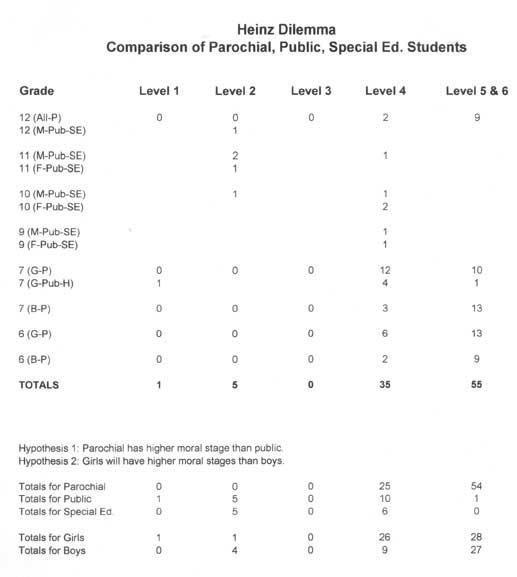
Heinz Dilemma
Experiment
In Europe, a woman was near death from cancer. There was one drug that doctors thought might save her. A druggist in the same town had discovered it, but he was charging ten times what the drug cost to make. The sick woman's husband, Heinz, went to everyone he know to borrow the money, but he could only get together half of what it cost. The druggist refused to sell it cheaper or let Heinz pay later, so Heinz got desperate and broke into the man's store to steal the drug for his wife."
Should Heinz have done that? Why?
Results:
******
Group Activity
TWO
Piaget’s
Theory of Cognitive Development
The
Formal Operational Stage
Questions Taken by 7th Grade Students
1. If A=B and B=C then C=?
2. Is this statement true? "All polar bears are white, and I am white, therefore, I am a polar bear."
3. If Susan hits a tambourine, she will make a noise. Suppose Susan did not hit a tambourine. Did Susan make noise?
4. Hide a red or green chip in your hand. Ask the Adolescent to evaluate if the following statements are true or false: "Either the chip in my hand is green or it is not green." "The chip in my hand is green and it is not green."
5. Is
this a logical statement? "If dogs are bigger than elephants, and
elephants are bigger than mice, then dogs are bigger than mice."
Hypothesis: Adolescents can evaluate the logic of propositions (verbal statements) without referring to real-world circumstances.
Questions:
A. Is the hypothesis confirmed or denied?
Propositions 2, 3, and 5 seem to address this question more than 1 and 4. Most of the students in 7th grade and the high school students said False to proposition 2, so that supports the hypothesis. With proposition 3, there was more confusion, with only a few saying maybe. Overall, they seemed pretty evenly divided between yes and no. For proposition 5, most answered yes, which showed that they could separate the logic from reality, but some mentioned the reality just the same. Therefore, for the most part, I would say that the hypothesis is confirmed.
B. What are some potential problems with Piaget’s theory?
I think the theory is too restricted to age. In our study, for example, we see that some kids in 7th grade did well with all the propositions, while some of the high school kids had problems with several of them. It seems likely to me that performance on these propositions is dependent upon prior experience as well upon age. For example, kids who have taken math and science courses may be better able to theorize or think logically than kids who have not studied much or done well in those areas. Also, this theory is really aimed at issues that require mathematical and/or scientific thought. It doesn't allow for the relativistic nature of the world and the need to see things from different perspectives. And I think that the presumption that as kids mature into adults, they will automatically think like scientists or logical philosophers does not consider the way the world really is.
C. How could you reinforce/improve formal operational thinking in your class?
In my experience, particularly with middle school kids, the kids have a strong tendency to take things literally. In language arts, they miss nuances and humor because they read things so literally. I think we can improve formal operational thinking by stressing the idea of thinking “outside the box.” For example, in proposition 5, clearly the statement isn't true. But given the premise, it is a logical statement. We can work with those kinds of statements and encourage students to look at an issue on its own merits, without any influence from other areas. Certainly in literature, there are many examples of writing which are unrealistic, such as science fiction or fantasy, and we need to encourage students to accept the premise of these writings. I believe that math and science will automatically encourage formal operational thinking. However, I do not believe that everything can be addressed in a logical way, so we need to be careful with this.
What about postformal thought?
I think we can certainly encourage this and try to move students in that direction. It allows students to look at things from different perspectives and then draw their own conclusions. We can do that easily with literary criticism, and I think that in history we can do so as well by asking the right kinds of questions. In addition, we can work with kids and their personal relationships with peers, adults, etc., and show them the relativistic nature of those relationships. Last week, we discussed the stressor that kids face, and clearly many of those are highly relativistic. If we work to help students handle those kinds of stresses, we will encourage postformal thought.
******
Group Activity Three
A) How is self-esteem related to children and adolescents who display mastery-oriented attributions and those who display learned helplessness?
Erikson
explains that the interplay between parent expectations and children’s
struggle for mastery set the stage for adolescent conflict. Children
gather their impression of their quality of self from their experience
with family, peers and teachers. The discovery of self is derived
from evidence of mastery or inferiority. Self worth is often based
on academic achievement, social relationships, athletic performance and
quality of physical aesthetics compared to peers.
Students
attribute themselves to be the responsible factor for results if they are
mastery-oriented. Even when negative results occur, they relate those
results to factors within their control. By contrast, students who
have learned helplessness believe their poor results are due to their lack
of ability, the manifestation of their low self-esteem. They have
certainty that their ability is fixed and change is beyond their control,
as they perceive themselves as inferior to others.
B) How do parenting styles influence a mastery-oriented attitude vs. a learned helplessness as well as Marcia’s "Four Identity Statuses"?
Style
Erikson
Marcia
Authoritarian
Learned Helplessness Identity
Foreclosure
Permissive
Indulgent Learned
Helplessness Moratorium
Erratic Neglectful
Learned Helplessness Identity
Diffusion
Authoritative
Mastery-Oriented
Identity Achievement
C) As a teacher, how can you help your students increase their self-esteem and, therefore, develop better coping skills so they can deal more effectively with the stress and pressures in their lives?
As teachers,
we should be cognizant that we play a pivotal role in the lives of every
child we teach and it is our duty to extend ourselves as much as we can
to “do no damage” to our charges. In fact, we may be in a unique
position to really help as adolescent having turmoil if we are equipped
and sensitive enough to respond.
What
can we do? Often teachers can sense when a student is anxious about
things. At their stage, adolescents can be affected and distracted
by many things. Grades, peer concerns, family problems are all highly ranked
in the world of the adolescent. Teachers should monitor the difficulty
and amount of homework, concentrate on emphasizing learning for the joy
of it more than for the grade associated with it. Alternative types
of assessment can do wonders for class morale and reinforcing the value
of authentic learning.
Students
need to not only express themselves, but they should be encouraged to raise
their voices toward social justice. They should be invited as special
guests to the world of activism. In this, they will gain a role to
play in the universe and acquire confidence in coming forward for justice.
This also leads to another means for reducing stress, properly equipping
students with the problem solving skills they will be required to use in
their lifetimes.
Our
world, dynamic as it is, will be faced with numerous problems. It
is incumbent on educators to instill the positive and constructive mindset
to enable and empower students to meet humanity’s challenges. Knowledge
about stress reduction will be a key to finding future success.
D) Why
do Erikson’s and Marcia’s theories apply only to North American and perhaps
most western cultures and how are they gender biased?
An examination
of both theories reveals that both are based upon an individualistic rather
than a collectivistic approach. With Erickson, for example, we see
the focus on issues such as learned helplessness and mastery-orientation,
both clearly individualistic in nature. At the same time, we see
that Marcia focuses on issues such as Identity Foreclosure and Identity
Achievement. With both of these theorists, we see that all issues
are involved with the concept of "self," and that is clearly individualistic.
As we look at cultures, we see that North America, and to some extent western
culture in general, is individualistic, so we can safely infer that their
theories apply only to North America and perhaps most western cultures.
Because
these theories apply to North America, they are, by default, gender biased.
In North America, parental and societal standards for males and females
are different. We have different objectives for the sexes as well
as different values for them. Society treats members of each gender
differently. As a society, we are still struggling with the concept
of gender equality. As children move into adolescence, males and
females experience different kinds of issues, so each gender will develop
sense of self differently. It seems apparent that the theories of Erickson
and Marcia do not address those differences. At the same time, we
understand that most, if not all, of the subjects used by these theorists
during the development of their theories were male. Since we know that
we cannot apply the same theories to males and females, given the differences
imposed by our society, we can safely presume that the theories really
apply only to males.
E) Define identity, self-esteem and self-understanding in your own words.
Identity
During
adolescence, students start thinking about themselves in new ways.
They think about a sense of self-unity and the fact that who they are or
who they choose to be will continue over time. Most important, teens
use idenitity to help themselves feel like a unique person. Be it
the way they dress, the music they listen to, the clothing they wear, or
the way they act, teens find countless ways to express themselves and let
everyone around them know they they indeed have their own established identity.
Puberty also plays an active role in helping teens to establish their identity.
Self-esteem
Self-esteem
is how good a teenager feels about him or herself. Do they like themselves?
Do they like what they see in the mirror? Are they positive about
who they are? There are two major factors that influence the level
of self-esteem in teens. They are physical attractiveness and peer
acceptance. Attractiveness is particularly important for girls, and
more girls seem to suffer from low self-esteem than boys. Although
these two top the list, self-esteem can also be gained from performing
well in school, sports and the like. Unfortunatly, low self-esteem
can lead to many problems for teens, including depression and even suicide.
Self-Understanding
This
is when an adolescent understands who he or she is, as the name implies.
Interests, values, skills, likes and dislikes, and strengths are just a
few examples of what teens might think about if they were to question if
they understood themselves. Self understanding is difficult to accomplish
for any person, let alone teens. The world is a complicated place,
and thus, we are complicated people. Few people every truly achieve
self-understanding. You must unlock your core self, understand where
your most personal conflicts derive from, and use wisdom to help heal emotional
wounds.