Poetry Explication
Explication by Jamie Hughes
The Soul selects her own society, is a twelve line poem written by Emily Dickinson. The poem begins with the line "The soul selects her own society." This line is saying that the soul, the very heart of a person, is choosing who she wants to be associated with. It seems the speaker is becoming tired of dealing with those she has to deal with in everyday life. The next line says "Then she shuts the door." Once again, the speaker is shutting those people she does not want to be around, out of her life. The next line reads "On her divine majority." This line when read with the previous line arouses questions. The speaker could be closing the door on everyone so that she may be alone and be by herself for the rest of her life. It could be read that she is shutting the divine majority in the room with her. It seems that the divine majority is the speaker's close friends and family. "Present no more" is the next line of the poem and this suggest to the reader that the speaker by shutting the door has completely cut herself off from the rest of the world. She will not be subjected to any of the ideals or horrors of the real world. The next two lines that read, "Unmoved, she notes the chariot's pausing/At her low gate,"imply that the speaker sees these chariots parked at her gate, but does not acknowledge them to let the reader know whether or not the chariots even exist. She can see the world through the door, but does not let it affect her. She remains in her room being completely set apart from the real world. Also the word choice of low gate seems to say to the reader that the speaker has an entrance to the room, but it is unwelcoming. The next two lines that read "Unmoved, and emperor be kneeling/Upon her mat," hint that she can see the outside world but makes no acknowledgement to it. The word choice of emperor seems to tell the reader that the speaker is not going to let anyone in the room even someone with the title of emperor. Also the emperor is kneeling, which infer to the reader, that perhaps he wants what the speaker has and lowers his ego by kneeling in front of her door. It is possible, that what the speaker has in her own little world is what everyone wants for themselves, even the upper class. "I've known her from an ample nation/Choose one." These two lines seem to come from an outside source, who appears to know the speaker. These lines provide an insight on the character of the speaker from an outside source. It would seem that the speaker is well known, by the word choice ample nation. The new speaker asks the reader to choose one perhaps saying that the speaker used to go out and spend time with people she did not know. The word choice of ample nation also could represent that the speaker was also well traveled. The last two lines of the poem read, "Then close the valves of her attention/Like stone. Once again this is the new speaker talking about the speaker. The tone seems to change from the two previous lines. The new tone is solemn, and the reader can infer that the new speaker is sad that they have been shut out along with everyone else. The old speaker takes her attention off what she used to like and now puts it all on living alone and keeping everyone else out. The word choice of "like stone" provides the previous line with a sense of finalization. The speaker shuts her attention off and provides no emotion towards anyone. She is now so focused on blocking out the world; her old acquaintances do not exist to her anymore. All in all this poem is about a person who wants to be alone and is so focused on wanting to be alone, blocks out everything she used to know.
Explication by Kat Demcheva
Emily Dickinson's poem, "The Soul Selects her Own Society," implies a paradoxical theme of being a feminist throughout selecting a mate. The speaker has always been aware of her own soul, which she manifests in her writing, and she is also conscious about her role as a female in her environment, and her role as an intuitive decision maker when it comes to adhering to the norms of society. The speaker reclusiveness is her temporary defense mechanism. She isolates herself from society to better understand herself before she chooses a soul mate. The Soul freely chooses to close herself off from the world in order to pursue the solitary, interior life of creativity and self-discovery.
"The Soul Selects her Own Society," introduces the Soul as the subject of the poem. The Soul is the speakers" inner consciousness that is not tangible. The poem states that the Soul is feminine, as indicated by the use of the word "her." The Soul is also subjective, and relies upon her personal opinions and feelings. She "selects," meaning that she chooses, "her own Society." This means that she chooses the company of her self over the company of others, and then closes herself off from the world. The narrator speaks about "shutting the door" which represents the soul/self as a fortress. Shutting out other people is her own means of self-reliance through building a self-protective barrier. In the following lines, the Soul is shutting her "divine Majority" inside with her, behind the door, which represents her own holy or sacred self, which is now no longer present to those outside of her closed door.
The Soul has rejects the symbols of the external world. She turns away from all the proper customs of the world?s society. "Chariots," contain potential suitors who stop before her gate. She notices them casually, but she is not interested. The Soul is even indifferent to royalty. The Emperor falls on his knees before her door, but she will not let him enter. This is a reverse image, for it is usually the common individual who must defer to an Emperor. The Soul's state of being is intensely private, personal, and unreachable.
The speaker of the poem uses the pronoun "I," comments upon the power and determination of the Soul. It is observed that the Soul could have had her pick of "an ample nation," which implies she has chosen just "One." The "One" means her private spiritual life. The Soul has given up the rest of the world for an inward life of rejection and self-realization. Soul also chooses to "close the Valves of her attention," with valve meaning folding door; which relates to the door that the Soul is shutting from the world. Once these Valves are firmly closed, the soul is free to forget external matters and concentrate solely on the "One" thing to which she has devoted her existence. "Like Stone," the soul is hardens against the world outside, and her decision is solid, permanent, and complete.
Explication by Janine Speer
The Soul Selects Her Own Society by Emily Dickinson is a poem that has had many different interpretations. There are very different possibilities and meanings that the reader could interpret the poem as trying to convey. To me, it seems that Dickinson is talking about a woman's soul in general. Dickinson is noting that a woman chooses who she'll be early in life, and who she will associate with, which is usually who she'll grow to be like. Choosing to ignore and not noticing the "divine majority" around her, she will notice men ("chariots") pausing at her "low gate" (I believe a sexual reference) throughout her life. Also, at one point she will note a certain "emperor", which I believe is referring to a special man in a woman's life, kneeling upon "her mat" (another sexual reference perhaps?) waiting in earnest for her complete attention. The poem is summarized by showing that because she had already chosen her "own society" and walk of life, she only accepts certain people in her life and remains firm in her believes, unmoved. But eventually of course, she will choose a suitor from among an "ample nation" and then she'll "close the valves of her attention" (another sexual reference) and remain loyal to her chosen man, staying unmoved as a stone throughout the rest of her life.
Explication by Lisa Trahin
Emily Dickinson's poem "The Soul selects her own Society (303)" has some obvious patterns that I would like to briefly call attention to. First, in every stanza the first line is longer than the three lines that follow. Also, the second and fourth lines are shorter, however the exception is the very short final line "Like Stone." This line completes the poems structure and imagery by sounding hard, emphatic and supports her final decision to completely seal herself off from the rest of society.
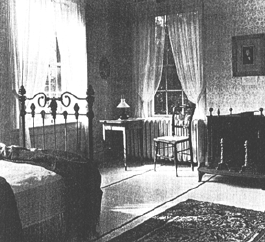
It has been hypothesized that Dickinson was bipolar and it is widely known that she spent a large part of her life secluded upstairs in her room and away from the exclusive society visiting within her home.
"The Soul selects her own Society" Then "shuts the Door" because there is limited space therefore the "Soul" is very selective of who it allows into her private domain. Space and time are precious and not to be wasted, therefore she securely shuts mainstream society out. The reference to "divine Majority" is a metaphor that does not refer to God, but represents the Bourgeois whose status and rich worldly positions are idolized like gods by the common society. Though Dickinson is from a wealthy background, she does not feel connected to this select group and therefore they are "present no more," meaning she has separated herself from them by shutting these symbolic doors.
Emily is "unmoved [as] she notes the Chariots" and "unmoved [as] an Emperor be kneeling;" if you pay close attention to the second and fourth lines that proceeds these lines, it is obvious that Emily's choices of words "low gate" and "mat" were used to show how she considered herself to be humble (low) and simple (mat). Thus she had no desire for luxury goods and was not impressed by social status.
The final stanza ends the poem on a very lonely and desolate feeling of existence. "[She} I've known her--from an ample nation;" here the word "her" represents Emily recognizing herself as an individual and non conformist living in a society of "ample" or plenty generic and materialistic people. She does "Choose One," referring to herself in which she "close[s] the valves" preventing anyone from entering her solitary soul that is "Like Stone."