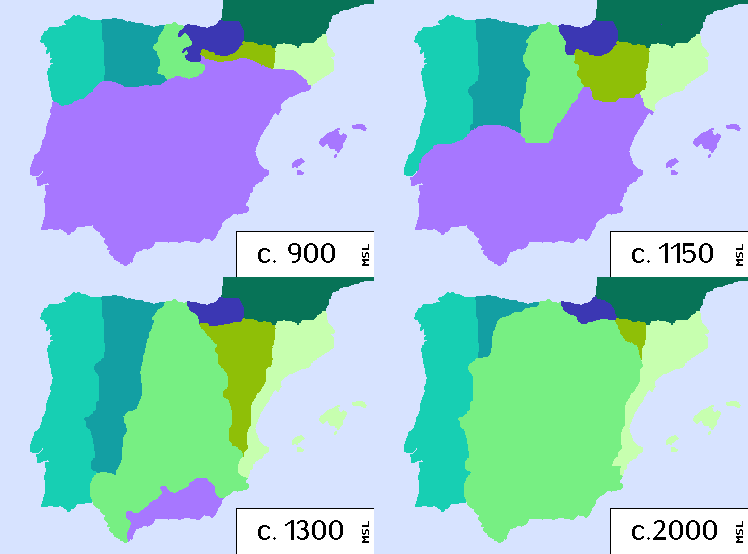
- Galician
- Leonese
- Castilian
- Basque
- Aragonese
- Catalonian
Below: Arabic / Mozarabic.
Romans became the rulers of all the Iberian Peninsula, though their control was never very strong in the Cantabrian region. Latin superseded previously spoken tongues and these stopped being used, with the exception of (proto)Basque.
Actually spoken Latin wasn't exactly 'Classical' Latin, the later being the language of culture used for many centuries and even now. Spoken Latin was always more or less different, and with time it gave rise to several languages, Romance languages. Nevertheless, until the Middle Ages only the classical language was written down (or at least it was pretended to be).
Traces of the vulgar speech can be found in inscriptions, and some words are quoted in classical works (often just to reject them).
The conversion of vulgar Latin into the different Romance dialects is a continuous process where no clear-cut division can be drawn. In the Renaissance, even later, the learned could yet build sentences that at the same time were Latin and Romance.
As a language of culture and religion, Latin has never ceased to influence Roman languages, by way of loans and otherwise. There are many words of Latin origin in Basque too.
Here's a link to a Finnish
radio station. They broadcast every day for some minutes in Latin.
Hispanic Romance languages (except Mozarabic) were born in the North of the Peninsula and extended southwards along with the occupation by Christian kingdoms of lands formerly in hands of the Muslim.
Beginning in the IXth-Xth century, some Romance words can be found in
Latin texts. For some centuries dialectal boundaries were fuzzy, because
all dialects were quite similar and several linguistic standards interfered
with each other. Speakers of the different dialects possibly had no much
trouble to understand one another.
|
From left to right:
Below: Arabic / Mozarabic. |
Officialy, Portuguese is spoken in Portugal, Brazilian in
Brazil and Galician in Galicia. Official Galician is quite different to
the other norms. Nevertheless, spoken dialects of Galician blend themselves
with those spoken in Portugal, and the general view is that the language
is the same.
At present, the boundary between Portugal and Spain does not coincide
with the limits of Portuguese and Leonese or Castilian. In Spain, Portuguese
dialects are spoken in and around Valverde del Fresno (Cáceres)
and Olivenza (Badajoz).
Links: Xunta de Galicia pages of
the Galician government; Diário de Notícias
a Portuguese newspaper.
Now several Bable dialects are spoken in Asturies, and Leonese
dialects in León, north of Cáceres and Miranda, in Portugal.
A link to some news
in Bable
In the beginning, Castilian was considered less elegant than Leonese
or Aragonese. Many of the first literary works have come to us written
down in those languages, though some of them were composed in Castilian.
This is the case with epic poetry (Poema de Mío Cid). King Alphonse
Xth, the Sage, standardized Castilian as official and literate language.
In the XVIth century, southern Castilian stops differentiating two phonemes,
and that's the main characteristic of Andalusian dialects. Dialects
of
this type are also spoken in the Canaries and in America (in northern dialects
'caza' and 'casa' are uttered differently; in the southern ones their pronunciation
is the same).
Castilian is an official language in all Spain, and it is spoken
by a great majority of population (though possibly one out of four Spaniards
is bilingual). This is the reason why internationally the term 'Spanish'
is preferred instead of 'Castilian', a denomination technically more adequate.
Officially, in the Balearic islands the 'Balearic variety of Catalonian',
in Valencia the 'Valencian language', are respectively spoken.
A link to a newspaper in Barcelona
(Catalonian from Catalonia proper).
Links: a poem in Aranese,
a page in Gascon,
Occitan
links .
| Volver al índice | Back
to Index
Página inicial | Home page |
Actualización Abril 2002 | Updated April 2002
© Manuel Sanz Ledesma |