

to Technology
- - - - - - - - - - - - - - - - - - - - - - - - - - - - - - - - - - - - - - - - - - - - - - - - - - -
Who: Dr. Frederick Banting, Charles Best, Dr. J.J.R. MacLeod
When: 1921
Where: Toronto (University of Toronto)
Why: Diabetes is a disease that has been around for thousands
of years and has made millions of people very sick. Diabetes
makes their blood sugar level very high, so that it becomes
dangerous. Many people died from diabetes. Insulin helps to
lower the sugar level.
- - - - - - - - - - - - - - - - - - - -
What: Hydrogen fuel cells to power buses and cars
Who: Geoffrey Ballard
Where: Vancouver
When: 1993 (research started in the 1980s)
Why: To replace gas and diesel fuel. To reduce air pollution and
help keep the environment clean. To reduce energy use.
- - - - - - - - - - - - - - - - - - - -
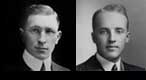
source: University of Toronto, Faculty of Medicine, Banting and Best Diabetes Centre
Who: H.S.M. (Donald) Coxeter
Where: He was a professor at the University of Toronto
When: He taught and did geometry research at the U of T
from 1936 to March 2003, when he died.
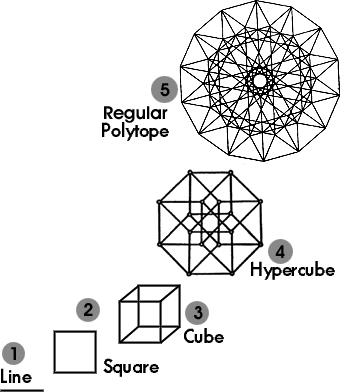
Why: Stretching geometric figures into a higher dimension.
Look at the figure on the right. A line (#1) is one dimensional.
If you pull it out, you get a 2-D square (#2); you can move
two ways: up and down and left and right. If you stretch the
square up and out, you get #3, a cube; it's 3-D--you can go
three ways: up/down, left/right, backwards/forwards. If you
stretch the cube into 4-D, you get a hypercube (#4). You get
#5, a polytope, when you pull into even higher dimensions.
Because our world only has 3-D space, we cannot make a
real #4 or #5.
- - - - - - - - - - - - - - - - - - - -
GCS Research Society, science.ca
Who: Willard Boyle
Where: born in Nova Scotia, educated in Montreal (McGill);
invented CCDs working in U.S.A.
When: 1969
Why: CCD--computer memory chips that are charged by light.
Used in scanners, digital cameras, Hubble telescope, satellites
- - - - - - - - - - - - - - - - - - - -
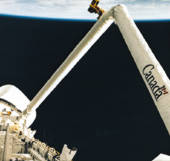
What: Canadarm
Who: Spar Aerospace Limited
Where: Mississauga, Ontario
When: first Canadarm--1981, Canadarm2--2001
Why: Canadarm's real name is Shuttle Remote Manipulator
System (SRMS). It is like a giant arm in space. It can grab,
lift and move big objects in space (up to 266,000 kg!).
- - - - - - - - - - - - - - - - - - - -
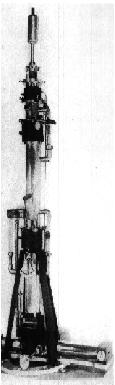
Who: James Hillier and Albert Prebus
Where: Ontario (University of Toronto)
When: 1938
Why: They wanted to get better magnification. This changed
scientific research all over the world. Before, microscopes
could magnify only 2,000 times; Hillier/Prebus's electron
microscope could magnify 7,000 times. Nowadays, electron
microscopes can magnify 2 million times!
- - - - - - - - - - - - - - - - - - - -
What: Alkaline battery
Who: Lew Urry
Where: born in Ontario; researched and made prototype of
alkaline battery in Toronto; finished it in the U.S.A.
When: 1969
Why: Before this, batteries didn't last very long. Alkaline
batteries last much, much longer. They are used in portable
devices such as laptops, CD players, cameras, phones, toys.
- - - - - - - - - - - - - - - - - - - -
What: Created JAVA computer language
Who: James Gosling
Where: born in Calgary, Alberta; works in the U.S.A.
When: 1994
Why: He wanted to develop a software technology that could
run on many different kinds of computers, and other devices.
- - - - - - - - - - - - - - - - - - - -
~interact/microsco/microhist.htm
Who: Roger Daley
Where: Montreal (Canadian Meteorological Centre)
When: 1972-1978
Why: To develop a better system for forecasting
weather.
- - - - - - - - - - - - - - - - - - - -
What: IMAX projection system
Who: Graeme Ferguson, Roman Kroitor and
Robert Kerr, who started IMAX Corporation
Where: Toronto, Ontario
When: 1968
Why: They wanted to get giant screen cinema
using one projector.
- - - - - - - - - - - - - - - - - - - -
Who: Harry Wasyluk
Where: Winnipeg, Manitoba
When: 1950
Why: He made disposable plastic garbage
bags for Winnipeg's General Hospital.
- - - - - - - - - - - - - - - - - - - -
What: Newsprint from pulp
Who: Charles Fenerty
Where: Nova Scotia
When: 1841
Why: Before this, most paper was made from
rags. A local paper mill was having trouble
getting enough rags. Fenerty was able to
make paper from wood pulp.
- - - - - - - - - - - - - - - - - - - -
BonBernard, Trudie. Canada and Its Trading Partners. Edmonton: Arnold Publishing Ltd., 2001.
site: 15/70 films. "IMAX� Motion Picture Systems." http://www.1570films.com/imax.htm#history (3/29/03)
site: The Canadian Encyclopedia. Acland, Charles. "IMAX Systems Corporation." http://www.thecanadianencyclopedia.com/index.cfm?PgNm=TCE&ArticleId=A0003957 (3/30/03)
site: Canadian Space Agency. "Canadarm." 2001-11-21. http://www.space.gc.ca/asc/eng/csa_sectors/human_pre/iss/canadarm/canadarm.asp (3/29/03)
site: Discovery of Insulin. "The Discovery of Insulin: A Canadian medical miracle of the 20th century."
http://www.discoveryofinsulin.com/Home.htm (3/29/03)
site: Fuel Cells Canada. Nuttall-Smith, Cris. " 'Waiting for the revolution,' Globe and Mail - Report on Business." January 31, 2003. http://www.fuelcellscanada.ca/Press%20releases/ballardnews13.html (3/29/03)
site: science.ca. (various pages for scientists' profiles) http://www.science.ca (3/29/03)
site: University of Toronto, Department of Physics. Watson, John H.L. "Very Early Electron Microscopy in the Department of Physics, The University of Toronto. A Personal Recollection." http://www.physics.utoronto.ca/~interact/microsco/microscopy.htm (3/29/03)