

Here's an example:
Rinaldo makes a sandwich for lunch every day. He doesn't want to eat the same sandwich all the time. He has white and whole wheat bread at home. He can choose either cheese or tuna to put in the sandwich. There are also tomatoes and lettuce in his fridge to put as toppings. How many days can he go without eating the same sandwich twice?
First, you have to organize the information.
Rinaldo has:
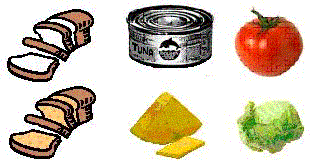
Bread: He can use white bread or brown bread to make his sandwich.
Filling: He can put tuna in his sandwich or he can put cheese.
Topping: He can top his sandwich with tomato, lettuce, tomato and lettuce, or leave it plain.
So he can choose from 2 breads, 2 fillings, 4 toppings.
Mathematically, he should have 16 choices, or possibilities. Let's do a tree diagram and see if this is correct and what the possibilities are.

But a tree diagram tells you more than just how many possibilities there are. It helps you organize the information so that you can answer other questions quickly.
How many choices does Rinaldo have if he uses whole-wheat bread? 8
How many kinds of sandwiches can he make with just lettuce as a topping? 4
What are they?
white bread, tuna, lettuce
white bread, cheese, lettuce
whole-wheat bread, tuna, lettuce
whole-wheat bread, cheese, lettuce
Back to Rinaldo's Math Page