POLYHEDRA
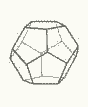
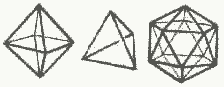


Polyhedra are one type of geometric solid.
POLYHEDRA
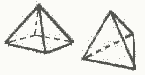
The solids in the diagram (at right) are called polyhedra. This is the plural form of the word; one of these solids is called a polyhedron.
A polyhedron is a solid made up of many flat sides, or faces, joined together. Each face is a polygon.
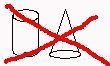
A polyhedron only has flat sides. So these two are not polyhedra because they have surfaces that are not flat.
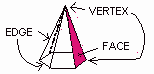
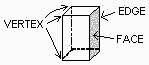
The parts of a polyhedron are called face, edge, and vertex.
Face is the flat surface of the solid.
Edge is the line segment where 2 faces meet.
Vertex is the point where the vertices of 3 or more faces meet.
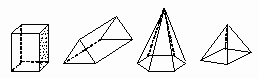
There are many kinds of polyhedra. Two main groups of polyhedra are pyramids and prisms.
PRISMS
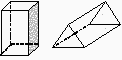
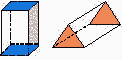
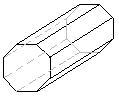
A prism has 2 congruent faces that are joined by rectangular faces. (congruent = same)
There are different kinds of prisms. Their names depend on the kind of polygon that's at either end.
For example:
A prism with triangles at each end is called a triangular prism.
A prism with rectangles at each end is called a rectangular prism.
A prism with pentagons at each end is called a pentagonal prism.
PYRAMIDS
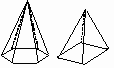
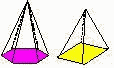
A pyramid has a polygon at the base with triangular faces at its edges that meet at a vertex.
There are different kinds of pyramids. Their names depend on the kind of polygon that's at the base. For example:
A pyramid with a triangle at the base is called a triangular pyramid.
A triangular pyramid made of equilateral triangles has another, special, name: tetrahedron.
A pyramid with a square at the base is called a square pyramid. It's also called a square-based pyramid or square-base pyramid.
A pyramid with a pentagon at the base is called a pentagonal pyramid.
OTHER POLYHEDRA
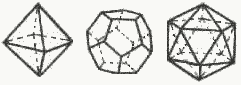
There are many different kinds of polyhedra. The pyramids and prisms are the most common ones. Here are three more: the octahedron (has 8 faces of equilateral triangles), the dodecahedron (12 faces of pentagons), and the icosahedron (20 faces of equilateral triangles).
two polyhedra
----------
Polyhedron comes from "poly" for "many," and "hedron" for "faces" or sides. (Actually "hedron" means "seat," but that's harder to remember.)

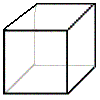
and vertices does this
polyhedron have?
Count carefully.
an octagon at the base? Try to draw one.
What are the names of these pyramids?