Math Journal
How to get the area of a rectangle
Little Joe, first you have to measure the length and the width of the rectangle. (Length is the longer side, and width is the shorter side.) Then multiply the length times the width. The product is the area of the rectangle.
Don't forget, if you measured in centimetres, the answer for the area will be in centimetres squared.
Look at this rectangle (to your left).
The length is 3 cm, the width is 2 cm.
3 cm x 2 cm = 6 cm�
So the area of this rectangle is 6 cm�.
------------------------------------------------------------------------------
The difference between multiple and factor
Hi Little Joe. Do you get multiple and factor mixed up? Just remember, you get a multiple of a number when you multiply -- multiple, multiply.
For example, if you have the number 3, you get multiples of 3 by multiplying 3 times another number:
3 x 5 = 15, so 15 is a multiple of 3.
3 x 8 = 24, 24 is a multiple of 3.
The answer (product) when you multiply 3 times another number is a multiple of 3.
Factor is the opposite.
For example, the number 15. What numbers do you multiply to get 15? 3 x 5 = 15. 15 x 1 = 15.
So 3, 5, 15, 1 are factors of 15. We usually put them in number order to make them easier to read: 1, 3, 5, 15.
------------------------------------------------------------------------------
Why the area of a triangle is � b x h
Little Joe, do you know why the area of a triangle is
� b x h?
Remember that you get the area of a parallelogram by multiplying base times height (b x h). If you take any triangle and add the same triangle but you flip it, what do you get? You get a parallelogram!
Look at the diagrams below. If I calculate the area of the purple parallelogram (b x h), I can get the area of the purple triangle by dividing by 2, right? So that's why the formula for the area of a triangle is b x h � 2, or � b x h.
2 cm
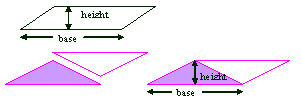
area of a parallelogram b x h
area of a triangle � b x h
The difference between possibility and probability
Hey, Little Joe. I'll bet you use math probability every day and you don't even know you're doing it.
When you want to stay up extra late to watch a movie, who do you ask: your mom or your dad?
Your mom could say "yes" or "no," and your dad could say "yes" or "no." These are the possibilities.
Who did you decide to ask, your mom or your dad? Why? What went through your mind?
Let's say you decided to ask your dad because he is more likely to say "yes." In a flash, your brain probably said to you: "The last 10 times I asked Mom, she said 'yes' only 3 times, and 'no' 7 times. The last 10 times I asked Dad, he said 'yes' 5 times, and 'no' 5 times. So I have a better chance of staying up late if I ask Dad." These are the probabilities that your mom or dad will say "yes" or "no."
You have a 3 in 10 chance (or probability) that Mom will say "yes," and a 5 in 10 chance that Dad will say "yes." If you ask Dad, there is a 50% chance he will let you stay up late; the probability is 50% or 1/2. Mom's 30%, or 3/10, isn't very lucky for you; Mom is more likely to say "No!" so you'd better ask your dad.
Try it tonight and see what the outcome, or result, is.
These are some words you need to know to talk about probability:
probability, probable, possibility, possible, likely, chance, outcome.
------------------------------------------------------------------------------