|
|
| The Mexico City
conurbation has borne the brunt of the recent migratory surge toward urban
areas. With a total population of 32 million, it is already home to nearly
one out of every four Mexicans, and it continues to grow at an alarming
rate. Each day, about 1000 people move to Mexico City; when added to the
1000 or so babies born there daily, that produces a truly staggering addition
of approximately 750 000 people every year. However, birth rates in urban
Mexico are higher than the national level. With half its population 18
years of age or younger, some demographers have forecast an astounding
total of between 40 and 50 million residents for greater Mexico City by
the year 2010. Mexico City is the world's largest single population agglomeration,
surpassing Tokyo -Yokohama's 30-odd million.
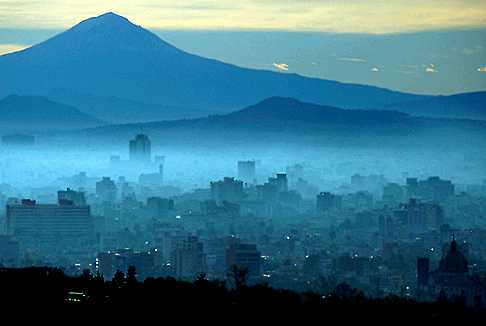
Even in a well endowed natural environment, such an enormous cluster of humanity would severely strain local resources. But Mexico City is hardly located in a favourable habitat; in fact, it lies squarely within one of the most hazardous surroundings of any city on earth - and human abuses of the immediate environment are constantly aggravating the potential for disaster. The conurbation may be located in the heart of the scenic Valley of Mexico, whose situational virtues led to the building of Tenochtitlan by the Aztecs, but two serious geologic problems loom; the vulnerability of the basin to major volcanic and seismic activity (such as the devastating earthquake in 1985), and the overall instability resulting from the weak, dry lakebed surface that underlies much of the metropolis (aggravated by land subsidence as groundwater supplies are pumped out in vast quantities). Water availability presents another problem in this semiarid climate: dwindling local supplies must be augmented by the expansion of long-distance transportation of drinking water from across the mountains, an enormously expansive undertaking that must be accompanied by the growth of a parallel network to pipe sewage out of the waste-choked basin. Mexico City's worsening air pollution, however, poses the greatest health hazard and is conceded to be the world's most serious, exacerbated by the thin air that contains 30 percent less oxygen than at sea level (the city's elevation is 2240m). The conurbation's 3 million+ cars and 7500 diesel buses produce about 75 percent of the smog, with the remainder caused by the daily spewing of 15 000 tons of chemical pollutants into the atmosphere by the area's 37 000 factories; on any given day, the pollution of Mexico City's air exceeds 100 times the acceptable level. For the affluent and tourists, Mexico City is undoubtedly on of the hemisphere's most spectacular primate cities, with its brand boulevards, magnificent palaces and museums, vibrant cultural activities and night life, and luxury shops. But most of its residents dwell in a world apart from the glitter of the Paseo de la Reforma, an increasing majority of them forced to live in the miserable poverty and squalor of the conurbation's 500 slums, plus the innumerable squatter shack towns that form the burgeoning metropolitan fringe (the notorious ciudades perdidas, or "lost cities". This is the domain of the newcomers, the peasant families who have abandoned the hard life of the difficult countryside, lured to the urban giant in search of a better life. With Mexico's underemployment rate hovering above 30 percent, decent jobs and upward mobility quickly become elusive goals for most of the new arrivals - and these families are forced to scratch out an existence on less than U.S. $5.00 per day. Yet, despite the overwhelming odds, a surprising number of migrants eventually do enjoy some success by becoming part of the so-called informal sector. This is a primitive form of capitalism that is now common in many underdeveloped countries, and takes place beyond the control of the government. Participants are unlicensed sellers of homemade goods (such as arts and crafts, clothing, food specialties) and services (auto repair, odd jobs, etc.) and their willingness to engage in this hard work has transformed many a slum into a beehive of activity that can propel resourceful residents toward a middle-class existence. For its part, although officially discouraging the growth of squatter settlements, the government has recently made life on the Mexico City outskirts more comfortable by improving schools, roads, and other municipal services; moreover, it still permits squatters who settle on public lands to get free title to those properties after a period of five years. |