Before any cell divides, it must first copy the genetic information within its chromosomes.
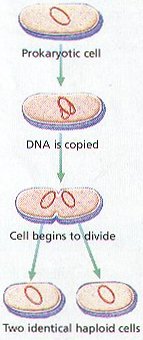
Bacteria (prokaryotes)
- Have circular chromosomes
- Copies its chromosome
- Each copy attached to cell wall.
- A new membrane and cell wall form between the copies.
- The cell splits into two cells, each with its own DNA.
Cell Division of a Prokaryotic Cell (Bacteria)
Eukaryotes
- Eukaryotes have more DNA than prokaryotes.
- DNA of eukaryotes are packaged into tightly wound chromosomes.
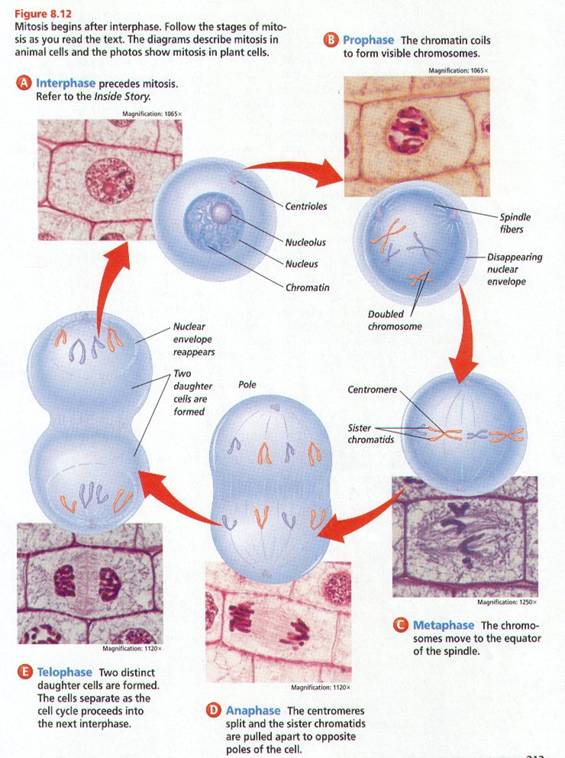
- Chromosomes in the nucleus are copied and the nucleus divides to form two nuclei (each contain a complete set of chromosomes). This is known as mitosis.
- Cell divides into two new cells. This is known as cytokinesis.
- The end result of mitosis and cytokinesis is two cells with the same genetic information.
The Cell Cycle
- Interphase – Period of growth for the cell. Takes in food, converts energy, discards waste, grows. During interphase the cell makes copies of its genetic material and duplicates its organelles. Includes G1, S, G2 phases.
- Prophase – Mitosis begins. Spindle fibers develop.
- Metaphase – Chromosomes attach to spindle fibers and line up in the center of the cell.
- Anaphase – Chromosomes move to opposite sides of the cell.
- Telophase – Nuclear envelope forms around each new set of chromosomes.
- Cytokinesis – Cytoplasm is pinched in half, forming two new cells.
- The time it takes to complete a cell cycle varies among organisms and cell type.
- Animal cell cycles are usually between 18 and 24 hours.
- Some cells never complete a cell cycle (some muscles, nerve cells).
- Some cells are dividing continuously (skin cells, intestine cells).
- Most human cells undergo about 50 divisions and then the cell dies.
- Proteins called cyclins control the cell cycle.
Faulty Cell Division – Cancer
- Without proper regulation, cells begin to grow and divide rapidly. The result is a clump of cells or tumor.
- When a tumor stays in the region where it formed it is usually harmless or benign.
- If a tumor continues to grow and invade other tissues it is cancerous.
- Cancer – Uncontrolled cell division and growth resulting from a malfunction of the cell cycle.
- Cancer is caused from a mutation (or change) in the genes regulating cell division.
- Most
cancers are not hereditary. There are exceptions.
- Environmental factors such as smoking and exposure to radiation contribute to mutations, which lead to unregulated cell growth and cancer.