Working with Radicals/Square Roots Notes
To Simplify:
· Try to find two factors of the number with one number being a perfect square. Try to find the largest perfect square you can.
Example: 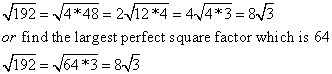
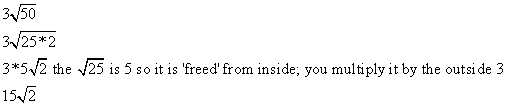
· When you “free” a perfect square from inside the radical, you multiply it by whatever is outside the radical sign
Example:
Addition and Subtraction:
· When adding or subtracting, you can simplify radical expressions by combining like terms but the number inside the radical sign MUST be the same.
like
terms  so if it was an addition problem it would equal

unlike terms:  cannot combine since the radicals are not the same
Example: 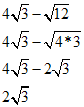
·
In the example above, the
 ’s are not ‘wiped out’ since it is 2 times the
. In the one example we did in class, we got 0
because:
’s are not ‘wiped out’ since it is 2 times the
. In the one example we did in class, we got 0
because:
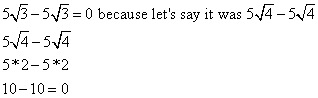
· Proof that you cannot combine if they are not the same:
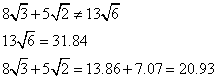
Multiplication:
· When multiplying radicals you might want to rearrange the numbers so you multiply the whole numbers together and any radicals together
Example: 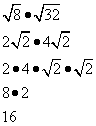
· When you multiply a radical by itself you get the whole number equivalent of that radical
Example 
So for any number, a,
when you multiply it by itself (square it) you wind up with that number.

Applications:
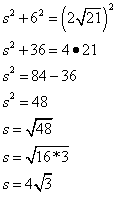
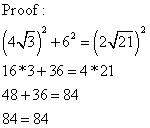
Use the Pythagorean theorem to find s. Express s as a radical in simplest form.

|
6 |
|
s |
|
|