In the 1700's the population of England was approximately 9 million people. At least 1 million of these were out of work; also a proportion of those that were working were not working either regularly or were paid badly.
The Industrial and Agarian Revolutions were both sweeping the land and in their wake huge changes were taking place in the country which was forcing people into umemployment; starvation loomed. Small farmers were losing their land and many labourers found that the new modern machines were taking their jobs.
City life too was altering. New factories sprung up and industries grew. The farm labourers and country people began to filter into the cities looking for work . All this lead to dirty, smoggy and overcrowded cities.
Prior to the Industrial revolution each man had his place in a community. In the new factory dominated towns these men and woman were simply "Factory Hands" or "Miners". They had no security from day to day, they could be laid off at the will of their employer. The old community base was weakened or in some cases completely destroyed.
So each day people were confronted with the harsh reality of living. Some turned to crime, they had nothing to lose, and their chances of getting caught was not high, due to the fact that in the 1700's no established Police Force existed, just old soldiers and mean patrolling the streets trying to catch criminals.
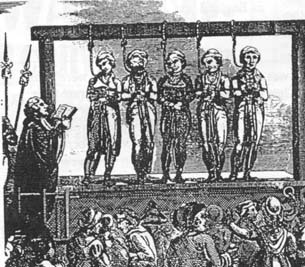
The Government reaction to this increase in crime was to introduce heavier penalties. In the 1700's people could be hung for picking pockets, stealing horses, cattle or sheep and even for some shoplifting offences. In fact there was over 160 crimes for which people could be given the death sentence.
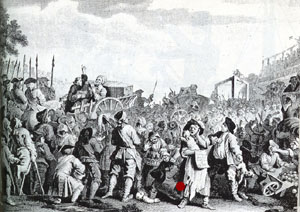
But rather than seen as the deterent that the government had wished for, hanging soon became a popular entertainment. Grandstands, food and drink stalls along with buskers helped make a hanging a family entertainment.
Transportation as a form of punishment has it's roots with a bill passed in 1597
"AN ACTE OF PUNYSHMENT OF ROGUES, VAGABONDS AND STURDY BEGGARS SHALL BE BANISHED OUT OF THIS REALM AND SHALL BE CONVEYED TO SUCH PARTS BEYOND THE SEAS AS SHALL BE ASSIGNED BY THE PRIVY COUNCIL"
From the 1600's convicts were transported across the Atlantic to work in the plantations of the new land, the USA. After 1717 transportation was stepped up to deal with more petty crimes and continued until 1775 when the Americans rebelled and the beginnings of the American Revolution halted the influx of convict labour into America.
America told Britian that is no longer needed or wanted convict labour to polute it's shores. America instead turned to Black Slavery from Africa. All this spelled the end of Britain's transportation to the Americas.
Britain immediately felt the effects of the forced end of transportation. Her gaols began to overflow. The British Government did not want to enlarge their gaols, instead they believed that America would change her mind, but the American Government steadfastly refused to receive any more convicts. Britain had to something, and it had to do it fast.
Hulks along the Thames were soon set up as a temporary prisons, but they were not, and never were intended to be a permanent solution. Soon disease spread in the cramped, wet and cold conditions. The increase in the cost of security in order to stop rioting that was also bubbling under the surface in the Hulks added further pressure. The British Government was forced to make a decision. Transportation as a punishment must recommence, but to where?
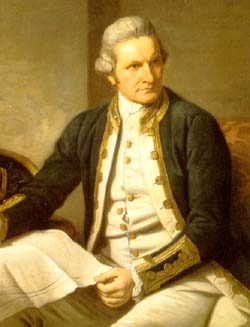
Australia, mapped in 1770 by Captain James Cook and a proclaimed British Possession was seen as the ideal answer for a number of reasons. If Britain colonised Australia, it would stop the French from doing so, and the British Government would gain a useful port in the growing trade area of the East. There had also been reports of good supplies of Flax and Timber in Nearby Norfold Island, essential supplies for an seafaring nation. It was the perfect solution.
"I have been 8 years working in the Pits. I have always hurried (dragged a cart of coal) with a belt around my waist and the chain through my legs. Sometimes I get cold and it being so wet, the wer covers my ankles. They thrash me sometimes in the pit. I have a shilling for hurrying two dozen"
"I have been in prison 13 times in all, every time I came out harder than when I went in. I saw Manning and his wife hung. I did 4S 6D at the hanging., two hankerchiefs and a purse with 2S in it. I've lived a great deal in lodging houses and knows the ways of them. They are very bad places for a boy to be."