| FOOD SAFETY AND SANITATION |
 |
|
 |
 |
 |
| Could what you can't see, hurt you? Is there a fungus among us (and maybe some bacteria too?) |
| YES! Whether you're taking a foods class just for the fun of it, or you plan on working in the foodservice industry, or you're just the average Joe making an afterschool snack, you need to follow basic food safety precautions. This website will highlight two food safety programs: - one aimed at the general public - called FIGHT BAC, - and one aimed at the foodservice industry - called the HACCP System. |
| * Answer questions on Food Safety Assignment Sheet. I. Is it really necessary for me to know this stuff? Absolutely! Let's go to the Centers for Disease Control to find out just how many Americans get a food borne illness every year. Link to the CDC: click here. Use your assignment sheet to record the information. |
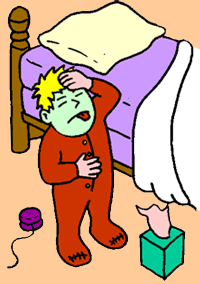
| II. Geez, that's a lot of sick people! So now we know how many people get sick from eating contaminated food. What are the symptoms of a common food borne illness like Salmonella? Visit the "Bad Bug Book" at the U.S. Federal Drug Administration website to find symptoms and approximate onset of symptoms. Record the information on your assignment sheet. |
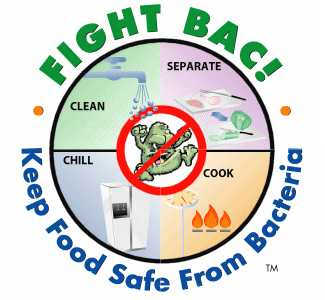
| I think we can agree, no one wants to get a food borne illness! So let's learn how to prevent that from happening from the Fight BAC campaign. Fight BAC is a cooperative of public and private groups that want to educate consumers about safe food handling to help reduce foodborne illness. They have broken all the food safety elements into 4 easy-to-remember steps: Clean; Separate; Cook; and Chill. |
| III. In addition to the initial symptoms, a few of the infections can develop into secondary long-term illnesses. Link to the Fight BAC Foodborne Illnesses page to read about these possible illnesses. Answer the question on your assignment sheet. |
 |
| Salmonella |
 |
| E. Coli |
 |
 |
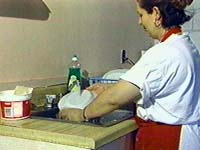
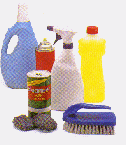
| IV. Keeping everything clean is the first step to fighting BAC. Read the recommendations and answer questions on assignment sheet. CLEAN |
 |
 |
| V. Cross-contamination is how bacteria spreads from one food to another. To prevent this, Fight BAC tells us to SEPARATE. Answer the questions on your assignment sheet. |
 |
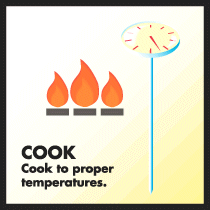
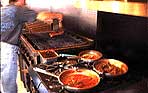
| VI. Raw meats and other food must be cooked to a high enough temperature in order to kill harmful bacteria. So the next Fight BAC step is to COOK. Read, then record the information on your assignment sheet. |
 |
 |
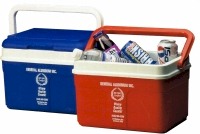
| VII. Food safety experts tell us that keeping foods cold, slows the growth of harmful bacteria. Fight BAC tells us to CHILL. Read the tips and answer questions on assignment sheet. |
 |
 |
| Remember to "Fight Bac!" |
| An Introduction to HACCP (Hazard Analysis Critical Control Points) |
 |
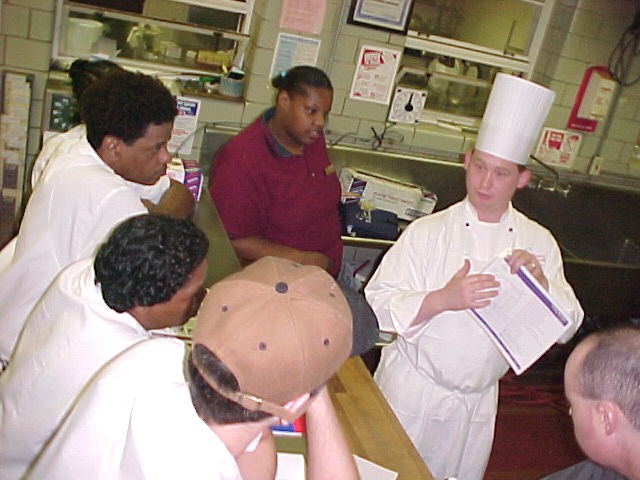
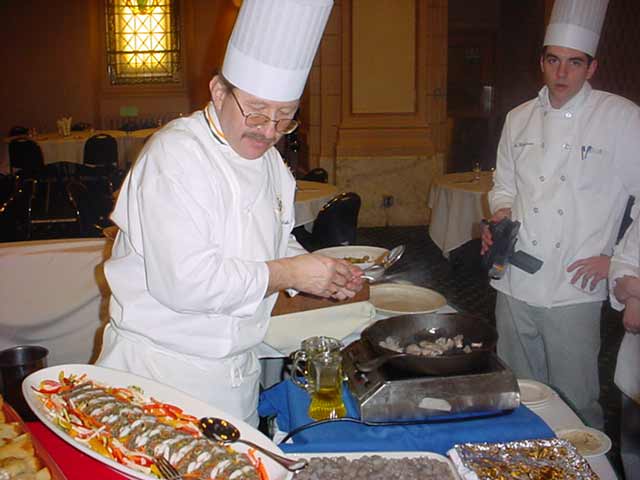
| HACCP is a system that foodservice personnel use to identify points where there is a potential for contamination as food flows through your establishment. There are 7 basic HACCP principles. |
 |
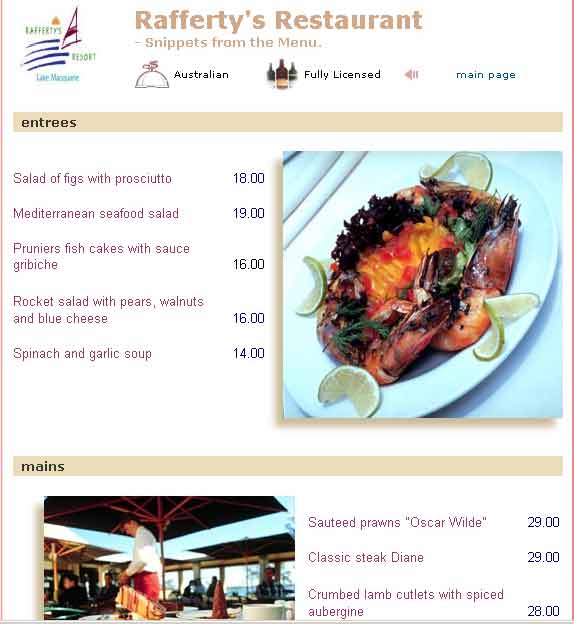
| Principle 1: Hazard Analysis *Consider all ingredients used in your menu items. * Identify potential food hazards - list of foods that may become contaiminated if handeled incorrectly at any stage in the flow of food. * Determine where hazards can occur; - Receiving - Storing - Preparing - Cooking From here... - Serving |
 |
 |
 |
 |
 |
| ...to here |
| Menu |
 |
 |
| Principal 2:Determine Critical Control Points * Critical Control Points are the last step where you can intervene to prevent, control, or eliminate the growth of microorganisms. |
|
 |
| Principal 3: Establish Critial Limits * Establish what the time and temperature limits are for each food. |
| Principal 4: Monitor Critical Control Points * Develop a monitoring program to check and record temperatures |
| Cook it Right . . . � Cook ground meat to at least 160 �F. Ground poultry should be cooked to 165 �F. � Cook roasts and steaks to an internal temperature of at least 145 �F for medium rare or to 160 �F for medium. � Whole poultry should be cooked to 180 �F -- measure the temperature in the thigh. Poultry breasts should be cooked to 170 �F. � Cook fish until it's opaque and flakes easily with a fork. |
| Principal 5: Taking Corrective Action * Predetermine what corrective action steps to take when food doesn't meet a critical limit. |
| Principal 6: Vertify that the System Works * Confirm that your HAACP plan works. |
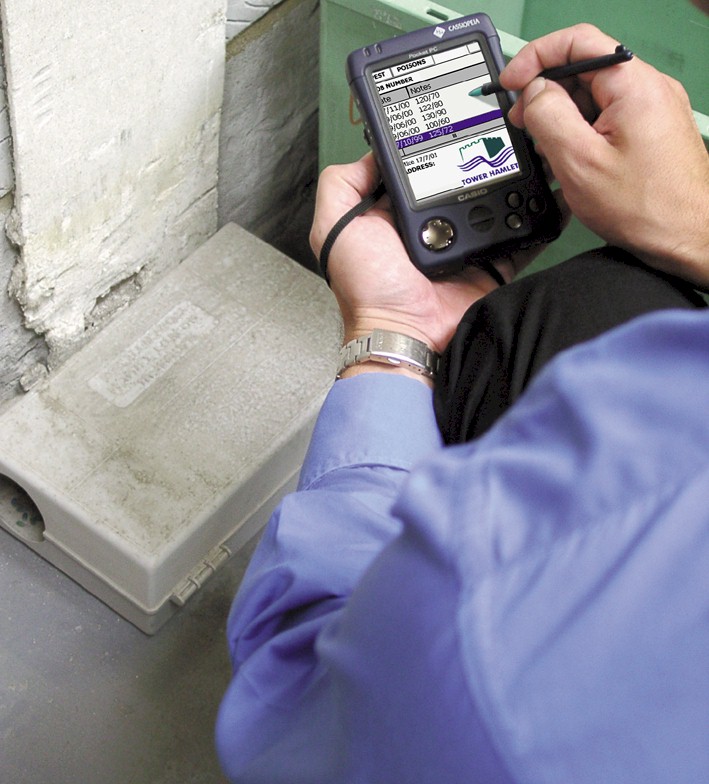
| Principal 7: Record keeping and Documentation * Document procedures and keep careful records. |
|
 |