 |
|
| Korean Culture & Cuisine |
| A Student Presentation |
 |
 |
 |
 |
 |
 |
 |
 |
 |
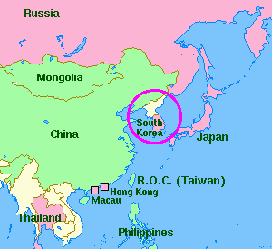
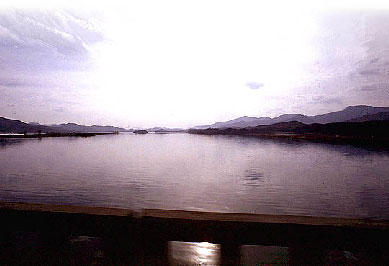
| The Basics Korea is a small country, sourrounded by water on three sides. More than half of it's land area is mountainous. Koreans enjoy a rich and varied menu, however. They began growing cereals during the mid-Neolithic period, and rice cultivation was introduced to some parts of the country around 2000BC. Rice remains the main staple and is eaten with an array of side dishes featuring vegetables, fish and meats. |
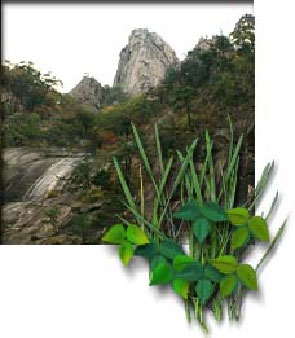
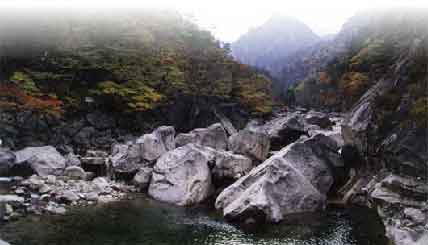
| Geography * Topography and Drainage: Approximately 70 % of land area mountain and uplands. * Principal ranges: Taeback and Sobaek range and Chiri Massif. * Tallest mountain - Mount Halla at 1950 meters * Volcanic cone located on Cheju Island. * Longest rivers: Naktong River, 521 kilometers; Han River, which flows through Seoul, 514 kilometers; and Kom River, 401 kilometers. |
| Climate Long, cold, dry winters, short, hot humid summers with late monsoon rains and flooding Seoul's January mean temperature: -5 degrees C to -2.5 degrees C Seoul's July mean temperature: 22.5 degrees C to 25 degrees C Annual rainfall varies from year to year but usually averages more than 100 centimeters, falling mainly between June and September. Droughts, particulary in the southwest; approximately one every eight years. |
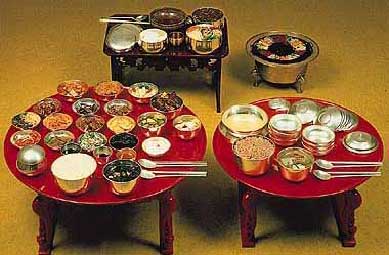
| Meals and Table Settings Traditional Korean society was highly stratified. This stratification is reflected in the names given to different table settings: * A children's table is simply called papsang, meaning literally "rice table." * An adult's meal is called chinjisang, or "honorable rice table." * The monarch's table is called surasand, or the "table offered to the king." |
| The Surasang The surasang usually consists of three tables. A large round table holds numerous side dishes, a bowl of rice and a bowl of rice mixed with read beans, two kinds of soup, small bowls of seasonings, at least three kinds of kimchi and 12 other side |
| dishes of caried styles and flavors. On a smaller round table are extra dishes and serving utensils, extra rice and water. A small rectangular table holds the ingredients to be used in the preparation of the chon'gol casserole which is made in a chafing dish next to the tables. |
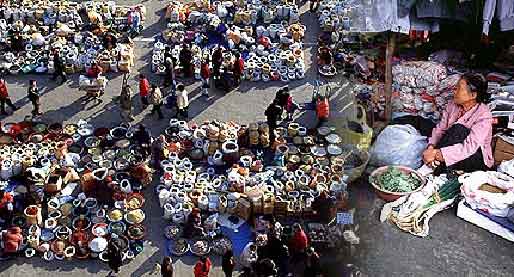
| Markets or Fairs Serve a myriad of purposes: * Sale and/or barter of goods * Gathering place for people * Information exchange At a market place one has the opportunity to meet old friends, distant relatives and neighbors, talk of everything from local affairs to even marriage proposals. |
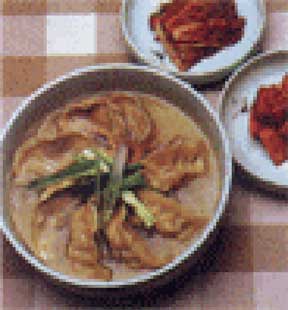
| Typical Meals A typical Korean meal usually consists of one main dish, generally meat or fish, and a wide range of tiny side dishes or Ban Chan. Kim Chi, a spicy fermented cabbage dish highly seasoned with garlic and red pepper, is served at virtually all meals and is probably the best known Korean Ban Chan. |
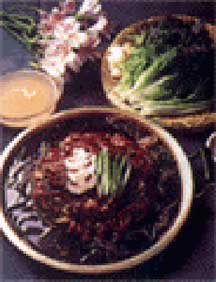
| Meat Dishes Two very popluar meat dishes are Bal Bi, and Bul Ko Ki which are marinated in a delectable sauce and grilled oven an open flame. |
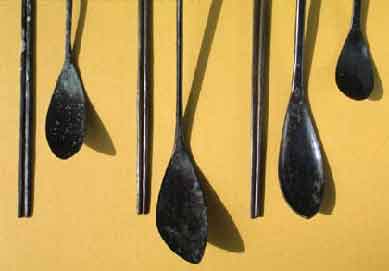
| Tableware Koreans are the only people in East Asia to eat their rice and soup with spoons. Neither the Chinese or Janpanese use their spoons with such regularity. The Korean's love for spoons no doubt derives from the many soups and stews they eat and the national preference for sticky rice. |