|
Math
& Science Pumpkin Activities @ the KES Pumpkin Patch!
On Oct. 30, the 4th graders made predictions of their pumpkin's weight,
circumference, number of lines, number of seeds, sink or float, &
distance rolled. The students then found the actual results of their
pumpkin. Finally, the students got to carve faces on their pumpkins to
take home!
| Strand |
The
Scientific Process |
| Standard
1: The Scientific Process: SCIENTIFIC INVESTIGATION: Discover,
invent, and investigate using the skills necessary to engage in the
scientific process |
| Topic |
Scientific
Inquiry |
| Benchmark
SC.4.1.1 |
Make
predictions, test your hypothesis, collect data, and make
conclusions |
Look
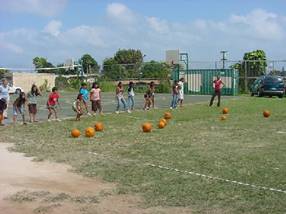
at our PUMPKIN PATCH!


Grade
4 Pumpkin Roll Off!
| Strand |
Measurement |
| Standard
4: Measurement: FLUENCY WITH MEASUREMENT: Understand attributes,
units, and systems of units in measurement; and develop and use
techniques, tools, and formulas for measuring |
| Topic |
Measurement
Attributes and Units |
| Benchmark
MA.4.4.2 |
Select
and apply appropriate customary and metric units and tools to
measure length, and circumference for the accuracy needed |

Our
Girls Winner! 
Our
Boys roll off!

Bransen
is the Boys Winner from our class! 
Measuring
the distance rolled . .


Girl
Winners from each class!

Grade 4 Boy
Winner vs Grade 4 Girl Winner (Both from Rm 23!)

And
the Grade 4 Champion is Rusty! 
| Strand |
Data
Analysis, Statistics, and Probability |
| Standard
11: Data Analysis, Statistics, and Probability: FLUENCY WITH DATA:
Pose questions and collect, organize, and represent data to answer
those questions |
| Topic |
Data
Collection and Representation |
| Benchmark
MA.4.11.1 |
Pose
questions, collect data using observations and experiments, and
organize the data into tables or graphs |
| Topic |
Data
Collection and Representation |
| Benchmark
MA.4.11.1 |
Pose
questions, collect data using observations and experiments, and
organize the data into tables or graphs |
| Topic |
Data
Collection and Representation |
| Benchmark
MA.4.11.2 |
Label the
parts of a graph (e.g., axes, scale, legend, title) |
Counting
Seeds!

Jack-o-lantern!

Pumpkin
Decomposition
Since
our Math/Science Pumpkin Activities on Oct. 30, we've been watching our
class pumpkin decompose. Talk about the lovely smells & winged
visitors to our room.
| Strand |
Life
and Environmental Sciences |
| Standard
3: Life and Environmental Sciences: ORGANISMS AND THE ENVIRONMENT:
Understand the unity, diversity, and interrelationships of
organisms, including their relationship to cycles of matter and
energy in the environment |
| Topic |
Cycles of
Matter and Energy |
| Benchmark
SC.4.3.1 |
Explain
how simple food chains and food webs can be traced back to plants |


Manoa
Heritage
Center
On October 10, our class went to visit the
Manoa
Heritage
Center
for the first time. We learned about and got to see and touch
native Hawaiian plants, some of us saw a Shama Thrush or a Poison Dart Frog,
a real heiau, as well as learning about the history of
Manoa
Valley
. Ask your child about his/her experience! Thank you to
Mr & Mrs Johnson, Mrs. Ishihara, Mrs. Fernandez, & Mrs. Condon for
chaperoning us.
| Strand |
History |
| Standard
3: History: PRE-CONTACT HAWAII HISTORY-Understand the people,
events, problems, and ideas that were significant in pre-contact
Hawaiian history |
| Topic |
Early
Hawaiian Society |
| Benchmark
SS.4.3.1 |
Explain
the origins and culture of early Hawaiians |
| Topic |
Early
Hawaiian Society |
| Benchmark
SS.4.3.3 |
Describe
the cultural contributions of different groups to the development of
Hawaii |
| Topic |
Exploration,
Migration, and Settlement |
| Benchmark
SS.4.3.5 |
Identify
reasons that early explorers, settlers, and immigrants came to
Hawaii (including the influence of Pa'ao) or the Polynesian region
and describe what their lives and experiences were like |
| Topic |
Exploration,
Migration, and Settlement |
| Benchmark
SS.4.3.7 |
Describe
the interactions (including economic exchanges and wars) among
different cultural and ethnic groups in early Hawaii |
| Strand |
Cultural
Anthropology |
| Standard
6: Cultural Anthropology: SYSTEMS, DYNAMICS, AND INQUIRY-Understand
culture as a system of beliefs, knowledge, and practices shared by a
group and understand how cultural systems change over time |
| Topic |
Cultural
Dynamics/Change and Continuity |
| Benchmark
SS.4.6.3 |
Describe
the changes in Hawaiian culture through contact with Westerners |

Picking & cracking open kukui nuts

Rubbing kukui nut oil on our hands.
Ike
Pono
We were fortunate to have 'Ike Pono from Kamehameha Schools come & teach
us Hawaiian Studies.
| Strand |
History |
| Standard
3: History: PRE-CONTACT HAWAII HISTORY-Understand the people, events,
problems, and ideas that were significant in pre-contact Hawaiian
history |
| Topic |
Exploration,
Migration, and Settlement |
| Benchmark
SS.4.3.4 |
Describe
the theories of early migrations from parts of Polynesia to Hawaii,
including migration myths and legends |
| Topic |
Exploration,
Migration, and Settlement |
| Benchmark
SS.4.3.5 |
Identify
reasons that early explorers, settlers, and immigrants came to
Hawaii or the Polynesian region and describe what their lives and
experiences were like |
| Topic |
Exploration,
Migration, and Settlement |
| Benchmark
SS.4.3.6 |
Illustrate
patterns and changes in population in Hawaii over a period of time |
Day
1 we learned about Hawaiian Exploration: theories, Polynesian Triangle,
Hokulea.

Day
2 we learned about Migration: directions.


Day
3 we learned about Settlement.
Guest
Speakers: Healthy Bodies through Healthy Nutrition
On Wed, Oct 24, we were fortunate to have a group of nursing students do a
healthy nutrition presentation with our class! We learned about eating
healthy, which foods and amounts are good for us, and what might happen if
you don't take care of yourself. We played a fun game that reviewed
what we learned and even got a healthy treat! Special thanks to
Mrs. Johnson who coordinated this special presentation!
| Standard
1: CORE CONCEPTS: Understand concepts related to health promotion
and disease prevention |
| Topic |
Healthy
Eating and Physical Activity |
| Benchmark
HE.3-5.1.2 |
Describe
the importance of physical activity and exercise as part of a
healthy lifestyle |
| Topic |
Healthy
Eating and Physical Activity |
| Benchmark
HE.3-5.1.3 |
Explain
the importance of a healthy diet as part of a healthy lifestyle |


Charlee & her mom's awesome group!
Bike Education
Standard
1: MOVEMENT FORMS: Use motor skills and movement patterns to perform a
variety of physical activities
| Topic |
Modified/Lead-Up
Games and Activities |
| Benchmark
PE.3-5.1.3 |
Use
combinations of mature (proper) movement forms, including locomotor,
non-locomotor, and manipulative skills |
Standard
2: COGNITIVE CONCEPTS: Understand movement concepts, principles, strategies,
and tactics as they apply to the learning and performance of physical
activities
| Topic |
Safety
and Play Etiquette |
| Benchmark
PE.3-5.2.2 |
Identify
procedures for safe participation in physical activities |
| Standard
3: ACTIVE LIFESTYLE: Participate regularly in physical activity |
| Topic |
Individual,
Dual, and Lifetime Activities |
| Benchmark
PE.3-5.3.1 |
Participate
regularly in physical activities that contribute to an active
lifestyle and bring personal enjoyment |
| Topic |
Individual,
Dual, and Lifetime Activities |
| Benchmark
PE.3-5.3.2 |
Describe
health-related benefits of regular participation in physical
activities |
Day 1: Learning
about dressing safely, the 6 bike safety check, & rules of the
road! Ask your child what they are!


Day 2: Some pics
of our 'new' riders! Yay!


Day 3 Woo
hoo!!!
100% Bike Riders are in Room 22!!! Awesome! I am so proud of
everyone for listening, following directions, never giving up, having a
positive "I Can!" attitude, while being safe & having fun!

 to top to top
|
|
|
