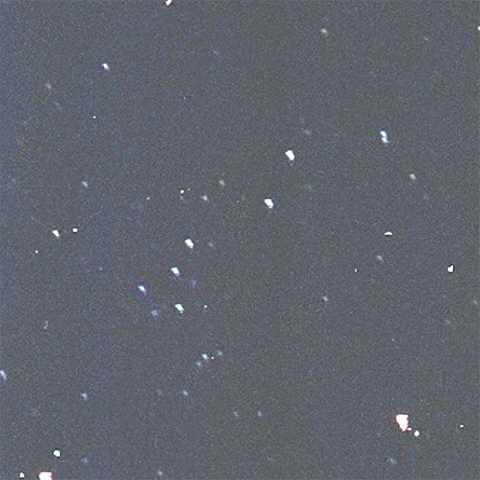
There are 2 elements in astrophotograhpy that are critical in taking keeper photos. One is proper focus and the second is accurate tracking. If you plan on starting out in this hobby expect to waste as much film as it takes you to properly perform these two tasks (I know). Proper focus is independent of the scope or mount you are using and has been dealt with in great detail on other websites. Accurate tracking on the other hand is entirely dependant on the mount you are using and should be the most important feature when deciding on which mount to purchase. While Meade touts the LX50 as a mount accurate enough to take photos I found this to be misleading.
Typical result from poor tracking of LX50 mount
This photograph illustrates what is meant by poor guiding. Stars seem to be smeared on the film because the actual star image was recorded in different areas if the film very close together. One solution to this problem is using an eyepiece with illuminated crosshairs called a guiding eyepiece. When used with an off axis guider, the guiding eyepiece grabs some of the incoming light from just outside of the image (off axis: telescopes are round and film is square, therefore there will be some of the incoming image that will not be "seen" by the film). Hopefully a star can be located and centered in the eyepiece. The trick is to keep the star centered throughout the exposure insuring that the image remains in the same position on the film eliminating the smearing. This better the mount the easier it is to keep the star centered because of something called periodic error (PE). The optimal situation is where there is no PE, the star does not move from the center of the crosshairs. This in reality is impossible and all mounts exhibit some error in varying degree. I found that the amount of PE in the Meade LX50 mount made it very difficult to keep the star centered. I was constantly using the keypad to correct the movement of the star and over the course of a long exposure was unable to eliminate the smearing effect (see picture).