|
DRAMA
UNIT
SOMEBODY LOVES YOU, MR. HATCH
Based
on the book - Somebody Loves You, Mr. Hatch by
Eileen Spinelli
|

|
|
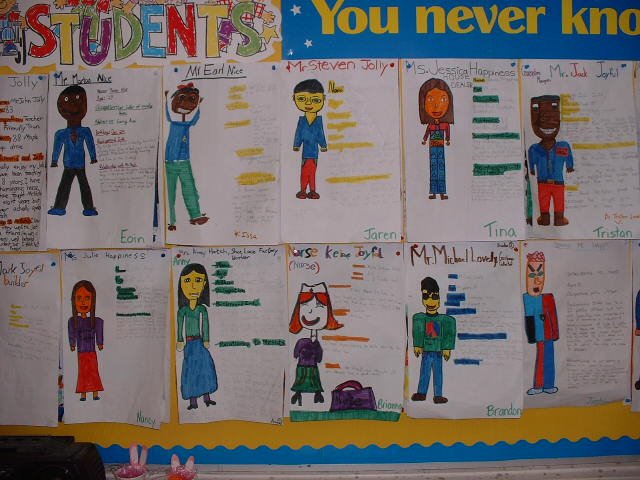
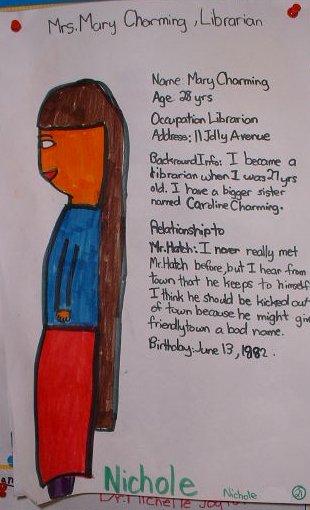
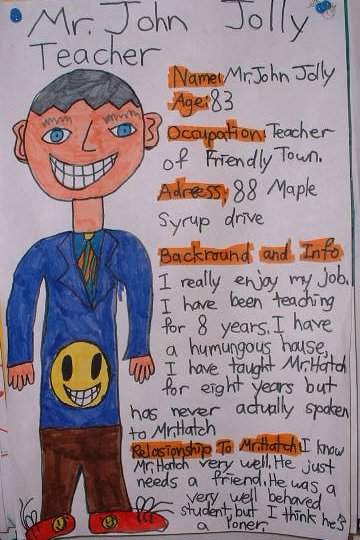
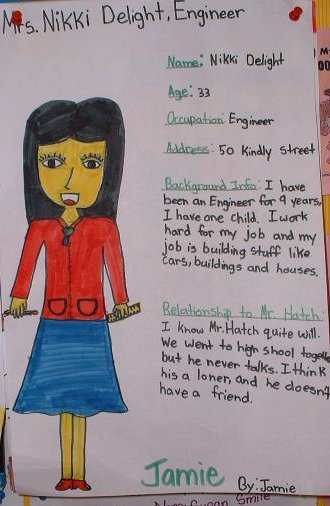
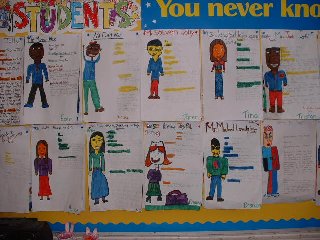
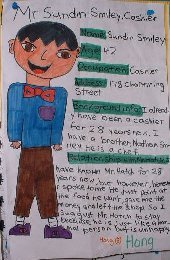
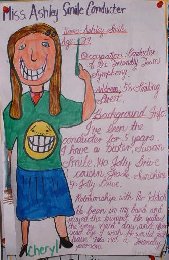
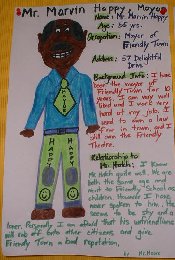
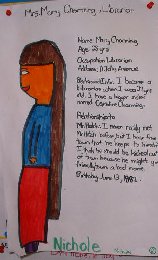
These are pictures of our
characters from our drama unit on the
book SOMEBODY
LOVES YOU, MR. HATCH. Mr. Hatch is a character
who lives a very dull life and does not have any
friends. I read the first few pages aloud to the
class and stopped. In groups we brainstormed
everything we knew so far about Mr. Hatch and words
to describe Mr. Hatch. We shared these as a group
and I recorded them on chart paper.
|
|
|
|
|
|
Next I told everyone that Mr.
Hatch lives in a place called FRIENDLY TOWN, the
friendliest town in Canada. We brainstormed the
names/professions of the people who might live in
Friendly Town, names of streets and places in
Friendly Town (e.g. Sunshine Street, Friendly Park,
Smiley University) and everyone assumed one of the
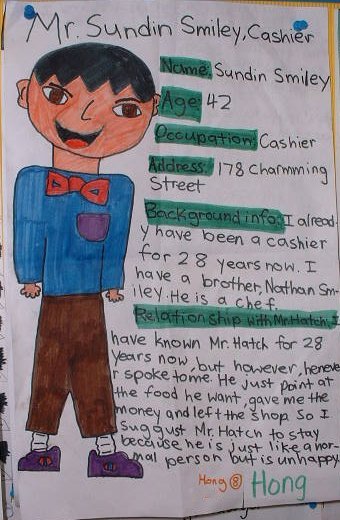
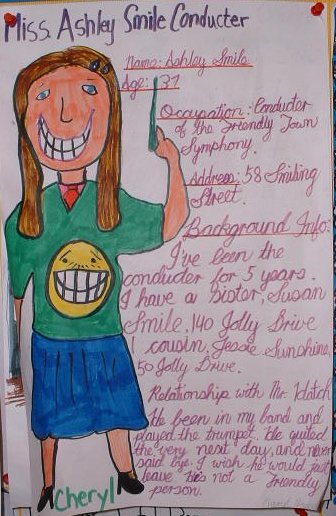
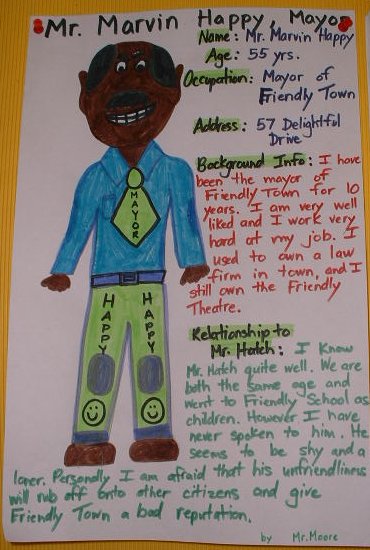
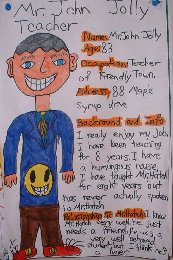
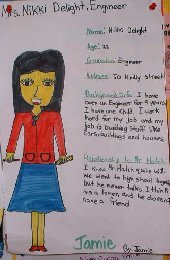
identities. Next they made pictures of their
characters and wrote about their occupations,
addresses, background information and relationships
to Mr. Hatch.
|
|
|
|
Once everyone had an
established identity, I called a town meeting and
as the Mayor of Friendly Town, I read an anonymous
letter aloud which was requesting that Mr. Hatch be
kicked out of town because he is so unfriendly. The
author of the letter was afraid that Mr. Hatch
would ruin the town's reputation for being friendly
and the town will lose tourists and money. People
might even move away. Everyone then divided into
two groups: those who wanted Mr. Hatch kicked out
and those who wanted Mr. Hatch to stay. In role,
they wrote letters to the mayor stating their
points of view. In the classroom I posted a notice
of a town meeting to kick Mr. Hatch out. The two
groups of citizens (pro and against Mr. Hatch) made
signs (e.g. HEY HO! HEY HO! MR. HATCH HAS GOT TO
GO!), wrote petitions and collected signatures.
They wrote short speeches which were to be read
aloud at the town meeting.
|
|
|
|
|
|
As mayor, I was in charge of
the town meeting and an ESL student was my
secretary. She wrote down the names of those who
wanted to speak. Two policemen were my guards and
they spoke to people when they became disorderly,
laughed, or spoke out of turn.
|
|
|
|
The meeting progressed with
each citizen giving a short speech. Mr. Hatch was
given an opportunity to speak but wasn't present
(too unfriendly, of course). Instead, his lawyer
read a letter by Mr. Hatch. A vote by secret ballot
was held and there was overwhelming support for Mr.
Hatch to stay. Everyone held a party and wrote
postcards to Mr. Hatch.
|
|
|
|
|
|
I finished the unit by
reading the entire book to the class and we made a
banner that said,
EVERYBODY
LOVES YOU, MR. HATCH!
|
|
|
This unit meets
the following specific expectations for Ontario's
grade 3 drama curriculum:
|
|
|
•demonstrate
an understanding of a character's point of view
through writing and speaking in role
•demonstrate the ability to concentrate while
in role in drama
•defend a point of view through speaking and
writing in role
•create works of drama
•identify the themes and subjects found in
drama, and make links between these and their own
experiences;
•clarify the meaning of complex or ambiguous
dramatic situations (e.g., by posing questions in
and out of role to characters in a
drama);
•solve artistic problems in drama in
cooperative work groups
|
PLAYING
FAIR
|
|
PLAYING
FAIR is a drama unit
based on a series of
videos called
PLAYING
FAIR. Each week the
class viewed and
discussed a video.
Students then
wrote a summary about
the video and two
diaries in-role (as the
bully and
as the victim of the
bully). The completed
summaries and diaries
were made
into booklets which were
shared with the
class.
The final activity was
called the PAPER DOLL.
Students stood in a
circle.
In the centre of the
circle, on the carpet,
was a life-size paper
doll. I
told everyone "I want
you to step into the
circle and say
something
hurtful to the paper
doll. After you say it,
you are to scrunch up
part of
the paper doll and then
step back." I
demonstrated what to do.
I said "You
are so stupid!" and
scrunched up a hand of
the paper doll. Students
then,
one by one, insulted the
paper doll and scrunched
it up. By the end,
the
paper doll was nothing
but a scrunched up ball.
I asked the students
to
describe the paper doll
in one word. Students
said things like
"Garbage"
and "Trash".
I told everyone "Now I
want you to step into
the circle and say
something
nice or comforting to
the paper doll. After
you say it, smooth out a
part
of the paper doll with
your hands." I
demonstarted what to do.
I said "You
are such a kind person!"
and smoothed out a hand
of the paper doll.
Students then, one by
one, said something nice
to the paper doll
and
smoothed it out. By the
end, the paper doll was
smoothed out but
pieces
were ripped or torn and
you could still see many
wrinkles and creases.
I
asked students to
describe the paper doll
in a sentence. Students
said
things like "The doll is
smoother but still
damaged." and "The doll
still
isn't what it was like
before we insulted
it."
At this point we
discussed how the paper
doll was like the
characters who
had been bullied in the
videos. The problems
were solved in the
videos but
the children had been
damaged by what had
happened and nothing
could erase
the memories of being
bullied and hurt by
others. We then made
anti-bullying and
anti-racist posters
which we displayed
throughout the
school.
This
letter was sent home to
the parents at the
beginning of the
unit:
Playing
Fair Parent
Letter
|
|
|
|
 Copyright � 2001 Michael Moore
|