
�
FUN WITH FRACTIONS
by
Mary Combrink
�
In a small, quiet corner of the world, there is a town called Fractionville. The residents are known as Fractions. They are a pleasant group -- friendly, calm, and rational. They get along well with one another.
Mr. and Mrs. Numerator live at the top of a hill in a split-level house in a quiet sub-division of Fractionville. Mr. Numerator mows his lawn every weekend, and Mrs. Numerator bakes all her cakes from scratch. They are content.
Mr. and Mrs. Numerator have four children. One-Half is the oldest. He is in eighth grade. Two-Fourths is next. She is just starting fourth grade. Four-Eighths is the second grader, and Eight-Sixteenths, the baby, is in first grade. Mr. Numerator is proud of the fact that, even though they are all different ages, they treat each other as equals.
As Mr. Numerator settled in with the newspaper one night after dinner, a notice on the front page caught his eye.
"Oh, look, " he said. "the Denominators have a new addition."
The Denominators live down the hill from the Numerators.
"Really?" One-Half asked with interest. "Bedroom or bathroom?"
"Neither," his father replied. "This is an addition of the numerical variety."
"Another baby?" Mrs. Numerator wrinkled her nose. "Those people multiply like rabbits. How can they afford another mouth to feed?"
Mr. Numerator shrugged. "I think they're nice."
"Mother doesn't." Two-Fourths giggled. "She says they're rather vulgar and second-rate. Those common Denominators, she calls them."
"A little snobbish of you, dear," Mr. Numerator said to his wife.
"Well, they are common." Mrs. denominator lifted her chin "They read comic books and eat frozen dinners. They let their children run barefoot in the street. They brag about how they never pay full price for anything. And," she lowered her voice," sometimes the children go to bed without brushing their teeth."
There was a moment of silence while the Numerator family contemplated these faults. One-Half thought of the stack of comics that were hidden under his bed. Two-Fourths remembered the frozen pizza she'd devoured at a friend's house just that afternoon. Four-Eighths imagined how free she would feel if she could run without shoes. Mr. Numerator considered all the wonderful bargains he'd found by using Mr. Denominator's shopping tips. And Eight-Sixteenths, the baby of the family, tried to recall when he'd last brushed his teeth.
Finally, Mr. Numerator rattled the paper and cleared his throat. "It says here that the school board is meeting to propose solutions to the Four-Color problem."
"I'd vote for pink, purple, green and white," Four-Eighths said.
"Those are girl colors." Eight-Sixteenths shuddered. "I want green, orange, red and blue."
"Ick," replied Four-Eighths. "Those don't even match."
The chime of the doorbell stopped the argument.
"Now who could that be?" Mrs. Numerator said. "It's after seven o'clock on a school night."
The door opened and Mrs. Numerator's younger brother Four walked in.
"Uncle Four!" His nieces and nephews crowded around him. "What did you bring us?"
Four shook his head. "Nothing tonight, kids. I'm here to talk to your folks. I've got a problem." He lifted his hands as he turned toward his sister. "What am I going to do?"
Mrs. Numerator helped her brother to a seat, then brought him a glass of water. "What's wrong?" she asked.
"I'm in love." Four's shoulders slumped and he pushed the water aside.
The family reacted in a variety of ways. Mr. Numerator sighed with relief. Perhaps now his brother-in-law wouldn't show up every weekend looking for free food. Mrs. Numerator fought off a stab of jealousy. No woman could possibly be good enough for her younger brother. The girls both imagined what they would look like in bridesmaids' dresses. Girls! One-Half thought. Gross! (Although that little blonde number in his math class wasn't half bad looking.)
Eight-Sixteenths wondered if there would be chocolate pudding for lunch the next day.
Mrs. Numerator was the first to regain her composure. "What's the problem, then?" Secretly, she hoped there would be no obvious solution.
"She's from the Thirds family." Four picked up his glass again, and watched the water slosh around. "First of all, there's the matter of that feud between the Sixths and the Thirds several generations ago. Secondly, I'm afraid Mother and Father will find her a little. . well. . . odd."
Mrs. Numerator shuddered. "We're not talking about One Third are we?" she asked.
Four quailed under his sister's reproachful look.
"Well, yes," he admitted. Then he added in a rush. "I don't care if she's a little odd. I love her. She completes me. When I'm with her, I feel whole."
"Why is she odd, Father?" Four-Eighths whispered to her dad.
Mr. Numerator shrugged. "She just is, that's all," he whispered back. "Her features are a little asymmetrical. She's not particularly even-tempered. But, Uncle Four loves her, so we'll accept her."
Four-Eighths was relieved. Perhaps the bridesmaid's dress was still in her future.
"You can't possibly be serious about this." Mrs. Numerator stabbed a finger at her brother. "Mother and Father will disinherit you. You will never be allowed to use the Sixths family name again."
Four set his glass back on the table. "Then that's the way it'll have to be," he sighed. "I just don't feel one hundred percent when I'm not with her."
"You're being irrational," Mrs. Numerator scolded.
"Impossible," her brother snapped back.
Mrs. Numerator gave an angry snort. The doorbell rang. Mr. Numerator rose to answer it.
"Mr. Denominator! Please come in. I just saw the notice about your new addition in the paper. Congratulations."
Mrs. Numerator stiffened.
Mr. Denominator bustled in, his hands full of foil-wrapped bubble gum cigars. He passed them out to all the children, who tore off the papers and stuffed the candy in their mouths before their mother could protest. He held out a cigar to Uncle Four, then stopped short when he saw Four's long face.
"Oh, dear," Mr. Denominator murmured. "This should be a happy occassion. What's wrong, young man?"
Four poured out the entire story. Mr. Denominator nodded and scratched his head.
"So your parents may disinherit you." he repeated. "You know, it is becoming something of a fad in our small corner of the world for the bride to take on the surname of her groom."
He smiled at Mrs. Numerator. She blushed.
"Well, yes," she admitted. "I did change my name from Sixths to Numerator when I married."
It took a moment for Four to puzzle this out.
"You mean," he replied slowly, "that she could change from Thirds to Sixths?"
Mr. Denominator nodded. "It's easily accomplished. I'd be glad to help."
Four considered this. "It might make Mother and Father a little happier," he said. "But there's still there matter of her. . er. . . oddness."
"I believe that the law requires you to change your first name as well as your last," Mr. Numerator told his brother-in-law. "Remember, your sister used to be Twelve instead of Two."
"Change her first name?" Four asked. "That might take some convincing."
Mr. Denominator once again had the perfect solution. "Since your sister's name is Two," he said, "perhaps your fiancee will consider using that also. As a tribute to her future sister-in-law. That would endear her to your parents."
"What a nice idea." Mr. Numerator peeked at his wife.
The children nodded in agreement. Mrs. Numerator didn't speak.
Four-Eighths had been sitting quietly, puzzling something out. "You'd be Four Sixths and Two Sixths!" she said. "No wonder you feel complete."
Everyone except Mrs. Numerator laughed when they realized that, indeed, Four Sixths and Two Sixths together make a whole.
"It's fate." Mr. Numerator grinned and slapped his brother-in-law on the back. "You must marry her now."
Mr. Numerator shook Mr. Denominator's hand. "I thank you, my friend," he said. "If it hadn't been for you, we would have been muddling around all night over how to make this all work out."
Mr. Denominator tried to hide his smile. Then, he smirked at at Mrs. Numerator. "It cannot be denied," he said, "that the only sure way to get two Fractions together is to find a common Denominator."
Mr. Denominator laughed and finished passing out his bubble gum cigars. Mrs. Numerator seethed. It must be said in her defense, however, that she finally came to love Two as a sister, and when little Six came along, she graciously accepted the invitation to become godmother.
�
THE TRUTH ABOUT FRACTIONS. . .
Now, everyone knows that fractions don't really talk. (Do they? How do you know what happens when you shut your math book?) What else do you know about fractions?
First of all, just what is a fraction? You can think of it as a number that represents a part of something. For instance, if you talk about one half of a thing -- perhaps one half an apple -- you are talking about one of two equal pieces of the apple. If you take an orange and cut it into three equal pieces, each of those pieces is one third. If your greedy older brother comes along and snatches two of those pieces away from you, he has taken two thirds of the orange.
Using numbers, one half is written as 1/2 or

The numerator is the number on top. The denominator is the number on the bottom. (This partly explains why Mrs. Numerator is always looking down on the Denominator family. The other reason is. . . well, face it, she's a snob.) The two numbers are separated by a fraction bar. The number of equal pieces the whole was divided into is shown by the denominator. The number of of those pieces you are talking about is given by the numerator.
In the fraction

three is the numerator and four is the denominator. Quick quiz: What's the numerator in
In the story, the fractions are described as being rational. That's a math pun, one that an algebra teacher would laugh hysterically at. But, don't worry, you can laugh, too. Let me explain. . .
If a person is described as rational, it means that he or she is sane , not crazy, of sound mind. If a number is described as rational, it means (hang on, this is straight from the dictionary) that it's
an algebraic expression, no variable of which appears in an irreducible radical or with a fractional exponent.
�
WHAT?
In other words, a rational number is one that can be written as a fraction. Plain and simple. All fractions are rational numbers. All rational numbers can be written as fractions. 1 is a rational number, because it can be written as 1/1 or 2/2 or an infinite number of other fractions. The number pi (pronounced"pie"), on the other hand, is irrational. It is a number that cannot be represented as a fraction. (Someone might tell you that is the same as 22/7. It's close, but not quite.)
Pi is also transcendental, but we'll save that for another day.
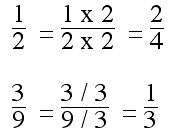
In our story, Mr. Numerator is pleased that his children treat each other as equals. Go ahead and give a big groan here, because that's another math pun. They treat each other as equals, because they are equals. Equivalent fractions, they're called. Those are fractions that represent the same number, or portion of a whole. You can go from one fraction to an equivalent one by either multiplying or dividing both the numerator and denominator by the same number.
Our friend Four Sixths was afraid that his parents wouldn't like his girlfriend because she was a little odd. In people terms, "odd" means strange or unusual. In math terms, however, odd simply means that it cannot be divided by two. You can't evenly split an odd number of things (like three books) between two friends unless you take a knife and cut one of those things in half (which would ruin the book and get you into trouble. Especially if it was your math book.)
Four was also afraid that his parents wouldn't like her because her last name was Third.
The solution? Use the idea of equivalent fractions to turn poor little One Third into someone else. Someone glamorous, someone exotic, someone wonderful.
What's that?
Just calling her by another name won't make her more exciting?
Congratulations! You now understand equivalent fractions. Just changing the name doesn't change the basic fraction. It still represents the same portion of a whole.
Anyway, to make One Third more acceptable to here future in-laws (although why she'd want to marry into such a stuck-up family is beyond me), we simply have to multiply her numerator and denomintor by the same number.
What do you think we should use?
Did you say two? (If you didn't, go ahead and say it now -- really loud.)
�
�
TWO!
Thanks.
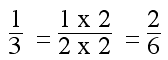
Now, One Third is now Two Sixths and she is free to marry her beloved Four.
Of course, in real life, fractions don't get married. (At least, we think they don't. Again, anything might be going on between the closed covers of your math book. That's why it's best to keep your math book open at all times, and to keep an eye on it.) Fractions do, however, get added. And that's where good old Mr. Denominator comes in. As he so proudly tells us, "If you want to get two fractions together, you have to find a common Denominator."
I promise, this is the last one of those math puns.
When we call a person "common" (actually, we shouldn't call a person "common" because it's not always nice), we might mean that he or she is unrefined and vulgar. This is, in fact, what Mrs. Numerator meant when she labeled the Denominators as common.
In mathematics, however, "common" can also mean "the same".
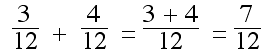
Two fractions can't be added together unless they have the same (a common!) denominator. If they don't have the same denominator, you have to use what you know about equivalent fractions to change them into fractions that do have the same denominator.
Got it?
Let's take 1/3 and 1/4, for example. Trying to add 1/3 and 1/4 is like trying to add 1 apple and 1 orange. You just can't do it. (Oh, you clever thing. I just heard you say "but they make two pieces of fruit". Ah, yes, That's true. But notice, before you added, you needed to find a word -- fruit -- that could describe both of them. And that, my dear student, is EXACTLY what we are trying to do with the fractions.)
Since 3 x 4 = 12 (I just multiplied the denominators together), I'm going to describe both my fractions as Twelfths.

Once the denominators are the same, it's a simple matter of adding the numerators together. (If you had 3 apples and 4 apples, how many would you have all together? Exactly! It's the same way with Twelfths.)
Back to our story. . .
Four Sixths and One Third hope to live happily ever after. They can only do that if she changes her name, So she does. Now, she's Two Sixths. And, as Four's niece so happily figured out. . .

Anytime the numerator and the denominator of a fraction are the same, the fraction can simply be written as the number "1".
As Four Sixths so poetically said, his future bride completes him.
She makes him whole.
�
�
�
�
One last note: If you look carefully through the story, you will notice a reference to the "Four-Color Problem". Despite what Mr. Numerator's children think, this has nothing to do with specific colors. Now it's time for you to do a little math research. Just what is the "Four-Color Problem"?
(Answer: Take a look at a map. Any map. You'll notice that the countries, or states, that share a boundary are colored with different colors. This makes it easier to see where one area ends and the other begins. In 1852, a man named Francis Guthrie noticed that, no matter what map you used, no more than four colors were needed to color it. He and his brother Frederick asked the mathematician Augustus De Morgan if it could be proven mathematically that four colors were always enough. This question remained unanswered until 1976 when Kenneth Appel and Wolfgang Haken used a computer to show that four colors were sufficient. Since the computer program took 1200 hours to run, and couldn't be verified by a human without a computer, many people did not feel that the problem really had been solved.)
All rights reserved. No portion of this text may be duplicated without the express written consent of the author.