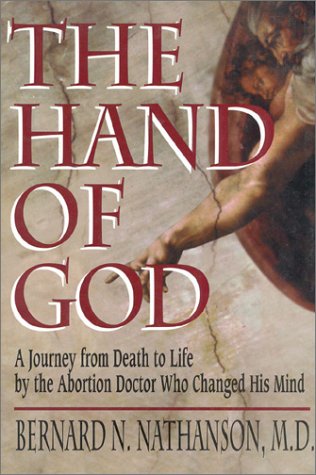
| The Hand of God by Bernard Nathanson |
| From Booklist Nathanson cofounded the pro-choice organization NARAL in 1969 and during 1971-72 made New York's Center for Reproductive and Sexual Health the best U.S. abortion clinic--accomplishments at the forefront of the push to make abortion commonplace. Before then, he had had a frustrating life distinguished by a love-hate relationship of epic proportions with his father. The senior Nathanson was a cold husband, a cruelly domineering parent, and a Jew who denigrated Judaism yet raised his son in it; but he was a conscientious physician faithful to the Hippocratic oath with its hard line against abortion. His son followed his example in most things, only rebelling by discarding religion and championing abortion. During the 1970s, Nathanson changed, becoming an important voice against abortion and assisted suicide and fetal tissue experimentation, too. At the end of his memoir cum apologia, he imparts that he hopes to be received into the Roman Catholic Church. Thanks to a wide-ranging vocabulary and a flare for cadenced prose, he makes most of his testimony lively and enthralling reading. Ray Olson From Kirkus Reviews , March 15, 1996 Autobiography combines with a battery of argument and data in this passionate account of the author's transition from pioneer of abortion rights to champion of the pro-life cause. Ob/gyn Nathanson (New York Medical College; Aborting America, 1979) was co-founder in 1969 of the National Association for Repeal of Abortion Laws (now known as the National Abortion Rights Action League) and the director of the first and largest abortion clinic in the US. He describes how he grew up in a ``hate-filled household'' in which his brilliant but autocratic father taught him to despise his mother and ridiculed the family's Jewish observances. Nathanson senior thwarted his son's desire to fight in WW II and in 1945 arranged his transition from Cornell to McGill Medical School, where our author was deeply impressed by Karl Stern. During his residency at New York's famous Woman's Hospital, Nathanson was horrified at the consequences of botched illegal abortions, and his efforts to change the laws took off in 1967. He describes the decriminalization campaign and how in 1971 he became director of the Women's Services Clinic, where over 120 abortions were being performed daily. Nathanson's doubts began when Ultrasound revealed the intimate life and development of the fetus for the first time. In 1985 he helped make the controversial film The Silent Scream, which shows a fetus being sucked out and dismembered during an actual abortion. He argues that, whether or not it feels pain or is deemed viable, the fetus is a distinct and developing human life. Nathanson excoriates violence against abortion clinics but warns that current legislation is cutting off legitimate dissent. He is clearly not at peace with his past, and he states that he is presently seeking admission to the Catholic Church. This concrete and powerful contribution will be required reading for all involved in the abortion debate. -- Copyright �1996, Kirkus Associates, LP. All rights reserved. Book Description The co-founder of the National Abortion Rights Action League examines and explains his change from an abortion provider to the most visible leader in the pro-life movement. Synopsis A prominent name in America's 30-year cultural war over abortion, Dr. Nathanson was co-founder of the National Abortion Rights Action League and director of the first and largest abortion clinic in the U.S. Part autobiography, part spiritual memoir, part scientific and philosophical treatise, this work offers startling new insights into abortion, human embryo research, and "physician-assisted suicide." |
 |