| NANOSENSORS |
| UPDATED DECEMBER 10, 2005 |

|
| Penn Researchers Introduce a New Nanotube-Laced Gel, Create New Means of Aligning Nanotubes Nematic Nanotube Gels, Physical Review Letters, 27 February 2004 |
| Microsensors put to practical use Dust Networks Inc., a chief developer, said that defense contractor Science Applications International Corp. of San Diego would become one of its first customers, using the technology for perimeter security systems. Link to article |
| Naomi Halas - Rice - Nanoshells Study shows nanoshells ideal as chemical nanosensors Link to article |
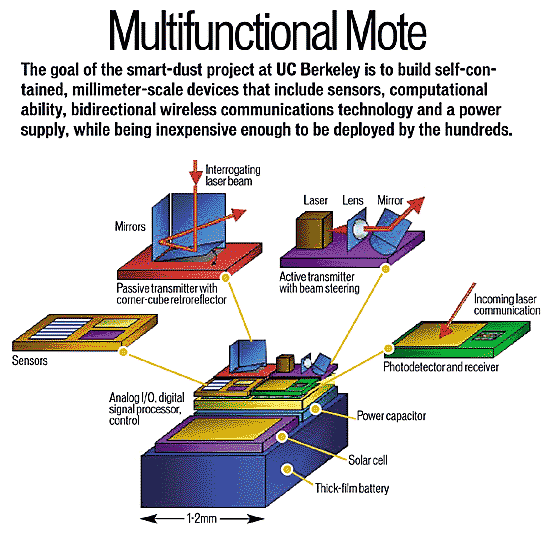
| Smart Dust Advances in Russia Luxoft, Luxoft Labs, WSN(Wireless Sensor Networks), ZigBee, IBM, HP, Nano-Crystals, Pervasive Distributed Computing Link to article Link to RB message NNPP Link tp RB message ABEW |
| Wayne State University/Stephanie Brock/Aerogels We have created a material that is mostly surface. That is because the very porous structure, through which environmental molecules can waft, has the maximum possible amount of surface area, essentially enabling every embedded quantum dot to sense the environment independently. Link |
| Chemical Detection with a Single-Walled Carbon Nanotube Capacitor E. S. Snow,* F. K. Perkins, E. J. Houser, S. C. Badescu, T. L. Reinecke Naval Research Laboratory Link to Science article United States Patent Application 20040192072 Inventors: Snow, Eric S., Novak, Jamie P. NAVAL RESEARCH LABORATORY Link to US application Carbon nanotube networks: Nanomaterial for macroelectronic applications E. S. Snow, J. P. Novak, Naval Research Laboratory We describe the properties and potential applications of an electronic material that consists of an interconnected random network of single-walled carbon nanotubes. We discuss two such applications: chemical sensing and macroelectronics. Link to Journal article/abstract Snow and Novak worked together at NRL - Naval Research Labs - on single walled CNT chemical sensors. Novak now works at NNPP. I therefor assume the company involved is NNPP. Link to RB message |
 |
| Harnessing Microbes, One By One, To Build A Better Nanoworld "One of the great challenges of nanotechnology remains the assembly of nanoscale objects into more complex systems," says Robert Hamers, a UW-Madison professor of chemistry and the senior author of the new reports. "We think that bacteria and other small biological systems can be used as templates for fabricating even more complex systems." Toward that end, Hamers and his UW-Madison colleagues Joseph Beck, Lu Shang and Matthew Marcus, have developed a system in which living microbes, notably bacteria, are guided, one at a time, down a channel to a pair of electrodes barely a germ's length apart. Slipping between the electrodes, the microbes, in effect, become electrical "junctions," giving researchers the ability to capture, interrogate and release bacterial cells one by one. Built into a sensor, such a capability would enable real-time detection of dangerous biological agents, including anthrax and other microbial pathogens. Link |
| University of Massachusetts Amherst Richard Vachet, Vincent Rotello, Sankaran �Thai� Thayumanavan To isolate and identify minute amounts of two types of hazardous substances: endocrine disrupting chemicals (EDCs) and microcystins, water-borne toxins that are considered potential bio-warfare agents. Rotello and Thayumanavan will design nanoparticles measuring 20 billionths of a meter that are coated with chemicals to capture the target compounds. Since the surface area to volume ratio actually increases as the size of particles decreases, the researchers could increase the capture of the target compounds by as much as 100 times more than currently used methods. �That's a huge jump,� says Vachet. Link |
| ALIEN TECHNOLOGY Army's New Sensors Rock The devices, which would be no larger than a golf ball, could be ready for use in about 18 months, the paper said. Link Alien Technology Alien Technology/ North Dakota State University (NDSU)/University of Alaska at Fairbanks article IH Message |