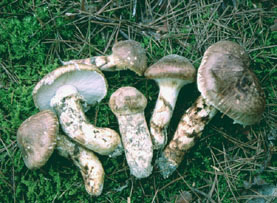
Pacific Northwest of the United States and in Canada. Mostly world wide in the northern latitudes. In British Columbia, they grow all along the pacific coast and in the interior. The
Pine only grows in the wild and can not be domesticated. For this reason there is a great
demand for the mushroom, which typically is harvested from late August to mi November,
depending on the latitude. Typically they will flush in the northern latitudes first, as the
temperatures begin to drop. The temperature that seems to induce flushing is from
2' C to 9' C. Freezing temps will very quickly turn the gill structures underneath to
a rusty brown color, as the gills a very delicate. Collectors interested in the Pine mushroom
for food, should compare it closely with the white aminitas species, very poisonous !
The best way to find the elusive Pine, is to cruise the side roads in Sept or Oct
and when you see some cars parked along the side, pull over and investigate. Douglas fir,
Hemlock and Pine trees are all a good sign. A few Cedars are ok, but if there are to many
you will more than likely not find any Pines. The reason for this, is that the Pine is a Mycorzial mushroom, meaning that it exchanges nutrients with the trees via their root
systems in a symbiotic relationship. The Cedar has a few noctious compounds that the Pine does not find favourable. A nice heavy thick moss floor is good, as this usually reduces the brush growth and aids in visibility. A heavy moss cover also helps retain moisture in the under lying root system of the mushroom (Mycellium). If you see a bump under the moss, check it, it might be a rock or a big Pine button just waiting for your skillet.
If you do find a Pine, the proper method of removal is to first clear dirt and moss away from the sides of the stem, down as far as you can. Do not pull on the cap. Firmly grasp the stem and gently pull upwards as you wiggle it from side to side and back and forth. If you need, clear more material holding the lower stem. If the lower stem is not cleared enough, it will probably break off as you pull it out. The base of the stem is surrounded by a light gray clay base dirt that is full of active Mycellium. Do not cut the stem out. The entire stem should be removed, and all of the gray mycellium dirt cleaned off of the stem and returned to the hole. Try to replace any moss, to cover the hole. In other words, leave no pine sign. Clean off any dirt from the cap and stem to prevent dirt getting into the gills of the other shrooms that you hopefully have in your bag. Some people rap each shroom in wax paper. I think this is going a bit over board. I just clean them well and then put them all in my bag with the gills facing down. Some people have no regard for the prestine nature of our wilderness and will proceed to use a rake to pull up all the moss to expose what is underneath. This act is a vicious rape of the forest and is severly frowned upon by the rest of the pickers. Raked moss can take upto 5 or 6 years to replace it's self. This method is not much more effective than an experienced picker, watching and probing for bumps under the moss. I have on occasion even been able to detect them by odour alone. When you find one, get down on your hands and knees to feel around for others, as they usually grow in groups of 3 or 4.
The best bag for your shrooms is paper or cloth. Plastic is not good. Your shrooms
will sweat and need to have some air flow. On the other hand to much drying and the
shrooms will wrinkle, lowering the grade, drying will reduce the weight of your shrooms.
Pine mushrooms are graded by the buyer, who decides the value of each mushroom.
GRADE
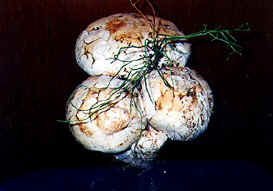
Number # 1 is a closed button, larger than a dollar coin with good color and texture,
with no deformaties.
** $ 30 to $ 100 per pound.
Number # 2 is a partially closed button, where a portion of the veil covering the
gills has been broken. Or a closed number 1 but has some deformaties.
** $ 25 to $ 60 per pound.
Number # 3 the veil is completley open and the gills are exposed. The cap is still convex and the margin inrolled. Good color and texture.
** $ 20 to $ 30 per pound.
Number # 4 open veil, cap flattened, margin not inrolled. Minor discoloration and
minor loss of texture.
** $ 15 to $ 25 per pound.
Number # 5 open, flat, with more discoloration and poorer texture (soft). Gills
underneath have started to turn a rusty brown color. Some loss of odour.
** $ 8 to $ 15 per pound.
Number # 6 open, flat, of poor quality. Advanced discoloration of gills and the cap.
Loss of odour.
** $ 0 to $ 5 per pound.
These figures are in the known range for the west coast of British Columbia.
I hope this information is of some help.
Good Hunting