

---------------------------------------------------------------------------------------------------
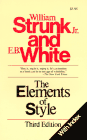
Eighty two years after its initial publication and ranking twenty-third on this week's New York Times' list of non-fiction bestsellers, Strunk and White's The Elements of Style remains a beacon of inspiration for writers of all persuasions. Emulated by many but surpassed by none, every undergraduate student should befriend this classic book.
The authors advocate fundamentally, a clear and concise writing style and then make curt suggestions on how this will be achieved . Their writing style is testament to their philosophy, covering most good writing essentials, rules of usage, and principles of composition in four short chapters. Chapter I begins with eleven "Elementary Rules of Usage," and then Chapter II continues with eleven more "Elementary Rules of Composition," followed by eleven "Matters of Form" in Chapter III. Each is presented as a brief statement followed by one or two more sentences of explanation and a few poignant examples. A useful twenty-six page listing of commonly used and abused words and expressions are reserved for the final chapter.
The Elements of Style covers aspects of grammar, word selection, and appropriate use of syntactical constructions. We are encouraged to leave out any superfluous vocabulary or clauses that are redundant. The book is generously illustrated with examples in parallel with correct and incorrect usage. Chapter V has been added as a sort of afterthought by Professor White. This chapter "An Approach to Style" includes a list of 'Reminders' that the writer should follow despite her/his natural tendencies to flout these recommendations. Stick to the rules and succeed, he implies.
Chapter IV is a devoted to misused words and expressions. The authors list many handy hints to redress some of the commonplace rudiments of bad style. After completing your manuscript, use the 'Find' feature to check the correctness of all the troublesome words and expressions in the previous paragraph. A second, very useful tip will expand and make more precise your use of those all important Latinate verbs. In a 'Word' document, click the right button over a verb and then move your cursor to 'Synonyms'. Check the meaning first, then the alternatives that your onboard dictionary offers. It is an excellent strategy for finding just the right verb that will power your writing forwards. Good writers are not generally born with a quill in their hand. They are people who have mastered this process through diligence and by learning to make use of the best available tools.
To recapitulate, The Elements of Style is not a panacea for student writing. It is more of a companion to writing than an all embracing reference book. Students should rather point their cursors to book review three for a comprehensive study of why the rules are as they are, why they sometimes conflict, and what to do when they do conflict. From this larger book you will gather knowledge of the sentence functions and rhetorical relationships that are important to develop your writing acumen. Your global organisation, structure, coherence, and focus will benefit enormously. Producing unintelligible and ambiguous sentences is part of the learning process for all students and can lead to valuable learning experiences. If we never did anything wrong, we would never know how to fix something when it did go wrong. Surely your writing will improve if you familiarise yourself with Strunk and White's succinct and unpretentious book.
In an era of digital shortcuts, business hyperbole, and bare-knuckle capitalism, it is comforting to know that an honest and readable tome is still available at the right price. I would like to recommend it as indispensable reading for undergraduate students.

