In this section, we will help you with several of the most common topics found in a newspaper. We can do this because each topic has certain consistencies. It is likely to have a group of frequently used words. Hence you could expect to see words like flames, gutted, and charred, in a fire story and candidate, poll and ballot in a story about an election. Most stories typically follow a particular sequence of events. A crime story may go something like this: crime, arrest, trial, verdict (decision) and sentencing (announcement of punishment). And it will take place in familiar settings (the crime scene, a courtroom, a police station, a prison etc.) and will involve people playing familiar roles (defendants, defence lawyers, prosecutors, judges etc.).
Let's take one of the clearest examples of a topic with consistent content: a storm. Let's focus on a severe tropical storm like Tropical Cyclone Joe that ravaged our north coast not long ago.Tropical storms generally follow a sequence and use some of the vocabulary most likely to be found in each stage of the sequence.
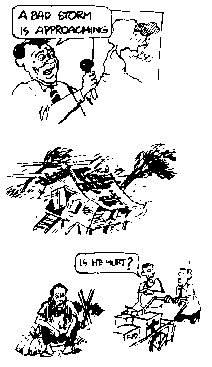


Thanks to modern science, meteorologists, are now usually able to predict tropical storms early enough so that people in the storm's path can be warned in advance. If it looks like the storm could be a serious one, people can take precautions like boarding up their houses, or evacuating low-lying coatal areas.
The storm hits: A Severe tropical storm ploughs through the countryside, leaving a path of destruction in its wake. Winds lash coastal communities, uprooting trees, ripping off roofs and collapsing buildings in the process. A storm may abate temporarily as it moves inland only to regain its full fury as it hits open water again.
Torrential rains accompanying the storm swell rivers and the surging waters overflow the river banks, submerging the surrounding area and isolating communities until the flood waters recede.
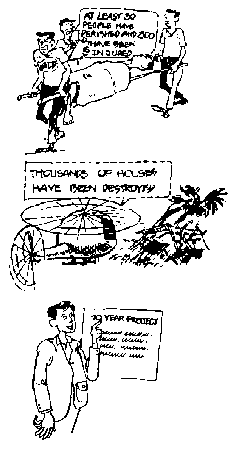
Casualty tolls and damage estimates: The first statistics concern the number of dead and injured. In the confused aftermath of a storm, however, the first casualty tolls are usually inaccurate, and it may be days, even weeks before the true figures are known.The same is true of damage estimates.
Future consequences: If there has been serious loss of life and property, people naturally turn their attention to how to prevent similar occurrences in the future. While there is little that can be done to prevent tropical storms, they can minimise their effects. Warning systems can be improved, emergency shelters provided, flood walls built or strengthened, pumps installed, and most importantly, people can be educated about how best to deal with disasters before they happen.