Pigs Are Friends, Not Food!
"Pigs have the cognitive ability to be sophisticated.
Even more than dogs and certainly 3-year-olds human child."
--Dr.Donald Broom
..In fact, pigs are curious
and insightful animals thought to have intelligence beyond that of an
average 3-year-old human child. They are smarter than dogs and every
bit as friendly, loyal, and affectionate.

"Please
don't eat me.." |
|
Many people who know pigs compare them to dogs because they are friendly,
loyal, and intelligent. Pigs are naturally very clean and avoid, if at
all possible, soiling their living areas. When given the chance to live
away from factory farms, pigs will spend hours playing, lying in the sun,
and exploring their surroundings with their powerful sense of smell. Considered
smarter than 3-year-old human children, pigs are very clever animals.
Most people rarely have the opportunity to interact with these outgoing,
sensitive animals because 97 percent of pigs in United States today are
raised on factory farms. These pigs spend their entire lives in cramped,
filthy
warehouses, under constant stress from the intense confinement and denied
everything that is natural to them.
As piglets, they are taken away from their mothers when they are less than
1 month old; their tails are cut off, some of their teeth are cut off, and
the males have their testicles ripped out of their scrotums (castration), all
without any pain relief. They spend their entire lives in overcrowded pens
on a tiny slab of filthy concrete. |
Breeding sows spend their entire miserable lives in tiny metal crates where
they can't even turn around. Shortly after giving birth, they are once
again forcibly impregnated. This cycle continues for years until their bodies
finally give out and they are sent to be killed. When the time comes for slaughter,
these smart and sensitive animals are forced onto transport trucks that travel
for many miles through all weather extremes—many die of heat exhaustion
in the summer and arrive frozen to the inside of the truck in the winter.
According to industry reports, more than 170,000 pigs die in transport each
year, and more than 420,000 are crippled by the time they arrive at the slaughterhouse.
Many are still fully conscious when they are immersed in scalding water for
hair removal.
Fascinating Facts !
Did You Know?
Scientists and scholars who have studied pigs say that pigs are the smartest
animals outside of primates (and pigs even outclassed some primate species
in some intellectual areas).
President Harry Truman stated, "No man should be allowed to be President
who does not understand hogs." Most people know very little about these
fascinating animals. In fact, pigs are curious and insightful animals thought
to have intelligence beyond that of an average 3-year-old human child. They
are smarter than dogs and every bit as friendly, loyal, and affectionate. When
in their natural surroundings, not on factory farms, they are social, playful,
protective animals who bond with each other, make beds, relax in the sun, and
cool off in the mud.
Since most people are not that familiar with pigs, you may be surprised to
learn that they dream, recognize their names, play video games more effectively
than some primates, and lead social lives of a complexity previously observed
only in primates.
People who run animal sanctuaries often describe pigs with human characteristics,
because they've learned that, like humans, pigs enjoy listening to music,
playing with soccer balls, and getting massages.
"Eating bacon is like eating my neice!" says actor Cameron Diaz, after hearing
that pigs have the mental capacities of a 3-year-old-human.
Pigs on today's farms are denied their every desire; they never run
across sprawling pastures, bask in the sun, breathe fresh air, or do anything
else that comes naturally to them. Mother pigs (sows) spend most of their lives
in tiny "gestation" crates, which are too small for them to turn
around in. They are continually impregnated until they are slaughtered. Piglets
are taken away from their distraught mothers after just a few weeks, and their
tails are chopped off, the ends of their teeth are snipped off with pliers,
and the males are castrated. No painkillers are given to ease their suffering.
Because of improper stunning methods, many pigs are still alive when they
are dumped into scalding-hot water, which is intended to remove their hair
and soften their skin. When they're killed, male pigs are still babies,
only about 6 months old. Since their natural life span is 6 to 9 years, they
never mature to enjoy a full life. On any given day in the United States, about
1,000 pigs are killed every hour. The average American meat-eater is responsible
for the abuse and deaths of approximately 31 pigs. Actor Cameron Diaz, upon
hearing that pigs have the mental capacity of a 3-year-old human child, decided
never to eat pigs again, saying "[Eating bacon is] like eating my niece!"
What the Experts Say ?
"Like us, pigs form close bonds. They like being scratched and, at the touch
of your hand, will contentedly roll over for a belly rub. They also snuggle
close to one another and prefer to sleep nose to nose."
Professor Stanley Curtis of Penn State University found that pigs play and
excel at joystick-controlled video games. He observed that they are "capable
of abstract representation" and "are able to hold an icon in the
mind and remember it at a later date." Professor Curtis says that "there
is much more going on in terms of thinking and observing by these pigs than
we would ever have guessed." Pigs are much smarter than dogs, according
to the research, and even did better at video games than some primates. Says
Dr. Sarah Boysen, Curtis' colleague, "[Pigs] are able to focus
with an intensity I have never seen in a chimp."
Pigs form complex social units and learn from one another in ways previously
observed exclusively among primates. For example, pigs use clever ploys to
try to outsmart each other. Pigs often learn how to follow others to food before
snatching it away. Those who are tricked learn to change their behavior in
order to reduce the number of times they are deceived. And Dr. Mike Mendyl
notes that pigs can signal their competitive strength and "use this information
to minimize overt aggression during disputes about social ranks," just
like many primates (including humans). He explains that "pigs can develop
quite sophisticated social competitive behavior, similar to that seen in some
primate species."
Pigs communicate constantly with one another. More than 20 of their oinks,
grunts, and squeals have been identified for different situations, from wooing
their mates to expressing, "I'm hungry!"
Pigs have a very long memory. Dr. Curtis put a ball, a Frisbee, and a dumbbell
in front of several pigs and was able to teach them to jump over, sit next
to, or fetch any of the objects when asked to and they could distinguish between
the objects three years later.
Scientists at the University of Illinois have learned that not only do pigs have
temperature preferences, they also will learn through trial and error how to
turn on the heat in a cold barn if given the chance and turn it off again when
they are too warm.
Professor Donald Broom of Cambridge University Veterinary School says, "[Pigs]
have the cognitive ability to be quite sophisticated. Even more so than dogs
and certainly three-year-olds."
Suzanne Held, who studies the cognitive abilities of farm animals at the University
of Bristol's Centre of Behavioural Biology, says that pigs are "really
good at remembering where food is located, because in their natural environment
food is patchily distributed and it pays to revisit profitable food patches."
Newborn piglets learn to run to their mothers' voices, and mother pigs
sing to their young while nursing.
Pigs are actually very clean animals. If given sufficient space, pigs will
be careful not to excrete near where they sleep or eat. Pigs don't "sweat
like pigs"; they are actually unable to sweat. Pigs like to bathe in
water or mud to keep cool.
Pig Prowess
"Pigs do not 'eat like pigs' or 'pig out.' They prefer to eat slowly and savor
their foods.
Like dogs, piglets learn their names by 2 to 3 weeks of age and respond when
called.
Pigs prefer water to mud. One woman developed a shower for her pigs, and these
astute animals learned to turn it on and off.
Pigs appear to have a good sense of direction and have found their way home
over great distances. Adults can run at speeds of up to 11 miles an hour.
Pigs have shown gentleness and forgiveness. Norwegian author Bergljot Borresen
writes about a mountain farmer who mistreated his pig. The pig locked her jaws
into his thigh but didn't bite down. The farmer believed it was a warning
not to treat her unkindly again. In her own way, she gave him another chance.
Author John Robbins notes that "unlike dogs, horses and humans, they will
never dangerously overeat even when given access to unlimited food." The
pork industry, however, has wreaked havoc on this healthful habit with a drug
called Hog-Crave, which causes pigs to overeat so that they will grow faster
and will thus be more profitable to those who kill them.
Pigs have been known to save the lives of others, including their human friends.
According to The Daily Telegraph, "a pet piglet called Pru was praised
by her owner … after dragging her free from a muddy bog." The owner
said, "I was panicking when I was stuck in the bog. I did not know what
to do and I think Pru sensed that. … I had a rope with me that I use
as a dog lead and I put it around her. I was shouting 'Go home, go home' and
she walked forward, slowly pulling me out of the mud."
Like dogs, pigs have done many heroic deeds. Babe's real-life counterparts
have rescued human and nonhuman companions, stopped intruders in their tracks,
and even saved themselves from slaughterhouses. In addition to the previously
mentioned piglet Pru, who dragged her human companion from a muddy bog, there
is also Priscilla, who saved a young boy from drowning; Spammy, who led firefighters
to a burning shed to save her calf friend Spot; and Lulu, who found help for
her human companion who had collapsed from a heart attack. A pig named Tunia
chased away an intruder, and another named Mona held a fleeing suspect's
leg until the police arrived. A pig in New Jersey jumped off a truck en route
to the slaughterhouse, while in England, a stone carving of a pig named Butch
was placed upon a historic cathedral after Butch and his friend Sundance escaped
from a slaughterhouse and roamed the country for several days before being
captured. Fortunately, a national outcry against slaughter allowed Butch and
Sundance to go to a sanctuary.
Pigs on Factory Farms
"When pregnant sows are ready to give birth, they are moved from a gestation
crate to a farrowing crate. One worker describes the process: "They beat the
shit out of them [the mother pigs] to get them inside the crates because they
don't want to go. This is their only chance to walk around, get a little exercise,
and they don't want to go [back into a crate]."
Many people think of Charlotte's Web and Babe when they imagine how
pigs are raised for meat. Unfortunately, these Hollywood tales do not depict
reality.
Almost all of the 100 million pigs killed for food in the United States every
year endure horrific conditions in controlled animal feeding operations (CAFOs),
the meat industry's euphemism for factory farms.4 Smarter than dogs,
these social, sensitive animals spend their lives in overcrowded, filthy warehouses,
often seeing direct sunlight for the first time as they are crammed onto a
truck bound for the slaughterhouse.
A mother pig, or sow, spends her adult life confined to a tiny metal crate.
She will never feel the warmth of a nest or the affectionate nuzzle of her
mate—she will spend her life surrounded by thick, cold metal bars, living
on wet, feces-caked concrete floors. When she is old enough to give birth,
she will be artificially impregnated and then imprisoned again for the entire
length of her pregnancy in a "gestation crate," a cage only 2 feet
wide—too small for her even to turn around or lie down in comfortably.
After giving birth, a mother pig is moved to a "farrowing crate," a
contraption even worse and smaller than a gestation crate, with only a tiny
additional concrete area on which the piglets can nurse. Workers will sometimes
tie the mother's legs apart so she cannot get a break from the suckling
piglets. She may develop open "bed sores" on her body from the
lack of movement. This practice is so barbaric that gestation crates have been
banned in Florida, the U.K., and Sweden and will be banned in the European
Union in 2013.
When pregnant sows are ready to give birth, they are moved from a gestation
crate to a farrowing crate. One worker describes the process: "They beat
the shit out of them [the mother pigs] to get them inside the crates because
they don't want to go. This is their only chance to walk around, get
a little exercise, and they don't want to go [back into a crate]."
"Imagine being shoved inside a small closet
with barely enough room to move. Your feet begin to ache from the hard
floor so you contort your
body
just enough to sit down. But after a while, this position offers no more comfort
and you struggle to stand up again. The lack of room to walk or turn around
starts to atrophy your muscles, and festering sores on your feet make every
movement agony. Now imagine spending six years like this--and you'll begin
to understand what life is like for nearly 6 million pregnant or nursing pigs
in the United States."
--Actor James Cromwell
The piglets are taken away from their mother after less than a month—in
nature, they would stay with their mother for several months. She is impregnated
again, and the cycle of forced breeding and imprisonment continues. For such
an intelligent animal, this intensive confinement causes debilitating stress
and boredom. With nothing to do but stare at the bars in front of her, a mother
pig may go insane. This is often exhibited by neurotic chewing on the cage
bars or obsessive pressing on her water bottle.12 After three or four years,
when her body is exhausted and her mind pushed to or even past the brink of
insanity, she is shipped off to slaughter.
Meanwhile, the sow's piglets have their testicles cut out of their scrotums,
their tails cut off, many of their teeth clipped in half,
and their ears mutilated, all without any pain relief. Terrified and in extreme pain, the piglets are
often put alone into tiny metal wire cages (called "battery cages" by
the farmers). These cages are stacked on top of each other, and urine and excrement
constantly fall on the piglets in the lower cages. After the piglets have grown
too big for the cages, they are placed into small, cramped pens crowded with
many other piglets, where they are kept until they are large enough for slaughter.
The animals are given almost no room to move because, as one pork-industry
journal put it, "[O]vercrowding pigs pays." Impeccably clean
by nature, pigs on factory farms are forced to live in their own feces, vomit,
and even amid the corpses of other pigs.
Overcrowding, poor ventilation, and filth cause rampant disease. Respiratory
problems are common because of high levels of humidity and toxic gases from
the manure pits—in fact, 70 percent of pigs on factory farms have pneumonia
by the time they're sent to the slaughterhouse. Many pigs die from
infections caused by the noxious fumes and filth of their enclosures. Pigs
are fed massive doses of antibiotics to keep them alive in these conditions.
Conditions are so filthy that at any given time, more than one-quarter of pigs
suffer from mange.
Because of illness, lack of space to exercise, and genetic manipulation that
forces them to grow too big too fast, pigs often develop arthritis and other
joint problems. Many pigs on factory farms live on slatted floors above giant
manure pits. Smaller pigs often suffer severe leg injuries when their legs
get caught between the slats.
Always concerned with their bottom line, some farmers kill sick animals instead
of giving them medicine or veterinary care. A PETA investigation found that
a manager at an Oklahoma farm was killing pigs by beating them with metal gate
rods, and others were left to die without food or water. Unwanted "runts" were
killed, as they are on most farms, by "thumping," which involves
slamming the animals' heads against the floor.20 Watch video from that
investigation.
After enduring months in these hellish conditions, pigs are forced onto trucks,
bound for a horrific and agonizing death at the slaughterhouse.
Managers of Canada's largest pig exporter faced cruelty
charges after 10,000 dead and dying pigs were found on the company's farms.
Investigators found
dead pigs stacked behind barns and dead piglets in manure tanks, and all the
live pigs "were in some form of distress."
Factory Farms Mutilate Baby Pigs
On factory farms, the following procedures are performed on piglets only weeks
old. The pig-flesh industry refuses to use painkillers even though local anesthesia
would cost about 1 penny per baby pig.
"Castration"
A worker slices into a piglet’s scrotum and pulls out his testicles while
the piglet screams and writhes in pain. Imagine asking a veterinarian to neuter
your dog—but without pain relief. That would be a felony in most states.
"Ear-notching"
Large hunks of each piglet’s ears are sliced off with scissors to make
identification patterns.
"Tail-docking"
Piglets have their tails cut off to reduce tail biting, a habit that arises
from boredom and frustration in stressful factory farm conditions. Scientists
testify that the pain is severe and continues for many days.
"Tooth-clipping"
The piglet’s incisor teeth are cut off with pliers that are similar to
wire cutters so that they can’t cause injuries by chewing on themselves
or their neighbors when the extreme confinement drives them insane. Imagine
dental surgery without anesthetics.
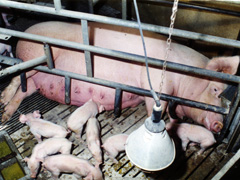
Mother pigs are confined to cages so small that they can't even turn around. |
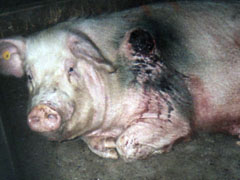
Pigs develop sores from living in filthy conditions that are too cramped
to even stand up in. |
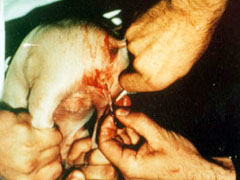
Piglets are mutilated and castrated without the use of painkillers; some
die from shock. |
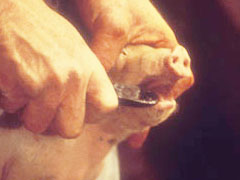
Workers cut piglets’ teeth, without the use of painkillers, in order
to prevent them from biting each other out of boredom and frustration. |
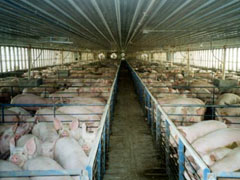
Pigs in factory farms never get to go outside until they are sent to slaughter. |
|
- Food and Agriculture Organization of the United Nations, "Pigmeat,
Slaughtered/Production Animals (Head) 2002," 10 Jun. 2003.
- Cambridge Daily News.
- Marc Kaufman, "In Pig Farming, Growing Concern," The Washington
Post, 18 Jun. 2001.
- Kaufman.
- The Humane Society of the United States, "Maryland: Support Minimum
Crate Size for Pregnant Pigs," HSUS Online, 2005.
- The European Union, "Animal Health and Welfare: Pigs," The
European Union Online (Europa), 2005.
- Eisnitz, p. 219.
- Lauren Ornelas and Juliet Gellatley, "A Report on the U.S. Pig Industry," Viva!
USA, 2004.
- A.J. Zanella and O. Duran, "Pig Welfare During Loading and Transport:
A North American Prespective," I Conferencia Vitrual Internacional
Sobre Qualidade de Carne Suina, 16 Nov. 2000.
- James Cromwell, "Veterinarians Should Act to Stop Crating of Pregnant
Pigs," The Chicago Sun-Times, 6 Nov. 2004.
- William Luce et al., "Managing the Sow and Litter," Oklahoma
Cooperative Extension Service, March 1995.
- Gene and Lorri Bauston, "Brutality: Main Crop of Factory Farms?" EarthSave
International Online, 2004.
- "Swine Diseases (Chest): Mycoplasma Pneumonia," Iowa
State University College of Veterinary Medicine, 2005.
- IVOMEC Pharmaceutical advertisement, Pork Magazine, 17 Dec. 2002.
- Cindy Wood, "Don’t Ignore Feet and Leg Soundness in Pigs," Virginia
Cooperative Extension, June 2001
- Jessica Gentry and John McGlone, "Alternative Pork Production Systems:
Overview of Facilities, Performance Measures, and Meat Quality," International
Meeting on Swine Production, April 2003.
- "Seaboard Pig Farm Investigation Video," PETA Online, 2001.
- Kelly Pedro, "Pigs Found Dead, Dying," The London Free Press,
15 Oct. 2003.
- Betsy Freese, "No Shortcut to Pig Welfare," Successful Farming,
Aug. 1999, p. 22.