|
How is Ebola Transmitted?
The Ebola
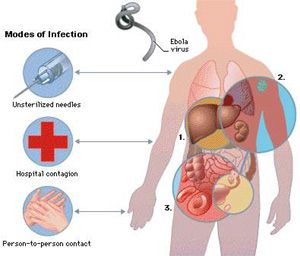
virus is spread most readily by person-person contact. Three of the
four strains of Ebola are transmitted only by the exchange of body fluids,
(such as blood, saliva, semen or vaginal secretions), with an infected
person. Because of this the disease is often transmitted to family
members and close friends. Several outbreaks have been linked to
the slaughter of infected primates. To date, there is one strain
of Ebola that is air-borne, (Ebola Reston),
however, this strain has proven to be fatal only to monkeys, not to humans.
It is still a mystery how the first person contracted this disease,
however there are many different theories, including contamination
by bats, primates, or small mammals.
|
| Where
did Ebola come from and where is it found in nature?
Discovered
in 1976, the Ebola virus first appeared in the country of Zaire, (now
the Democratic Republic of the Congo.) The natural reservior, (the source
of infection), of the Ebola virus is not presently known, yet it is
believed to be somewhere deep in the rainforests of Africa. Current research
suggests that it is a zoonotic
disease, (animal-borne), which somehow infects primates, including people.
While monkeys and humans become sick and may eventually die from the virus,
other animals may experience no effect. Because of this, the Ebola
virus can potentially replicate within many different hosts, and continue
to thrive. One hypothesis suggests that the virus resides within a
plant, while other research shows that bats who have been injected with
the virus do not display symptoms. Non-human primates,
such as chimpanzees and gorillas are threatened by the Ebola virus. Many
of these animals are faced with extinction due to habitat destruction and
various other human forces. The devestating impact of this disease on primate
populations has been observed in the wild and has also become a concern for
scientists
studying these animals.
|

|